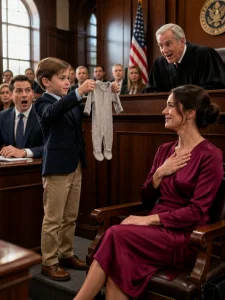
The family courtroom in Knoxville, Tennessee, felt colder than the January morning outside.
I sat at a narrow wooden table with my eight-year-old son, Oliver, beside me. His sneakers did not quite reach the floor, so his feet swung gently beneath the chair whenever he became nervous.
That morning, I had chosen his cleanest jeans, a navy-blue shirt with a small embroidered moon near the pocket, and the winter shoes I had polished with a damp kitchen towel.
The shirt was not new.
Its collar had softened after many washes, and a faint mark remained near the bottom seam. I had tried twice to remove it, but some stains seemed determined to become part of the fabric.
Across the aisle, my former husband, Victor Vance, sat beside his attorney.
Victor wore a charcoal suit, polished shoes, and the silver watch he had purchased shortly after telling me he could not afford to send child support on time. He looked calm, successful, and prepared.
I wore a secondhand cream blazer over a simple black dress.
I had no attorney.
All I had was a folder filled with school records, medical appointment summaries, rent receipts, work schedules, and messages showing how often Victor had failed to keep his promises.
His attorney, Julian Vance-Sterling, rose and approached the judge.
“Your Honor, this hearing is not about whether Mrs. Vance cares for her son,” he began smoothly. “It is about whether affection can compensate for a continuing lack of stability.”
My hand tightened around the edge of the table.
Judge Thorne looked down through his glasses.
“Proceed, Mr. Vance-Sterling.”
The attorney lifted a printed photograph.
It showed Oliver leaving school three days earlier.
He was wearing the same navy-blue shirt.
“This photograph reflects the concern,” Vance-Sterling said. “The child repeatedly appears in worn clothing. His mother works irregular hours, lives in a modest apartment, and depends heavily on an older relative for childcare.”
Oliver stopped swinging his feet.
Vance-Sterling pointed toward the small mark near the bottom of Oliver’s shirt.
“She cannot even provide consistently presentable clothing for her son.”
Several people in the courtroom glanced toward us.
Oliver looked down at himself.
At that moment, I understood that Victor was not merely asking for more parenting time.
He wanted the court to believe that struggling financially meant I loved our child less.
The Life Behind the Photograph
Victor had left our marriage two years earlier.
He had packed his clothes, his coffee machine, the television from our bedroom, and nearly everything he considered valuable. Then he moved into a new townhouse across the city and told me we could arrange financial support without involving the court.
“We are adults, Elena,” he had said. “There is no reason to make this complicated.”
Within three months, he stopped answering most of my messages.
My mother, Clara, moved into our apartment shortly afterward. She arrived with one suitcase, a slow cooker, and enough determination for all three of us.
She never asked whether I wanted her help.
She simply began helping.
“You can be heartbroken later,” she told me that first evening. “Right now, your son needs dinner, and you need sleep.”
Our apartment sat above a small bakery and a dental office. The windows rattled when delivery trucks passed, the heater worked only when it felt cooperative, and the kitchen was barely wide enough for two people to stand side by side.
Still, it was home.
I worked breakfast shifts at a neighborhood diner and cleaned offices three evenings each week. On weekends, I delivered groceries whenever my aging sedan decided to start.
Some days, I left before Oliver woke up.
Other nights, I returned after he had already fallen asleep.
But I never missed his school conferences. I prepared his lunches the night before. I wrote notes on napkins and tucked them beneath his sandwiches. I checked his homework after midnight when my eyes felt too heavy to focus.
Oliver noticed more than I wanted him to notice.
He knew when I ate cereal for dinner because there was only enough chicken for him and my mother.
He knew why I kept turning the thermostat down.
He knew that the best apple always went into his lunchbox while the softer one remained on the kitchen counter for me.
Once, he found me sitting alone at the table with several bills spread in front of me.
“Are we in trouble?” he asked.
I quickly turned the papers over.
“No, sweetheart. I am just deciding which one gets my attention first.”
He climbed onto the chair beside me.
“Sometimes I do the easiest homework first,” he said. “Maybe bills work like that.”
I smiled, even though tears pressed behind my eyes.
That was Oliver.
He could find hope in a stack of overdue envelopes.
The Shirt With the Moon
I had purchased the navy-blue shirt four months before the hearing.
Oliver had become fascinated with the night sky after his class visited a science museum. He talked constantly about planets, distant stars, and the idea that light could travel for years before reaching Earth.
One evening, after cleaning an office building downtown, I passed a small department store that was preparing to close.
The shirt was hanging on a clearance rack.
It was simple, soft, and decorated with a tiny silver moon near the pocket.
I had eighteen dollars left until payday.
The shirt cost twelve.
I knew I should have purchased groceries instead.
But I imagined Oliver’s face when he saw it, and for once, I wanted to give him something that had not belonged to another child first.
I bought it and carried it home in a thin paper bag.
When I entered Oliver’s room, he appeared to be sleeping. I folded the shirt carefully and placed it on the chair near his bed.
I stood there longer than necessary, looking at him beneath his faded green blanket.
I was exhausted.
I was worried about rent.
I was also proud that, despite everything, I had brought something home that would make my son happy.
I smiled.
Then I quietly cried.
I did not know Oliver had been awake.
When Oliver Stood Up
Back in the courtroom, Mr. Vance-Sterling continued speaking.
“This is not a judgment about wealth,” he said. “It is an assessment of consistency. Mr. Vance can provide a private bedroom, dependable transportation, structured activities, and a predictable home environment.”
Victor remained still, his hands folded confidently on the table.
Judge Thorne looked at Oliver’s shirt again.
Then Oliver stood.
The movement was so unexpected that Vance-Sterling stopped speaking.
I reached for my son’s arm.
“Oliver, please sit down.”
He shook his head.
His ears had turned pink, and his fingers trembled slightly as he held the bottom of his shirt.
“This is the shirt he means,” Oliver said.
The courtroom became silent.
Vance-Sterling attempted to regain control.
“Your Honor, the child is understandably emotional, but—”
“Let him speak,” Judge Thorne said.
Oliver looked at the judge.
“My mom bought this after she worked all night,” he explained. “She thought I was asleep when she put it in my room, but I wasn’t.”
My chest tightened.