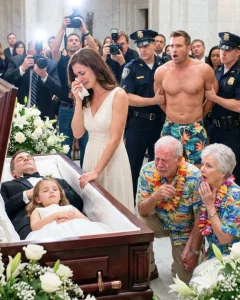
I buried my husband and daughter beneath a sky so gray it looked bruised. My parents had sent a beach photo.
They stood barefoot in white sand, my brother grinning between them, holding cocktails with tiny umbrellas.
Underneath, my mother wrote: We’re sorry, sweetheart, but flights are expensive and funerals are emotionally draining. This is too trivial to ruin the trip.
Too trivial.
Three days later, I returned to my silent house. Maya’s yellow rain boots waited by the door, dotted with dried mud. Marcus’s coffee mug sat beside the sink. My world had stopped, but cruelty kept arriving.
At seven that evening, someone pounded on my front door.
My parents stood on the porch in linen clothes, tanned and annoyed. Julian leaned against their rental SUV.
Beatrice pushed past me without asking. “Finally. You look awful.”
Richard glanced around my house. “Where’s the insurance paperwork?”
Beatrice dropped her purse onto my table. “Don’t play fragile with us, Elena. Marcus had life insurance. The accident payout must be substantial.”
Julian walked in behind them. “Forty grand. That’s all we need.”
“All you need,” I repeated.
Beatrice snapped, “After everything we’ve done for you, you owe us.”
I looked at their sunburned faces, then at the black folder in my hands.
For the first time since the funeral, I smiled.
Part 2
“Family attends funerals,” I replied, my voice dropping an octave, settling into a cold, terrifying calm.
Julian scoffed loudly, rolling his eyes as he leaned against the doorframe. “Oh, for God’s sake, Elena, don’t make this into a Greek tragedy. People die every single day. We mourned in our own way. Now we have business to attend to.”
The temperature in the room seemed to plummet by ten degrees.
Beatrice shot Julian a sharp, warning glare. Not because she found his words morally reprehensible or cruel, but because he was being careless. He was rushing the con.
I walked slowly to the dining table and placed the black folder precisely in the center of the oak surface. I kept my hand resting flat atop it.
Both of my parents leaned forward like starving hounds scenting meat.
I still didn’t open it.
“Marcus and my daughter died because an eighteen-wheeler ran a solid red light at fifty miles per hour,” I said, my gaze locked on Julian. “That is the official narrative. That is what the local police report claims.”
Richard let out a theatrical, impatient sigh, tapping his fingers on the wood. “Yes, yes. We read the news. It’s an absolute tragedy. A terrible accident. Now, regarding the liquidity of the funds—”
“But,” I interrupted, my voice slicing through his bluster, “when you dig into the internal maintenance logs of Apex Freight, the trucking company involved, they tell a vastly different story.”
Beatrice’s painted-on smile twitched. A hairline fracture in her composure. “What internal records? What on earth are you blabbering about?”
Out of the corner of my eye, I saw Julian’s thumb abruptly halt its endless scrolling. His phone slowly lowered.
There it was. The first genuine crack.
My family had always viewed my profession with thinly veiled disdain. Before I met Marcus, before I learned what it meant to be truly loved, before I became Maya’s mother, I spent ten grueling years as a senior forensic accountant for the state attorney’s office. To my parents, numbers were tedious, working-class drudgery. They only cared for numbers when they could be inherited, manipulated, or stolen. They never understood that ledgers are just diaries written in mathematics. They hold secrets. They tell stories.
And they never lie.
In the agonizing, sleepless weeks following the crash, while my family sipped piña coladas in the Bahamas, I hadn’t just been grieving. I had been hunting. I utilized every favor, every backdoor database access, and every old contact from my days at the state attorney’s office.
“Apex Freight has been hemorrhaging cash for two years,” I explained, my tone clinical, as if presenting a quarterly review to a board of directors. “To survive, they began funneling money through an intricate network of phantom shell vendors. They billed for fictitious warehouse repairs, heavily inflated diesel fuel invoices, and hundreds of thousands of dollars in vague ‘logistics consulting fees.’ And one of those primary consulting firms…” I paused, turning my head to lock eyes with my brother. “…belonged to you, Julian.”
Part 3
Julian’s face went chalk-white. His fingers twitched around his phone, his confident posture collapsing into rigid terror.
“What… what are you talking about?” he stammered, his voice rising an octave. “I run a legitimate marketing and operations consultancy. You don’t know what you’re talking about, Elena!”
“Don’t I?” I asked softly, tapping the cover of the black folder.
Richard slammed a heavy palm down onto the table. “Enough of this hysterical nonsense, Elena! Your brother has nothing to do with your husband’s accident! You’ve completely lost your mind with grief. Hand over the paperwork!”
“Listen to me very carefully, Richard,” I said, dropping the word Father forever. “Apex Freight’s owner was desperately siphoning capital out of his company before filing for bankruptcy. He paid Julian’s shell firm over seven hundred thousand dollars in kickbacks over eighteen months. In exchange, Julian laundered the cash and took his cut.”
I opened the folder. The crisp white pages inside were covered in dense spreadsheets, bank routing numbers, red callouts, and official state seals.
“Because Apex Freight was draining every dollar to pay Julian,” I continued, my voice entirely devoid of emotion, “they deferred critical fleet maintenance for over two years. They forged safety inspections. They bypassed brake replacements. And six weeks ago, when one of their trucks lost its hydraulic fluid, the owner signed off on sending it back out onto the highway anyway—rather than spending five hundred dollars to fix the lines.”
Beatrice’s mouth opened and closed like a dying fish. “Elena… you can’t possibly prove…”
“The truck that slammed into Marcus and Maya had completely blown brake lines,” I said, staring into her eyes until she flinched and looked away. “The driver tried to stop. He pressed the pedal all the way to the floorboard. There was nothing there. My six-year-old daughter died in her car seat because Julian took bribes from a company that chose to trade human lives for profit.”
Silence suffocated the room. The loud, ticking grandfather clock in the hallway sounded like a hammer striking an anvil.
Julian took a trembling step back toward the front door. “She’s bluffing. Mom, Dad, she’s insane. Let’s just leave—”
“No one is leaving,” I said.
Richard’s eyes darted to the folder, then to me. A ruthless, calculating look crossed his face—the same expression he used whenever he was cornered in business. “Even if any of this delusional story were true, Elena, you’re our daughter. You wouldn’t destroy your own family over an unfortunate corporate oversight. Family protects family.”
I let out a sound that wasn’t quite a laugh. It was hollow, sharp, and cold as grave dirt.