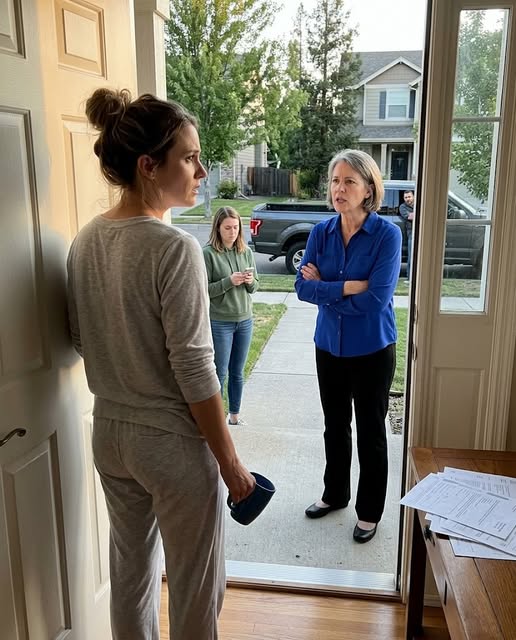
My mom told me not to contact them anymore on my birthday, my sister backed her with a thumbs-up, and six days later they were on my porch demanding money they had spent years pretending did not come from me.
My name is Sabrina Nolan, and for most of my life I was the daughter who made things easier.
I was the one who remembered appointments, signed forms, covered gaps, called contractors, showed up early, stayed late, and answered the phone even after being treated like an inconvenience.
My younger sister Megan was the celebrated one.
She was bright, pretty, emotional in a way people rushed to protect, and my mother, Linda, had built her whole life around whatever storm Megan happened to be having that week.
I used to tell myself I did not mind.
That was a lie I learned young.
The truth was that I minded all the time.
I just got very good at swallowing it.
When my grandfather Harold was alive, he was the only person in the family who seemed to notice the pattern clearly.
He had built a small portfolio of rental properties over four decades, not glamorous, but solid.
Duplexes, a few townhomes, an older brick apartment building on the edge of town, some land that turned out to be worth more than anybody expected.
He was practical to the bone.
He believed in receipts, promises made in writing, and the kind of kindness that still kept both eyes open.
I started helping him in high school.
At first I just filed invoices and sorted mail.
Then I learned how to track rent rolls, read repair estimates, and reconcile account statements.
By the time I was twenty-six, I knew the books better than anyone.
My mother said I had an “old woman soul,” which was her way of making responsibility sound like a personality flaw.
When Harold got sick, the work shifted almost entirely to me.
Megan visited him with cupcakes and flowers.
I sat with him during medication changes and attorney calls.
My mother cried in the hospital room.
I took notes during discharge meetings and made sure the insurance paperwork was submitted on time.
A month before he died, he asked me to come by the house alone.
He was sitting at the kitchen table in his flannel shirt, even though it was warm out, with a yellow legal pad beside him and a mug that had gone cold.
His hands looked thinner than I had ever seen them.
But his eyes were clear.
“I know what I’ve asked of you,” he said.
I told him it was fine.
He gave me that look he used to give tenants who lied about pets.
“No,” he said.
“It’s not.
And I need you to hear me all the way through.”
So I sat down.
He told me he had set up a family trust.
Income from the properties would continue to cover certain support for Linda and Megan, along with maintenance of the assets themselves.
But he was naming me trustee.
I remember staring at him and saying, “Why me?”
He smiled without humor.
“Because you know the difference between helping and feeding a habit.”
I did not fully understand then how heavy that sentence would become.
After he died, the
trust began operating exactly as his attorney, Ray Whitfield, had laid out.
Property income came in.
Expenses were paid.
Distributions could be made for housing, transportation, ordinary support, and limited discretionary requests, but nothing was automatic.
Every payout had to be approved by the trustee.
That trustee was me.
My mother knew I handled paperwork.
My sister knew I “managed the estate.” But I do not think either of them ever let themselves grasp what that meant.
They talked about the trust like it was a magical family stream.
Money appeared, therefore money existed.
Nobody looked upstream.
For seven years, I let it continue.
Mortgage help for Mom.
Car insurance when she fell behind.
Utility assistance when bills stacked up.
Supplemental money for Megan that started as “temporary support” and somehow became a lifestyle.
There were always reasons.
A surprise dental bill.
A transmission problem.
A laptop needed for work.
A rent issue.
A deposit.
A cancellation fee.
Bridal planning costs after Megan got engaged to Derrick.
I reviewed each request, made the best decision I could, and signed the approvals because Harold had asked me to take care of them.
What I never admitted, even to myself, was that I had slowly become less like a daughter and more like an account manager they resented whenever I had boundaries.
By the time my thirty-fourth birthday arrived, that resentment had curdled into something colder.
It fell on a Tuesday.
I woke up at 6:15, made coffee, glanced at Harold’s picture, and went to work.
I checked my phone all morning.
Nothing.
At lunch, my best friend Clare called to wish me happy birthday.
She was the kind of friend who did not need many words to detect damage.
“You sound off,” she said.
“Just busy.”
She let that sit for a beat.
“Did they forget?”
“I don’t know,” I said, which was ridiculous because by noon I did know.
All day I waited for some sign from my mother or sister.
A text.
A call.
A lazy emoji.
There was nothing.
That night I went home, heated up leftover soup, and ate in a dark kitchen because turning on the overhead light made the room feel emptier.
At 8:40, feeling embarrassed with myself for even caring, I typed into the family group chat: “Hey, I know everyone’s busy, but it’s my birthday today, and I’m feeling a little down that no one reached out.”
They both saw it immediately.
Then they said nothing.
At 10:14, my phone buzzed with a message from my mother: “Sabrina, we’ve been meaning to tell you this.
We need space from you.
Please don’t reach out anymore.”
Underneath it, Megan hit the thumbs-up reaction.
That tiny symbol broke something in me more cleanly than a paragraph ever could have.
I sat on the edge of my bed and scrolled up through weeks of messages about Megan’s engagement ring, venue tours, table settings, flowers, dress alterations, and guest list drama.
My mother had commented on all of it with hearts and enthusiasm.
She had enough energy for centerpieces.
She had none for my birthday.
I did not cry.
I went numb.
At five the next morning, I stood in my kitchen and looked at Harold’s photograph.
I heard his voice as clearly as if he were
beside me: “Take care of them, Sabrina.
But take care of yourself first.”
For years I had obeyed only the first half.
I called Clare.
I read her my mother’s message and Megan’s reaction.
Clare was silent for a moment, then said, “You know what this means, right?”
“That they hate me?”
“No,” she said.
“It means they thought they could cut you off and still use you.”
Then I called Ray Whitfield.
Ray had known Harold for decades.
He was not dramatic, which was one reason I trusted him.
I forwarded the messages.
He read them while I waited on the line.
Finally he said, “As trustee, you have broad discretion.
If the relationship has become abusive and distributions are no longer serving the trust’s intended purpose, you are within your authority to suspend and reassess.”
“Are you saying I should?”
“I’m saying Harold did not appoint you to be emotionally blackmailed.”
I opened the trust portal on my laptop.
Two recurring distributions stared back at me.
Linda Nolan.
Megan Nolan.
My hand shook once, then steadied.
I clicked suspend on the first.
Then the second.
No announcement.
No speech.
For forty-eight hours, my phone exploded.
Calls from Mom.
Calls from Megan.
Calls from Derrick, who rarely acknowledged me unless I was helping with something.
Even calls from extended relatives who suddenly found time in their schedules when money was involved.
I listened to the voicemails in order.
“Sabrina, call me immediately.”
“There has to be a banking error.”
“The mortgage draft didn’t hit.”
“My florist payment bounced.”
“What kind of game are you playing?”
Not one person said, “Happy birthday.”
Not one person asked, “Are you okay?”
Not one person sounded confused about why I might have been hurt.
They were not calling about me.
They were calling about the interruption of service.
On the third day, Megan texted: “If this is because you got emotional about your birthday, this is honestly unhinged.”
That word did something useful.
It burned away the last trace of guilt.
I spent that evening reviewing seven years of distributions.
What I found made my stomach tighten.
My mother’s “housing support” had often been followed by purchases that did not look like survival at all.
Megan’s repeated “temporary needs” coincided with salon charges, boutique receipts, and pre-wedding upgrades she had never mentioned.
Individually, some of it could be explained.
Together, it formed a pattern: they had come to treat the trust not as support, but as a private extension of their appetites.
I printed the records.
The next afternoon, Ray called and said there was one more thing I should have.
He dropped off a sealed copy of a letter Harold had left in the trust file for me, to be provided at counsel’s discretion if administration ever became “personally compromising.”
That phrase alone made my throat tighten.
I did not open the letter right away.
Six days after the birthday message, my doorbell rang at seven in the morning.
I was still in my pajamas, coffee in hand.
When I looked through the peephole, I saw my mother on the porch in a blue blouse I recognized immediately because I had approved the reimbursement request the month she bought it.
Her arms were crossed.
Her mouth was set in that hard line
she used when she planned to dominate the conversation by force of certainty.
Behind her, Megan climbed out of Derrick’s truck and pushed her sunglasses on top of her head.
Derrick stayed near the walkway, already irritated.
My mother hit the bell again, then pounded on the door.
I unlocked it but kept the chain on.
“What is wrong with you?” she demanded.
I stared at her.
“Good morning to you too.”
Megan came up the steps.
“My venue payment bounced,” she said.
“Mom’s mortgage didn’t clear.
Derrick had to cover the caterer deposit because of whatever weird stunt you’re pulling.”
“A weird stunt,” I repeated.
My mother lowered her voice, probably for the neighbors.
“Turn the payments back on right now.
Whatever mood you’re in, it has gone far enough.”
A mood.
I thought about my birthday message.
About the thumbs-up.
About the dark kitchen and the leftover soup and the way my chest had gone hollow when I realized I could disappear and neither of them would mind unless money disappeared with me.
I closed the door, slid the chain free, and reopened it.
“Come in,” I said.
They looked surprised.
People who expect to steamroll you are always startled when you become calm.
I led them to the dining table.
Printed records sat in neat stacks.
The sealed letter lay beside them.
My mother glanced at the papers and frowned.
“What is this?”
“The part of reality you’ve both avoided,” I said.
Megan sank into a chair with an annoyed exhale.
Derrick stayed standing behind her.
I handed my mother the first page.
It listed her monthly support history.
Dates, amounts, approvals.
Then I slid Megan’s stack across the table.
She looked down, then up again, expression hardening.
“Okay?”
“Read it.”
She flipped a few pages.
So did my mother.
The room stayed silent except for paper moving under tense hands.
Derrick leaned over Megan’s shoulder.
I watched his expression shift first to confusion, then embarrassment, then anger.
“These are monthly?” he asked.
Megan snapped, “It’s family support.”
“Since when?” he said.
She ignored him and turned to me.
“Why are you acting like we stole something? Grandpa wanted us taken care of.”
“Supported,” I corrected.
“Not indulged.
And not at the cost of being treated like I’m disposable.”
My mother set the papers down.
“You are being dramatic.”
I actually smiled at that.
“You told me not to contact you anymore on my birthday.
Megan endorsed it.
Then six days later you showed up because your money stopped.
Which part do you think I’m dramatizing?”
My mother’s eyes flickered, just for a second, and I knew she had expected this point to be easy to dodge.
So she reached for the oldest trick she had.
“You know how stressed Megan is with the wedding.
And you can be difficult when you feel left out.”
There it was.
The entire family script in one sentence.
Megan’s emotions were always valid.
Mine were character defects.
Derrick looked from Linda to Megan to me.
“Wait,” he said slowly.
“Are you telling me Sabrina has been approving all of this?”
“Yes,” I said.
He frowned at Megan.
“You told me your grandfather set up money for your mom.
You never said Sabrina controlled it.”
Megan’s face flushed.
“Because that part
isn’t relevant.”
“It seems pretty relevant,” he said.
My mother straightened in her chair.
“None of this changes the fact that she can’t just cut us off.”
“Actually,” came a voice from the doorway, “she can suspend distributions pending review.”
All three of them turned.
Ray Whitfield stood there with his briefcase.
I had texted him when my mother first started pounding on the door, and he had said he was nearby.
He stepped inside, calm as a man arriving for a routine appointment.
My mother’s expression darkened instantly.
“You brought a lawyer into this?”
Ray set his briefcase down.
“Harold did, years ago.
I am simply still doing my job.”
What followed was the ugliest half hour our family had ever spent in one room.
Ray explained, in precise language that left little room for fantasy, that the trust was discretionary.
Support was not an entitlement detached from behavior or purpose.
Sabrina Nolan, as trustee, had full authority to review distributions if she believed the trust was being misused or the administration had become personally compromised.
He did not raise his voice once.
He did not need to.
My mother accused him of twisting Harold’s intentions.
Megan accused me of trying to ruin her wedding out of jealousy.
Derrick asked questions that made it obvious he had not known how much money had been flowing in for years.
Then I opened Harold’s letter.
The paper was thick and faintly yellowed.
His handwriting leaned slightly right, neat and stubborn.
Sabrina,
If Ray has given you this, then the burden has become personal in a way I hoped it never would.
I know your mother and sister love comfort more than they understand discipline, and I know you love them more than they deserve some days.
That is why I put you in charge.
Not because you are hardest, but because you are fairest.
If they ever ask you to disappear while still expecting your labor, your judgment, or your signature, then you must understand that the trust is no longer helping them.
It is helping them mistreat you.
You are not obligated to fund disrespect.
You are not obligated to mistake access for love.
Help where there is true need.
Stop where there is entitlement.
And for once in your life, choose yourself without apology.
By the time I reached the end, the room had gone still.
My mother looked stunned in a way I had never seen.
Not wounded.
Exposed.
“He would never write that,” she whispered.
Ray answered before I could.
“It is in Harold’s hand, witnessed and filed with the trust records.”
Megan pushed back from the table so hard her chair scraped.
“This is insane.
So what, now you’re punishing us because Grandpa liked you best?”
“No,” I said.
“I’m ending a system that taught both of you I could be erased as a person and still function as your wallet.”
Derrick was staring at the documents in front of Megan.
He pulled one page free.
“What is this charge? Bridal emergency support?”
Megan snatched it.
“Don’t start.”
“No, answer me.
You told me your florist issue was because your card got compromised.”
She stood up.
“This is not your business.”
He gave a short, stunned laugh.
“Apparently it has been my business every time I’ve
covered something you said was temporary.”
My mother tried to redirect, but the room had shifted.
The truth was finally moving on its own.
I took a breath and said the words I had been afraid of for years.
“The recurring cash distributions are over.”
My mother’s head whipped toward me.
“You cannot mean that.”
“I do.”
“You would leave me without help?”
“I will consider direct payment for documented essentials for ninety days while you make other arrangements,” I said.
“Mortgage only after I receive statements directly from the lender.
Utilities only if the bills are submitted by due date.
No cash.
No extras.
No reimbursements.
Megan gets nothing for wedding costs.
If there is a genuine emergency, it will be reviewed in writing.
By me.
Through Ray.”
Megan looked like I had slapped her.
“You want me to beg?”
“No,” I said.
“I want you to stop calling luxury a crisis.”
My mother stood up so fast her chair tipped backward.
“After everything I sacrificed for you—”
“Say it clearly,” I cut in.
She froze.
Years of swallowed things rose in my throat all at once.
“Say what you really mean.
That it was easier to neglect me because I was useful.
That you knew I’d keep showing up.
That Megan got tenderness and I got responsibility because you assumed I’d survive it.
Say it once without dressing it up.”
For a moment I thought she would deny it.
Instead she looked at me with a tired, bitter honesty that made my skin go cold.
“You were always the stronger one,” she said quietly.
“Megan needed more.”
There it was.
Not an apology.
Not regret.
A confession disguised as logic.
I nodded, because something inside me had finally gone beyond breaking.
It had settled.
“Then let her need more from somebody else,” I said.
Nobody shouted after that.
There was no cinematic collapse.
Real endings are often quieter than the damage that led to them.
Ray gathered the relevant documents and told my mother and sister future requests had to be submitted formally.
Derrick walked out first, expression dark and unreadable.
Megan followed him, furious and humiliated.
My mother lingered in the doorway like she expected me to call her back, to soften, to return to the role she preferred.
I did not.
When the door closed, the house became so still I could hear the wall clock in the kitchen.
I sat down at the table and cried for the first time.
Not because I regretted it.
Because I had waited so long to stop volunteering for my own erasure.
The fallout lasted months.
My mother learned that when she had to submit actual mortgage statements instead of vague claims, many of her “urgent needs” disappeared.
The lender accepted limited direct payments while she refinanced and eventually took a part-time bookkeeping job for a church office.
Megan postponed the larger venue and scaled the wedding back to something she and Derrick could actually afford.
Their engagement survived, though barely, and from what I heard through the family grapevine, trust around money became a standing argument.
A few relatives called me cold.
A few called me brave.
Most of them stopped calling once they realized there would be no more informal favors tied to guilt.
Clare came over
that Friday with takeout and a cupcake with one candle jammed into the icing.
We sat on my back steps in the dark, and she handed me a plastic fork.
“Belated birthday,” she said.
I laughed through swollen eyes.
“How does it feel?” she asked.
I thought about it for a while.
Lighter, yes.
But also sad in the specific way grief is sad when the person you lost is not dead, only finally visible.
A week later, I took flowers to Harold’s grave.
I told him out loud that I had done what he asked, though maybe later than he would have liked.
Wind moved through the trees around the cemetery, and for the first time since my birthday, I did not feel abandoned.
I felt accompanied by the version of love that had tried to prepare me for this all along.
My mother did eventually text me.
Not right away.
Not with an apology that matched the wound.
Three months later, on a Thursday evening, my phone lit up with a single line: “I still don’t agree with what you did, but I know your grandfather trusted you.”
It was not enough.
But it was the closest thing to acknowledgment she had ever offered without a performance attached.
I did not answer that night.
The next morning, I replied: “I was never asking to be agreed with.
I was asking to be treated like family.”
She did not respond.
Maybe she could not.
Maybe she finally understood the cost.
Maybe she still believed I had exaggerated everything.
Families can live beside the truth for years and never once turn fully toward it.
What I know is this: the money had not been the real inheritance.
The real inheritance was the test hidden inside it.
How long would I confuse usefulness with love? How many years would I let duty excuse humiliation? At what point does helping become permission for people to keep shrinking you until there is nothing left but your function?
I was thirty-four when I stopped answering that question the old way.
Sometimes I still think about that thumbs-up under my mother’s message and wonder whether Megan realizes it was the smallest gesture that revealed the biggest truth.
Not that they could be cruel.
I had known that in pieces.
The truth was that they had become comfortable enough to be cruel without even bothering to name it.
That was the red flag.
Not the missed birthday.
Not the money.
Not even the porch confrontation.
It was how ordinary my disappearance felt to them until it started costing them something.
And I still wonder, even now, whether the crueler act was suspending the support they relied on, or letting it continue one more day after I finally understood what it had been buying.