“Your daughter deserved it for being rude.” For a long time, that sentence was the loudest thing I remembered from my father’s sixtieth birthday party. Not the siren. Not the dispatcher on my husband’s phone. Not the backyard music still playing through the open sliding door while my little girl lay on my parents’ kitchen floor. Just my mother’s voice, flat and controlled, saying my three-year-old deserved what had happened because she had taken a soda without asking. My name is Rebecca Hutchinson, and before that day, I thought I understood what damage looked like. I had spent eight years as a prosecutor before moving into criminal defense. I knew the difference between panic and performance. I knew when a witness was protecting someone. I knew how quickly an ordinary afternoon could become a police report, a medical chart, a custody file, and a set of videos nobody could unsee. But knowledge does not make you ready when the defendant is your own father. It does not make your hands steadier when the child on the floor is yours. Gerald Hutchinson had always been the kind of man people described as “old school” because it sounded nicer than cruel.
He had worked construction for decades. He shook hands too hard, laughed too loud, and believed every room needed one man in charge. My mother, Patricia, treated his temper like weather. If Gerald shouted, she opened a window. If Gerald slammed a door, she turned up the television. If one of us cried, she told us to stop embarrassing the family. That was the house I grew up in. A tidy suburban house with a front porch, trimmed hedges, and a small American flag my mother kept near the mailbox during the summer. From the street, it looked like the kind of home where people brought casseroles and borrowed ladders. Inside, we learned the math of survival. How loud was too loud. How fast to apologize. How to read the sound of a belt sliding through loops before it reached the hallway. By the time I was twenty-two, I had left town for law school and promised myself I would never raise a child inside that kind of fear. My husband James believed me the first time I explained it. He did not laugh it off as family drama. He did not tell me I was being too sensitive. He only listened, took my hand, and said, “Then our home will be different.” And it was. Our daughter Lily grew up with bedtime stories, sticker charts, kitchen dance parties, and consequences that did not come with humiliation. She was three years old, bright-eyed, stubborn, sweet, and still young enough to think a grandparent’s house was supposed to be safe. That was the part that broke me later. She had no defenses because James and I had never made her need them. Gerald’s birthday party was on a Saturday. My mother called three times that week to make sure we were coming. “It would mean a lot to your father,” she said. Then she added the line she always used when she wanted me to feel selfish.
“Just for a few hours, Rebecca. No drama.”
James heard the whole call from across the kitchen and gave me the look he always gave when he knew I was about to say yes to something my body was already rejecting.
“We can skip it,” he said.
I looked at Lily coloring at the table, humming to herself while her pink crayon rolled under one elbow.
Then I thought about my mother telling everyone I kept her granddaughter away because I thought I was better than them.
I thought about how many family fights had started from silence, not speech.
“Two hours,” I told James.
He nodded.
“After cake,” he said.
We arrived at 2:31 p.m.
That time stayed with me because James’s dashcam stamped it on the video as we pulled into the driveway.
The backyard was already full.
Folding chairs dotted the grass.
A cooler sat near the open sliding glass door.
Smoke from the grill drifted over the fence, and the smell of burgers, lighter fluid, and hot plastic cups made the air feel sticky.
Gerald was near the grill with a beer in one hand.
My brother Travis stood beside him, nodding along to one of Gerald’s stories like he was still a boy hoping to be chosen.
Travis owned a car dealership now, but around our father he became smaller and meaner at the same time.
My sister Vanessa was at the patio table, scrolling her phone while her twelve-year-old daughter sat beside her with the tired expression of a child who had already learned not to ask adults for much.
My mother moved through the guests like a hostess in a commercial.
She adjusted napkins.
She laughed too brightly.
She told people where to put their purses.
She watched everybody watching her.
Lily hid behind my leg for the first few minutes, then saw Travis’s boys playing with a plastic truck near the fence.
“They have cars,” she whispered.
“You can ask nicely,” I said.
She walked over with that open little toddler bravery that comes from believing the world will meet kindness with kindness.
It did not last.
Within ten minutes, Travis’s boys had taken the truck from her hands twice, called her a baby, and laughed when she looked back at me for help.
I started to get up, but she came running first.
She climbed into my lap and pressed her face into my shirt.
“They don’t want me,” she whispered.
James’s jaw tightened.
I kissed the top of her head.
“Then you can stay with us,” I said. “We’ll have cake, and then we’ll go home.”
The afternoon dragged.
Gerald held court by the grill.
Patricia kept praising the turnout.
Travis drank too fast.
Vanessa corrected her daughter for sitting wrong, chewing wrong, looking bored, and breathing too loudly.
I watched all of it with the strange double vision that comes when you are both a grown woman and the child you used to be.
At 4:36 p.m., Lily tugged on my hand and asked for her cup.
It was in the kitchen by the cooler.
The sliding door was open, and I could see the kitchen island from my chair.
Letting her go inside felt harmless.
That is the sentence every parent hates afterward.
It felt harmless.
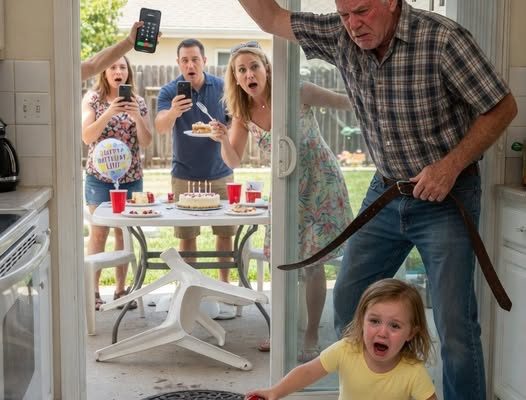
She was gone maybe thirty seconds before Gerald’s voice cut through the yard.
“Put that down.”
The music kept playing, but every conversation stopped.
James turned first.
Then I saw it.
Lily stood beside the cooler with a soda can held in both hands.
Her eyes were huge.
Gerald towered over her, face flushed, finger pointed.
I was already moving when he said, “You don’t take what isn’t yours.”
“She’s three,” I said, but I do not know whether he heard me.
His hand went to his belt.
I knew that motion.
So did Travis.
So did Vanessa.
So did my mother.
That was the secret hidden in plain sight.
Not one bad temper.
Not one rough afternoon.
A whole family trained to recognize danger before outsiders even understood the room had changed.
Leather scraped through belt loops.
The buckle hit the back of a kitchen chair.
Lily whispered, “I’m sorry.”
Gerald pulled the belt free.
Lily stepped backward, tripped on the slick tile, and fell.
The crack of her head hitting the floor cut through everything.
For one second, the whole party froze.
Plastic forks hovered above potato salad.
A red cup rolled off the counter and bounced once.
Soda foamed across the tile.
One of the neighbors at the edge of the patio put a hand over her mouth.
The speaker outside kept playing some old rock song that suddenly sounded obscene.
Then James and I ran.
I dropped beside Lily.
Every instinct in me wanted to scoop her up, but every hour I had spent listening to medical testimony told me not to move her neck.
So I kept my hands where I could.
I spoke her name.
I checked her breathing.
I tried to keep my voice from cracking.
James called 911 at 4:38 p.m.
His call log later showed the exact minute.
He gave the dispatcher the address and said the words no father should have to say.
“Three-year-old. Head injury. Adult male had a belt.”
Gerald was still standing over us.
He had not thrown the belt down.
He had not said he was sorry.
He looked irritated, like Lily had inconvenienced him by falling wrong.
“She took a soda without asking,” he said.
I looked up at him from the floor.
For one ugly second, I wanted to forget every rule I had ever lived by.
I wanted to take the belt from his hand and make the entire house feel the fear it had spent years teaching children.
But Lily’s breath fluttered under my fingers.
James’s voice shook into the phone.
Guests were watching.
Phones were recording.
So I did not move toward Gerald.
I stayed with my daughter.
Vanessa stepped into the kitchen doorway.
She looked down at Lily and said, “Some kids need to learn respect sooner or later.”
That sentence landed differently in the room than she expected.
Several guests stared at her.
One woman whispered, “She’s a baby.”
Then Patricia looked from the guests to me, then to Lily.
Her face did not show fear.
It showed annoyance.
“Your daughter deserved it for being rude,” she said.
The room went colder.
That was when I knew it was over.
Not just the party.
Not just my relationship with my parents.
The story they had been telling about themselves for decades ended in that kitchen.
I lifted one hand from the tile just enough to point toward the phones.
“Nobody deletes anything,” I said.
My mother’s face changed.
Gerald finally understood there were strangers in the room who did not owe him loyalty.
Travis looked toward the patio and saw two guests still recording.
Vanessa took one step back.
The siren turned onto the street.
The dispatcher’s voice came through James’s speaker.
“Sir, confirm for responding officers that the adult male still has the belt in his hand.”
James said, “Yes.”
Gerald looked down at his own fist like he had forgotten what he was holding.
That was the first honest thing his body did all day.
The knock came hard at the front door.
No one moved to answer it.
A second knock followed.
Then one of the guests, a man from my father’s old job site, walked through the hallway and opened it.
Two officers entered first.
Paramedics were right behind them.
The first officer’s eyes went to Lily, then to Gerald’s belt, then to James’s phone.
“Sir,” he said to my father, “put the belt down and step back.”
Gerald started talking immediately.
People like him always do.
“She fell,” he said. “Nobody hit her. She was stealing from my cooler.”
The officer did not blink.
“Step back.”
My mother moved toward Gerald like she was going to explain him into innocence.
The second officer held up one hand.
“Ma’am, stay where you are.”
That word, ma’am, hit Patricia harder than any insult could have.
It put her in the same room as everyone else.
No hostess voice.
No social shield.
Just a woman being told not to interfere.
The paramedics took over Lily’s care with calm, practiced hands.
One asked me questions while another stabilized her.
Name.
Age.
Did she lose consciousness.
Did she vomit.
Did she respond to sound.
I answered because answering was something I could do without falling apart.
At the hospital intake desk, my hands were still shaking when I signed the first form.
The intake nurse asked what happened.
I said, “My father pulled a belt on her. She fell backward and hit her head.”
The nurse’s expression changed in a way I recognized.
Not shock.
Documentation.
She wrote it down.
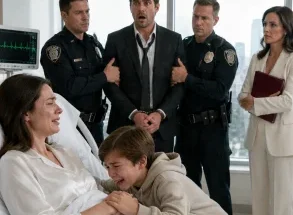
The emergency physician examined Lily.
They ordered imaging.
PART 2-MY FATHER RIPPED OFF HIS BELT AND WENT FOR MY THREE-YEAR-OLD DAUGHTER …
They cleaned the cut near her hairline. They monitored her for signs of concussion and worse. When Lily finally stirred, she cried without opening her eyes. “Mama,” she whispered. I bent over her so fast my knees hit the side of the bed. “I’m here,” I said. “Daddy’s here. You’re safe.” James turned away, but not before I saw his face break. That was the only moment that day when I almost fell apart. Not in the kitchen. Not with my mother. Not when police asked for my statement. Only when Lily reached blindly for me and trusted I would be there. The officer came to the hospital later that evening. He asked for my statement in a small consultation room with beige walls and a box of tissues nobody touched.
I gave him the timeline. 2:31 arrival. 4:36 Lily went inside. 4:38 911 call. Gerald pulled the belt. Lily fell while trying to get away. Patricia said Lily deserved it. Vanessa supported the punishment. Multiple guests recorded. James provided his call log and the 911 line details. The officer wrote steadily. At the end, he asked whether there had been prior incidents. That question is simple only if you have never lived inside a family that calls fear tradition. I looked at James. Then I told the truth. I told him Gerald had used belts when we were children. I told him Patricia had excused it. I told him Travis and Vanessa knew because they had lived it too. I told him I had left home and built a different life because I knew exactly what my father believed children were for. The officer did not ask why I had ever gone back.
I was grateful for that.
The first video came from the neighbor with the blue phone case.
It began before Gerald pulled the belt.
You could hear the music.
You could see Lily near the cooler.
You could hear Gerald shout.
Then the belt came free.
The video did not show an impact because there was no strike before she fell.
It showed enough.
It showed a grown man using a weapon of fear on a three-year-old.
It showed a child backing away.
It showed the fall.
It captured my mother’s sentence afterward.
The second video came from a guest near the patio table.
The third came from James’s phone audio.
The fourth came from the dashcam of a neighbor’s truck parked across the street, which recorded the siren arrival and the officers entering.
By Monday morning, the police report existed.
By Monday afternoon, the hospital records existed.
By Tuesday, a victim advocate had called me.
By Wednesday, my mother had left seven voicemails.
The first was angry.
The second was tearful.
The third blamed the guests for recording.
The fourth blamed me for “turning one accident into a criminal matter.”
The fifth was the one that told me she still understood nothing.
“She is family,” Patricia said. “Family does not do this to family.”
I saved it.
Then I sent it to the detective.
Not because I enjoyed it.
Because I had learned a long time ago that people who survive families like mine often feel guilty for keeping proof.
I was done feeling guilty.
Gerald was charged.
I will not pretend the legal process moved like television.
It did not.
There were interviews, continuances, medical summaries, witness statements, and defense arguments about accidents and misunderstandings.
There were family members who stopped speaking to me.
There were people who told me Gerald was from a different generation.
There were people who asked whether I really wanted to ruin his life over one mistake.
That phrase became almost funny by the end.
One mistake.
A belt pulled from loops was not a mistake.
A three-year-old backing away in fear was not a misunderstanding.
A grandmother saying the child deserved it was not old-fashioned discipline.
It was a family system doing what it had always done, only this time witnesses were present.
Travis tried to stay neutral.
Neutral, in families like ours, usually means waiting to see who still has power.
But the videos changed him.
Not morally.
Practically.
He realized his dealership customers had seen the clips moving through private messages and group chats.
He called me once.
“You didn’t have to let it get out,” he said.
“I didn’t post it,” I told him.
“You didn’t stop it either.”
I looked across the living room at Lily asleep on the couch with her stuffed rabbit tucked under one arm.
“No,” I said. “I didn’t.”
Vanessa took longer.
She sent a text that said I had made our parents look like monsters.
I answered with one sentence.
“They did that in the kitchen.”
She did not reply for three weeks.
Then, one night at 10:14 p.m., she texted again.
“I keep hearing the belt.”
I stared at those words for a long time.
Then I wrote back, “Me too.”
That was the beginning of the only honest conversation Vanessa and I had ever had.
She admitted she had said what she said because if Lily did not deserve it, then maybe none of us had.
That is the quiet horror of family conditioning.
It teaches children to defend the person who hurt them because the alternative is admitting nobody came to save them.
I did not forgive her that night.
Forgiveness was not the point.
Truth was.
Lily healed physically faster than any of us healed emotionally.
The cut closed.
The bruising faded.
The scans were clear.
For weeks, she startled at loud male voices.
She asked whether Grandpa was mad.
She asked whether soda was bad.
Every time, James and I answered the same way.
“No, sweetheart. You did not do anything wrong.”
One afternoon, while she sat at the kitchen table with crayons, she looked up and asked, “Grandma said I deserved it?”
The room went still.
James put down the coffee mug he was holding.
I sat beside her.
“Yes,” I said, because I would not teach my daughter to doubt her own memory.
“Was she wrong?”
I took her small hand.
“She was very wrong.”
Lily nodded like she was filing that somewhere her little heart could reach later.
Then she went back to coloring.
The case ended with Gerald accepting responsibility in the narrow, legal way men like him sometimes do when the evidence corners them.
There was a plea.
There were conditions.
There was mandated counseling.
There was a no-contact order involving Lily.
The exact terms mattered less to me than the paper itself.
For the first time in my life, somebody outside our family had written down that Gerald Hutchinson’s behavior was not discipline.
It was harm.
My mother never apologized.
Not really.
She wrote a long letter six months later about “pain on all sides” and “how families should heal.”
She mentioned Gerald’s embarrassment.
She mentioned the neighbors.
She mentioned church friends asking questions.
She mentioned how hard birthdays had become.
She did not mention Lily’s head hitting the tile.
She did not mention the belt.
She did not mention the sentence that ended her access to my child.
Your daughter deserved it for being rude.
I kept the letter in a folder with the police report, the hospital discharge papers, the 911 call reference number, and printed screenshots from the videos.
Not because I wanted to live inside that day forever.
Because memory can be bullied when paper is missing.
And I had no intention of letting my daughter grow up in a family where people called cruelty love and evidence disrespect.
A year later, we had Lily’s fourth birthday in our own backyard.
No shouting.
No forced hugs.
No adults drinking too much and calling it celebration.
Just cupcakes, bubbles, sidewalk chalk, and a little girl in sneakers running across the grass while James grilled burgers and I carried lemonade outside.
At one point, Lily dropped a cup.
It hit the patio and cracked.
She froze.
Her eyes flew to mine.
For a second, I saw my childhood standing inside hers, waiting to see which way I would turn.
I crouched, picked up the pieces carefully, and said, “Accidents happen. Let’s get another cup.”
She watched me for one breath.
Then she smiled.
That was the ending my parents never understood.
Not the plea.
Not the police report.
Not the guests who finally saw through them.
The ending was my daughter learning that a mistake did not make her unsafe.
It was her learning that no adult gets to buy respect with fear.
It was her learning that love does not arrive with a belt in its hand.
People ask sometimes whether I regret going to the party.
I regret trusting the house.
I regret ignoring the knot in my stomach.
I regret that Lily had to become the person who finally exposed what all of us had known for years.
But I do not regret what happened after.
I do not regret James calling 911.
I do not regret telling the officer the truth.
I do not regret saving every voicemail, every document, every timestamp, every ugly sentence.
Because the day my mother said my daughter deserved it for being rude, she thought she was defending Gerald.
Instead, she gave the whole room the clearest evidence of what our family had been built to excuse.
And this time, everyone heard it.
THE END.