My sister’s son spit directly into my dinner plate and said, “Dad says you deserve it.” Everyone at the table laughed. I quietly stood up and walked out. That night, Mom texted: “Don’t contact us again.” My brother reacted with a thumbs-up emoji. I replied, “Understood. Mortgage auto-pay ends tomorrow.” By 11:42 PM, the family chat exploded…
My name is Rachel Whitman, and I was thirty-six years old the night my family finally showed me exactly what I meant to them.
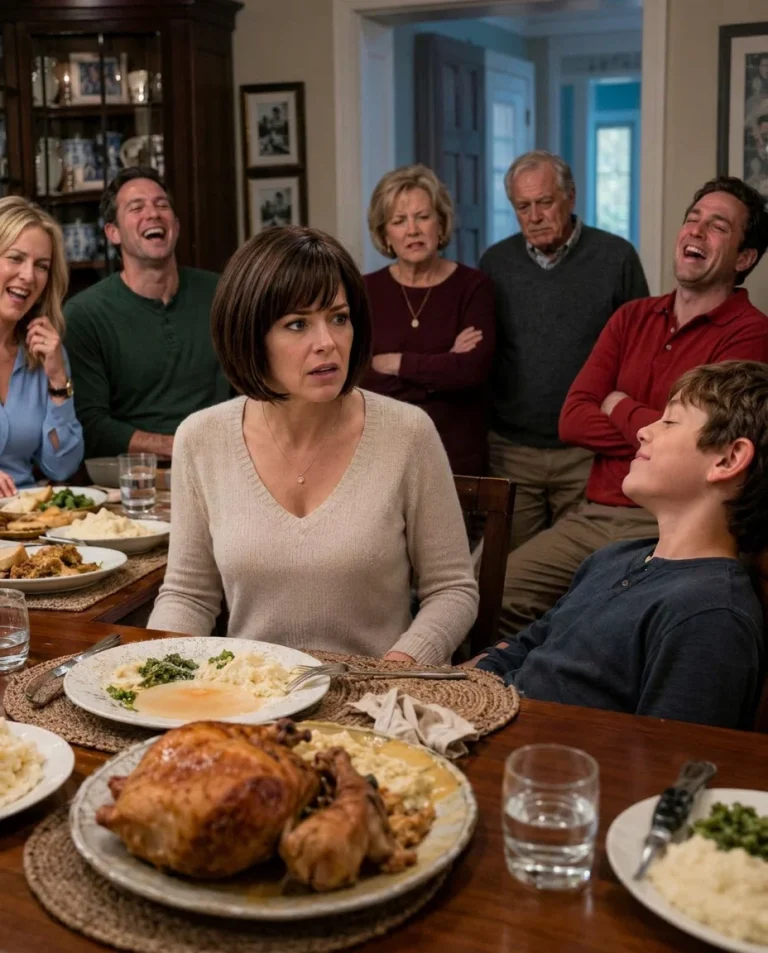
It happened at my mother’s dining table in a quiet suburb outside Columbus, Ohio, beneath a chandelier I personally paid to repair two winters earlier. My sister Lauren sat across from me beside her husband Derek and their twelve-year-old son Mason. My brother Eric lounged beside my father like he owned the house, scrolling through his phone while Mom carried out roast chicken.
I came because Mom told me Dad’s blood pressure had gotten worse and “family needed to stay close.” I believed her.
I always believed her.
For three years, I had been secretly covering my parents’ mortgage after Dad’s construction company collapsed. Twenty-four hundred dollars every month automatically withdrawn from my account while Mom told the rest of the family they were “doing just fine.” I never corrected her because I didn’t want Dad humiliated.
Then Mason dragged his fork through mashed potatoes, looked directly at me, and spit onto my plate.
The sound was small.
Wet.
Disgusting.
For one long second, nobody moved.
Then Mason smirked and said, “Dad says you deserve it.”
I looked directly at Derek.
He smiled into his drink.
Lauren gave a tiny uncomfortable laugh—the kind people use when cruelty embarrasses them just enough to notice but not enough to stop.
“Mason,” I said quietly, “why would you do that?”
He shrugged casually. “Because you act rich and better than everybody.”
My father cleared his throat but stayed silent.
My mother sighed dramatically like somehow I caused the problem. “Rachel, don’t make a scene. He’s just a child.”
“He spit in my food,” I said.
Eric laughed openly. “Honestly, you do walk in here like you’re the queen of the family.”
I looked around the table.
These were the same people whose utility bills I paid.
The same people whose car insurance I covered when Dad’s truck nearly got repossessed.
The same people who cashed my checks while mocking the career that made those checks possible.
Slowly, I pushed my chair back.
Mom’s face tightened immediately. “Sit down. You’re being dramatic.”
I placed my napkin neatly beside the ruined plate. “No.”
Derek muttered under his breath, “There goes Rachel again. Always the victim.”
I walked toward the front door while laughter followed me down the hallway.
Nobody called my name.
At 9:18 that night, Mom sent a message into the family group chat.
Don’t contact us again. We’re tired of your attitude.
Eric reacted with a thumbs-up emoji.
I stared at the screen for a very long time.
Then I typed a single sentence.
Understood. Mortgage auto-pay ends tomorrow.
By 11:42 p.m., the family chat exploded.
Part 2
The first call came from my mother.
I ignored it.
Then my father called.
Then Lauren.
Then Eric—the same brother who never contacted me unless he needed money, a favor, or someone to blame.
I stood barefoot in my dark kitchen watching my phone light up over and over against the counter while the smell of roast chicken still clung to my sweater. For years, I imagined some dramatic moment where my family finally realized everything I sacrificed for them. I thought maybe they would apologize. Maybe cry. Maybe admit I was the one quietly holding everything together while they treated me like an outsider.
Instead, the messages arrived like shattered glass.
Mom: Rachel, don’t be ridiculous. Everyone was upset.
Lauren: You’re seriously going to make Mom and Dad homeless because Mason made one dumb joke?
Eric: You always use money to control people. That’s why nobody likes you.
Derek: Real classy. Punishing your parents over dinner drama.
I didn’t respond.
At 11:03, Dad finally texted.
Your mother is crying. Call me.
That one nearly worked.
Dad had always been my weak spot. When his business collapsed, he never directly asked for help. He sat in my apartment staring at the floor, twisting his wedding ring while quietly saying, “I don’t know how to tell your mother we might lose the house.”
So I offered.
At first, it was supposed to last three months.
Then six.
Then “just until business improves.”
Three years later, I had paid over eighty-six thousand dollars toward a home where I was still treated like an unwanted guest.
At 11:19, Mom sent a voice message.
I listened once.
Her voice shook—but not from guilt.
“How could you embarrass us like this? After everything we’ve done for you? You think making good money means you can hold us hostage? Your father gave you a roof. I gave you life. And this is how you repay us? By threatening our home?”
I almost laughed.
Their home.
Not the home I protected.
Not the home where my name existed nowhere.
Not the home they used to host Sunday dinners where everyone except me received respect.
Then Lauren sent a longer message.
Mason is crying now because he thinks Grandma and Grandpa will lose the house. I hope you’re proud of yourself. He’s twelve, Rachel. You’re a grown woman.
That was when I finally replied.
Mason is crying because adults taught him cruelty has no consequences. That is not my responsibility.
The group chat fell silent for almost two minutes.
Then Eric typed:
You’re insane.
I opened my banking app. My hands stayed perfectly steady. I located the automatic payment scheduled for the next morning and canceled it.
Then I took screenshots.
Every mortgage payment.
Every utility bill.
Every emergency transfer.
Every message from Mom saying, “Please don’t tell your siblings. They’ll judge your father.”
At exactly 11:42, I dropped every screenshot into the family chat.
Eighty-six thousand four hundred dollars.
Three years of silence.
Three years of pretending.
Then I sent one final message.
I didn’t make you dependent on me. I only stopped allowing you to insult me while I paid for the privilege.
This time, nobody reacted with a thumbs-up.
Part 3
The next morning, my mother showed up at my office.
I worked downtown as a senior financial analyst for a medical equipment company, and Mom had never visited before. She hated telling people what I actually did because it contradicted the version of me she preferred: selfish, cold, difficult, too proud.
She stood in the lobby wearing a beige coat and the expression of a woman expecting public tears to become leverage.
“Rachel,” she said when I came downstairs. “We need to talk.”
“No,” I answered calmly. “We needed to talk three years ago.”
Her mouth tightened. “Not here.”
“Exactly,” I replied. “Not here.”
She lowered her voice. “Your father didn’t sleep. The mortgage company already called. The payment didn’t process.”
“I know.”
“You can’t suddenly stop paying.”
“I can.”
For a brief second, the fragile mother disappeared and the woman from the dinner table returned.
“So this is revenge.”
“No,” I said calmly. “Revenge would be telling everyone at your church that Dad didn’t save the house. I did. Revenge would be explaining to Lauren that all those vacations she mocked me for missing happened because I was paying your bills instead. Revenge would be letting Mason keep believing cruelty is funny until life teaches him harder than I ever could.”
Mom just stared at me.
“This isn’t revenge,” I continued. “This is the end of a financial arrangement you never respected.”
She began crying then.
Quietly.
Carefully.
The way people cry when they still believe they might win.
“What are we supposed to do now?”
“You and Dad will call the bank. You’ll discuss refinancing, downsizing, selling the house, or charging Eric rent since he still lives in your basement at thirty-four.”
Her face reddened instantly. “Your brother is between jobs.”
“Your brother has been between jobs since 2021.”
She flinched like I slapped her.
And for the first time in years, I felt absolutely no guilt.
That evening, Dad called again.
This time I answered.
He sounded smaller somehow.
“Rachel,” he whispered, “I’m sorry.”
I stayed quiet.
He breathed heavily into the phone. “Not just about dinner. About all of it. I let your mother pretend we didn’t need you because I was ashamed. Then I let everyone treat you like the problem because admitting you were the one keeping us afloat was harder.”
His voice cracked.
“I should’ve stopped Mason. I should’ve stopped Derek. I should’ve stopped your brother years ago.”
Rain streaked down my apartment windows while I listened.
“Why didn’t you?” I finally asked.
Silence stretched between us.
Then he answered quietly.
“Because I was weak.”
It was the first truly honest thing anyone in my family said in years.
The ending wasn’t clean or beautiful. Real families rarely break neatly.
Four months later, my parents sold the house. Not because I forced them, but because the numbers finally exposed the truth everyone avoided. They moved into a smaller condo twenty minutes away. Dad took a part-time job managing supplies for a local contractor. Mom stopped hosting Sunday dinners because without the old house, there was no stage left for pretending.
Eric moved out only after Dad demanded rent. He blocked me for six weeks, then eventually unblocked me just to ask if I knew anyone hiring. I never replied.
Lauren sent one apology through email. It was stiff, defensive, and mostly blamed Mason being “influenced by adults.” I responded once.
Then become a better adult.
A month later, Mason mailed me a handwritten apology. He admitted his father told him spitting in my food would be funny. I believed he was sincere, but I also understood repairing what his parents taught him wasn’t my responsibility.
I never restarted the mortgage payments.
I did help Dad once privately—with a budgeting spreadsheet after he respectfully asked and showed me every account honestly. No guilt. No manipulation. No insults disguised as family loyalty.
As for me?
I started spending money on my own life.
I vacationed in Maine.
Bought myself a better car.
Adopted a gray rescue cat named Winston who never once made me earn affection.
The last text Mom ever sent me read:
I miss when we were a family.
I answered:
I miss when I thought we were one.
Then I placed my phone face down, made dinner for myself, and ate every single bite in peace.
## Part 2
### *“Three Weeks After the House Was Sold… Rachel Received a Call From a Hospital She’d Never Heard Of.”*
For the first time in years, silence no longer scared me.
It healed me.
The condo my parents moved into was smaller, quieter, and far enough away that Sunday dinners disappeared completely. No more forced smiles. No more passive-aggressive comments hidden behind “family jokes.” No more pretending I belonged in rooms where I was only valued when my bank account was involved.
I started sleeping better.
Winston, my rescue cat, had developed a habit of curling against my chest every night like he was guarding something fragile inside me. Maybe he was.
Some mornings, I still replayed the dinner table in my mind.
The spit hitting the plate.
The laughter.
My mother sighing like I was the problem.
And somehow, the memory that hurt most wasn’t Mason.
It was that nobody stopped him.
Three weeks after my parents sold the house, I was halfway through a budget presentation at work when my phone vibrated three times in a row.
Unknown Number.
Ignored.
Then it rang again immediately.
I stepped outside the conference room and answered quietly.
“Hello?”
A woman’s voice spoke carefully.
“Is this Rachel Whitman?”
“Yes.”
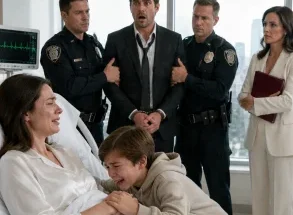
“This is Saint Catherine Medical Center in Dayton. Your father has been admitted following a cardiac episode.”
Everything inside me froze.
For one terrible second, all the anger vanished beneath pure instinct.
“Is he alive?”
“Yes,” she said quickly. “He’s stable. But he asked specifically for you.”
Not Mom.
Not Lauren.
Not Eric.
Me.
Rain hammered the parking garage windows as I drove forty minutes through traffic with my hands locked tight around the steering wheel.
The entire drive, I argued with myself.
You owe them nothing.
But he apologized.
He failed you for years.
But he finally told the truth.
By the time I reached the hospital, I was emotionally exhausted.
Dad looked older than I remembered.
Smaller, too.
Machines beeped softly beside him while pale afternoon light spilled across the blanket covering his legs. For a moment, seeing him there shattered something in me because he no longer looked like the man who raised me.
He looked human.
Fragile.
Afraid.
When he saw me, his eyes watered instantly.
“You came,” he whispered.
I stayed near the doorway. “The hospital said it was serious.”
He nodded weakly. “Stress.”
I almost laughed at the irony.
Three years of financial secrets, pride, lies, resentment, humiliation, and emotional warfare finally collecting interest all at once.
Dad swallowed hard before speaking again.
“Your mother doesn’t know I called you.”
That surprised me.
“Why?”
His eyes drifted toward the window.
“Because she still thinks this is about money.”
The room fell silent.
Then he looked directly at me.
“But I know it’s about what we allowed to happen to you.”
That hit harder than the apology weeks earlier.
Because this time… he didn’t sound guilty.
He sounded devastated.
I slowly sat down beside the bed.
Dad stared at his trembling hands.
“You know what the worst part is?” he asked quietly.
I didn’t answer.
“I think somewhere along the way… we became jealous of you.”
I blinked.
“You worked harder than all of us,” he continued. “You escaped. You became successful. Independent. And instead of being proud, your mother started treating your success like betrayal.”
My throat tightened painfully.
“She used to say you thought you were better than the family,” he whispered. “After enough years… everyone started repeating it.”
Suddenly, dozens of old memories rearranged themselves inside my head.
Every sarcastic comment.
Every joke about my career.
Every time my accomplishments were minimized.
Every holiday where I somehow left feeling guilty for succeeding.
Dad closed his eyes.
“I should’ve protected you from that.”
The machine beside him beeped steadily.
“But weak men stay quiet,” he said softly. “And quiet men become part of the cruelty.”
I looked down at my hands because suddenly I couldn’t breathe correctly.
For years, I wanted someone in my family to finally understand what they did to me.
Now that it was happening…
It hurt worse than the insults ever did.
Dad reached slowly into the drawer beside the hospital bed and handed me a folded envelope.
“What’s this?”
“I was supposed to give it to you after dinner that night.”
Confused, I opened it carefully.
Inside was an old photograph.
Me at sixteen.
Standing beside Dad at his construction site wearing one of his oversized hard hats, both of us smiling like the world hadn’t broken yet.
On the back, in Dad’s handwriting, were six words:
You were always the strongest one.
My vision blurred instantly.
Dad’s voice cracked.
“I think you spent your whole life trying to earn love from people who already decided to resent you for needing less from them.”
The room became unbearably quiet.
And for the first time since the dinner table…
I cried.
## Part 3
### *“Two Days After the Hospital Visit… Rachel Learned Why Her Mother Truly Hated Her Success.”*
I couldn’t stop thinking about the photograph.
For two straight days, it stayed on my kitchen counter beside Winston’s food bowl, and every time I walked past it, I felt something strange and unfamiliar inside me.
Grief.
Not for the family I lost.
For the family I almost had.
At sixteen, I worshipped my father.
Back then, he still laughed loudly. Still carried me on construction sites introducing me as “the smartest Whitman alive.” Still looked at me with pride instead of shame.
Somewhere between bankruptcy, pride, and my mother’s bitterness, that version of him disappeared.
Or maybe he slowly surrendered piece by piece.
Wednesday evening, my phone buzzed while I was cooking pasta.
Lauren.
I considered ignoring it.
Then I answered.
Her voice sounded tense immediately.
“Mom found out you visited Dad.”
I stirred the sauce quietly. “Okay.”
“She’s furious.”
Of course she was.
Not because Dad nearly died.
Because he called me.
“What does she want?” I asked calmly.
Lauren hesitated.
“She thinks you’re turning Dad against her.”
I actually laughed this time.
The sound startled even me.
“Lauren,” I said softly, “Dad is seventy years old. If someone can ‘turn’ him against Mom after forty years of marriage, their problems are much bigger than me.”
Silence.
Then Lauren exhaled shakily.
“She’s not handling any of this well.”
I thought about the hospital room.
Dad’s trembling hands.
The envelope.
The photograph.
Meanwhile Mom was still fighting over control.
Not love.
Control.
Finally Lauren spoke again, quieter this time.
“There’s something you don’t know.”
Something inside my chest tightened.
“What?”
Another long pause.
Then:
“Mom always thought Dad loved you more.”
The wooden spoon stopped moving in my hand.
“What?”
“She never said it directly,” Lauren admitted quickly. “But after you left for college, she changed. Especially once you started succeeding.”
“That’s ridiculous.”
“No,” Lauren whispered. “It’s true.”
I leaned against the kitchen counter while rain tapped softly against the windows.
Lauren’s voice became smaller.
“When Dad’s business failed… you became the stable one. And I think that humiliated her somehow.”
I stared silently ahead.
“She used to say things like…” Lauren stopped herself.
“Like what?”
Another pause.
Then Lauren forced the words out.
“‘Rachel acts like she saved this family.’”
The irony hit like a punch.
Because I had saved them.
Financially.
Emotionally.
Repeatedly.
But the truth was apparently too painful to admit.
Lauren continued carefully.
“You know Mom grew up poor. Really poor. Grandma depended on relatives constantly. Mom always swore nobody would ever have power over her financially again.”
Suddenly something terrible clicked into place.
Mom didn’t hate receiving help.
She hated needing it from me.
Her daughter.
The daughter who became successful without her.
The daughter Dad openly admired.
The daughter who proved strength could exist outside Mom’s control.
My stomach twisted.
“All those years…” I whispered.
Lauren sounded close to tears now.
“I don’t think she even realized what she was doing anymore.”
I closed my eyes.
That almost made it worse.
Because intentional cruelty is easier to understand than unconscious resentment.
Then Lauren said something that truly shocked me.
“Mason heard Mom and Derek talking the week before dinner.”
Ice slid down my spine.
“What did they say?”
Lauren inhaled shakily.
“They were laughing about how you’d never leave because you ‘needed the family more than the family needed you.’”
The room went completely silent.
Even Winston stopped crunching his food.
For years, I thought they disrespected me because they underestimated me.
But this?
This was different.
They believed I would tolerate anything for crumbs of love.
And maybe the most painful part was…
For a long time, they were right.
Lauren suddenly began crying softly.
“I should’ve stopped all of it,” she whispered. “I saw it happening. I just… staying quiet was easier.”
Dad’s words returned instantly:
> Quiet men become part of the cruelty.
Not just men.
Everyone.
I sat down slowly at the kitchen table.
“Why are you telling me this now?”
Lauren sniffed hard.
“Because Dad scared us.”
That answer was honest enough to hurt.
Not love.
Not guilt.
Fear.
The possibility of losing him finally cracked open truths nobody wanted to face.
Then Lauren said quietly:
“Mom blames you for the hospital.”
Of course she did.
I almost smiled.
“She says if you restarted the payments, none of this would’ve happened.”
There it was.
The real wound.
Not the disrespect.
Not the family collapse.
The money.
Even now.
Still the money.
I looked down at the old photograph beside me.
Sixteen-year-old me smiling beside Dad before life became transactional.
Then I asked the question I think I already knew the answer to.
“Does Mom miss me?”
Lauren cried harder before answering.
“I honestly don’t know anymore.”
That one hurt the most.
## Part 4
### *“The Night Rachel Learned Her Mother Had Been Hiding Something For Years.”*
After the call with Lauren, I barely slept.
Not because of anger.
Because for the first time in my life, the story inside my head about my family no longer matched reality.
Children grow up believing love is natural.
Automatic.
But some families turn love into competition so quietly you don’t notice until adulthood.
And suddenly every memory changes shape.
I kept hearing Lauren’s words over and over:
> “Mom always thought Dad loved you more.”
At 2:13 a.m., unable to sleep, I opened an old storage box in my closet.
Inside were pieces of my old life:
* college acceptance letters
* debate medals
* birthday cards
* faded family photos
I don’t know what I was searching for exactly.
Maybe proof that I imagined everything.
Maybe proof that I didn’t.
Then I found it.
A folded piece of paper tucked between two old photographs.
My stomach tightened immediately.
It was one of my high school report cards.
Straight A’s.
At the bottom, written in blue ink, was my mother’s handwriting:
> “Your father already praises you enough. Don’t become arrogant.”
I stared at the sentence for a very long time.
Not because it was cruel.
Because I suddenly remembered exactly how old I was when I read it.
Seventeen.
And I remembered crying alone in my bedroom afterward, wondering why achievement always seemed to make my mother colder instead of proud.
Back then, I thought I simply wasn’t lovable enough.
Now?
I finally understood.
Success made her feel abandoned.
The next afternoon, Dad called again.
His voice sounded stronger.
“They’re releasing me tomorrow.”
“That’s good.”
Silence lingered.
Then he spoke carefully.
“Your mother doesn’t know I’m calling.”
Something about that sentence exhausted me instantly.
“Dad…”
“No,” he interrupted softly. “There’s something I should’ve told you years ago.”
My chest tightened.
“What?”
I heard him exhale slowly.
“The night you got accepted into Northwestern…”
I froze.
That had been one of the biggest moments of my life.
A full academic scholarship.
A ticket out.
A future.
“What about it?”
Dad’s voice cracked slightly.
“Your mother cried after you went to bed.”
Confusion hit first.
“She was proud?”
“No,” he whispered painfully. “She was afraid.”
I sat down slowly.
Dad continued:
“She thought once you left… you’d realize you didn’t need us anymore.”
The room felt suddenly smaller.
“She made me promise something that night,” he admitted.
“What promise?”
His silence lasted so long I thought the call dropped.
Then finally:
“She asked me not to help you too much.”
I stopped breathing.
“What?”
“She said struggle would keep you humble. Keep you connected to family.”
My hand tightened around the phone.
Suddenly dozens of painful memories slammed together all at once.
The student loans Dad said they “couldn’t help with.”
The broken car I drove for years.
Working two jobs in college while Lauren’s apartment was partially paid for.
Every moment I thought I simply mattered less.
Dad sounded devastated now.
“I argued with her at first. But after the business started failing… after money got tighter… I justified it to myself.”
Tears burned behind my eyes.
“You let me believe I was on my own.”
“I know.”
“You watched me drown.”
“I know.”
I stood up abruptly and walked toward the window because suddenly the apartment felt unbearable.
Outside, the city lights blurred through tears.
“I used to call home crying,” I whispered. “Do you remember that?”
Dad began quietly sobbing.
“Yes.”
“And Mom would say things like ‘Life is hard for everyone’ or ‘Maybe this experience will toughen you up.’”
“I know.”
“And the whole time…” My voice broke completely. “The whole time this was intentional?”
“No,” Dad said desperately. “Not intentional like that—”
“But it happened anyway.”
Silence swallowed both of us.
Then Dad whispered the sentence that shattered me completely.
“She thought dependence would keep the family together.”
I covered my mouth instantly as tears spilled down my face.
Because that was it.
That was the sickness inside my family.
Not love.
Dependence.
Need.
Control disguised as closeness.
The reason my success felt threatening was because independence broke the system.
I wasn’t supposed to escape emotionally.
Only financially useful.
Dad cried quietly on the other end.
“I failed you,” he whispered.
For once…
I didn’t argue.
## Part 5
### *“Three Days Later… Rachel Accidentally Heard The Truth Her Mother Never Meant Her To Know.”*
After the call with Dad, something inside me changed permanently.
Not dramatically.
Quietly.
Like a door finally unlocking after years of pressure against the frame.
For most of my life, I believed love had to be earned through usefulness.
Be helpful.
Be successful.
Be generous.
Be patient.
Be smaller.
And maybe then people would choose you.
But once you realize some people only love the version of you they can control…
You start grieving differently.
Not the loss of love.
The realization it may never have existed the way you imagined.
I stopped answering family messages after that.
Lauren texted twice.
Dad sent one photo of Winston’s favorite toy he found under the hospital chair after my visit.
Even Eric tried calling once at midnight.
I ignored them all.
Then Saturday happened.
I was at a grocery store downtown comparing pasta sauces when I heard my name behind me.
“Rachel?”
I turned and froze.
Mrs. Porter.
My mother’s longtime church friend.
Late sixties. Silver hair. Permanent smile.
The woman who practically lived at our house during holidays growing up.
“Oh my goodness,” she said warmly. “Your mother said you moved away after the family disagreement.”
Of course she did.
I forced a polite smile. “Not exactly.”
Mrs. Porter’s expression shifted slightly.
Then came the sentence that changed everything.
“She’s taking the house situation very hard.”
My stomach tightened instantly.
“What situation?”
Mrs. Porter blinked.
“The mortgage, dear.”
Cold dread slid through me.
Mom told people?
Publicly?
I stayed very still. “What exactly did she say?”
Mrs. Porter looked uncomfortable now.
“Oh… I probably shouldn’t…”
But it was already too late.
“What did she say?” I repeated calmly.
The older woman hesitated.
“She told everyone your father lost the house because you suddenly abandoned the family financially.”
For a moment, the entire grocery store disappeared around me.
The fluorescent lights.
The shopping carts.
The conversations.
Everything faded beneath one overwhelming realization.
Even after everything…
Mom still needed me to be the villain.
Mrs. Porter touched my arm gently.
“She said success changed you.”
I almost laughed.
That sentence again.
Success changed you.
Not:
We depended on her secretly for years.
Not:
We humiliated her repeatedly.
Not:
A child spit into her food while adults laughed.
No.
Success changed her.
Because that version protected my mother from shame.
Mrs. Porter lowered her voice carefully.
“Between us… some people at church didn’t fully believe her.”
That surprised me.
“Why?”
The woman looked almost embarrassed.
“Because your father got emotional during men’s breakfast last Tuesday.”
My heartbeat slowed.
“What did he say?”
Mrs. Porter hesitated again.
Then softly:
“He said he spent years allowing the strongest person in his family to carry burdens she never should’ve carried alone.”
My throat tightened instantly.
“He cried, Rachel.”
I looked away quickly.
“He said you saved the family while everyone else criticized you for surviving differently than they did.”
The grocery store blurred again.
Because for the first time in my life…
Dad was telling the truth even when I wasn’t there to hear it.
Mrs. Porter squeezed my arm.
“I think your father is trying to make peace with himself.”
I swallowed hard.
“And Mom?”
The older woman’s face fell slightly.
“She’s angry.”
Of course she was.
Truth threatens people who survive through narrative control.
Then Mrs. Porter said something quietly that stopped me cold.
“She’s especially angry because people started asking why you were paying the mortgage instead of your siblings.”
I stared at her.
And suddenly…
I understood everything.
The real humiliation for Mom wasn’t needing help.
It was needing help specifically from the daughter she spent years minimizing.
Because if I became the savior…
Then her entire version of reality collapsed.
Mrs. Porter sighed softly.
“Your mother always struggled with pride.”
No.
Not pride.
Hierarchy.
Control.
Dependence.
And suddenly I remembered something terrifying.
When I was nineteen, Mom once told me:
> “Never let people know how much power they have over you.”
At the time, I thought she meant relationships.
Now I realized…
She meant survival.
That night, I sat alone on my apartment balcony watching rain slide across the city.
Winston slept beside my feet while the old photograph from Dad rested in my lap.
And for the first time in my life…
I asked myself a question I had avoided for years.
If my mother truly loved me…
Why did my pain always seem to comfort her more than my happiness?
## Part 6
### *“The Following Monday… Rachel Discovered Her Mother Had Been Hiding One Final Secret From The Entire Family.”*
Monday morning arrived gray and heavy.
The kind of sky that makes the whole city feel emotionally exhausted before the day even begins.
I barely touched my coffee.
The question from the balcony still haunted me:
> Why did my pain always seem to comfort her more than my happiness?
No daughter wants to ask herself that.
Because once you do…
You can never fully unlearn the answer.
Around noon, my office receptionist called.
“Rachel? There’s someone here for you.”
My stomach tightened instantly.
“Who?”
A pause.
“Your mother.”
Of course.
I closed my eyes briefly before heading downstairs.
Mom stood near the lobby windows clutching her purse tightly against her chest. She looked older than I remembered even a month ago.
Not softer.
Just… worn down.
The moment she saw me, her expression hardened defensively, like she already expected rejection and wanted to attack before I could.
“Five minutes,” I said calmly.
“That’s all I need.”
We sat across from each other in a small conference room visitors sometimes used for interviews.
Neither of us spoke at first.
Finally Mom looked around the office.
“So this is where all the money comes from.”
There it was again.
Always the money.
Not:
How are you?
Not:
Are you okay?
Not:
I miss you.
Just the thing she both resented and depended on.
I stayed quiet.
Mom folded her arms tightly.
“People at church are talking.”
“I know.”
“You embarrassed this family.”
“No,” I answered calmly. “The truth embarrassed this family.”
Her jaw tightened instantly.
“You didn’t need to expose us.”
I almost laughed from disbelief.
Expose us.
As if I leaked secrets maliciously instead of simply refusing to continue carrying them.
“You told people I abandoned you,” I said quietly.
“You did.”
“I stopped funding adults who treated me with contempt.”
“You always talk like a lawyer,” she snapped.
“No,” I replied softly. “I talk like someone who got tired of pretending.”
That seemed to hit something deeper than anger.
Mom looked away quickly.
For a long moment, neither of us spoke.
Then suddenly she asked:
“Did your father tell you?”
Cold unease slid through me.
“Tell me what?”
The silence that followed felt dangerous.
Mom’s fingers tightened around her purse.
“He wasn’t supposed to say anything.”
Something inside me dropped.
“What are you talking about?”
Her eyes finally met mine.
And for the first time in my life…
My mother looked afraid of me.
Not angry.
Afraid.
Then she whispered:
“You weren’t supposed to become the successful one.”
The room went completely still.
I stared at her.
“What?”
Mom inhaled shakily.
“When you were little… you were sensitive. Emotional. You needed reassurance constantly. Your father used to say you’d do something important one day, but I didn’t believe him.”
Every word felt unreal.
“Lauren was easier,” Mom continued quietly. “She needed us. Eric needed us. But you…”
Her voice cracked strangely.
“You kept becoming more independent every year.”
I felt physically cold now.
“You say that like it’s a bad thing.”
“To a mother?” she whispered bitterly. “Sometimes it is.”
I couldn’t speak.
Mom laughed softly then, but there was no happiness in it.
“You know what nobody tells women?” she said. “Children grow up and leave. And the ones who leave easiest are usually the ones who survive best without you.”
The sentence hit me like ice water.
Because buried underneath all the manipulation…
There was something horrifyingly human there.
Fear.
Not fear of losing support.
Fear of becoming unnecessary.
Mom looked down at the table.
“When you got into Northwestern, your father looked at you like you hung the moon.” Her smile trembled painfully. “I knew right then I was losing you.”
“You didn’t lose me,” I whispered.
Her eyes filled instantly.
“Yes,” she said quietly. “I did.”
The room fell silent except for the soft hum of fluorescent lights overhead.
Then she said the one thing I never expected to hear from her.
“I think part of me wanted you to struggle.”
The words shattered something deep inside me.
Not because I didn’t already suspect it.
Because hearing it aloud made it real forever.
Mom started crying quietly.
“I told myself hardship would keep you grounded. Keep you close to family. But every time you succeeded without us…” Her voice broke completely. “I felt smaller.”
I stared at the woman who raised me.
And suddenly I saw it clearly.
My mother did love me.
But her love was poisoned by insecurity.
Every achievement of mine became evidence she was losing importance.
Every step toward independence felt like abandonment.
And instead of healing that wound…
She punished me for triggering it.
Tears burned behind my eyes.
“You made me feel guilty for surviving,” I whispered.
Mom covered her mouth instantly.
Because she knew it was true.
For several seconds, neither of us moved.
Then she whispered the most honest thing she had ever said to me.
“I don’t know how to love people without needing them.”
And somehow…
That was even sadder than the hatred.
## Part 7
### *“That Night… Rachel Finally Learned Why Her Father Stayed Silent All Those Years.”*
After Mom left my office, I sat alone in the conference room for nearly twenty minutes without moving.
Her final sentence echoed endlessly inside my head:
> “I don’t know how to love people without needing them.”
Most people would hear that and feel anger.
I felt grief.
Because suddenly my entire childhood made sense.
The guilt whenever I succeeded.
The coldness after achievements.
The emotional distance every time I became more independent.
My mother didn’t know how to love freely.
Only possessively.
And the worst part?
I think she truly believed that was love.
That evening, rain covered the city again.
I was feeding Winston when my phone buzzed.
Dad.
For a long moment, I considered letting it ring.
Then I answered quietly.
“Hey.”
His voice sounded tired.
“Your mother told me she saw you today.”
Of course she did.
“She said things finally came out.”
I leaned against the kitchen counter.
“Yeah.”
Silence settled between us.
Then Dad asked softly:
“Do you hate her?”
The question surprised me.
I looked down at Winston circling my feet.
“No,” I admitted finally. “I think that would be easier.”
Dad exhaled shakily like he’d been holding his breath.
“She wasn’t always like this.”
I closed my eyes.
“Then why didn’t you stop it?”
The silence afterward lasted so long I thought he might avoid answering again.
But this time…
He didn’t.
“Because your mother scared me.”
I froze.
Not physically.
Emotionally.
“What?”
Dad laughed bitterly under his breath.
“You grew up thinking I was the strong one.” His voice sounded distant now. “Truth is… your mother always controlled the emotional temperature of the house.”
Memories flashed instantly.
Mom angry?
Everyone tense.
Mom upset?
Everyone apologizing.
Mom silent?
The whole house walking carefully.
Dad continued quietly:
“When your mother felt insecure, she lashed out. When she felt abandoned, she punished distance. And after enough years…” He swallowed hard. “Keeping her calm became easier than confronting her.”
I sat down slowly.
“So you sacrificed me.”
The honesty in my own voice startled me.
Dad inhaled sharply.
“Yes.”
No excuses.
No defending himself.
Just truth.
And somehow that hurt even worse.
“I told myself you were stronger,” he whispered. “That you could handle more.”
Tears burned instantly behind my eyes.
Every oldest daughter.
Every responsible child.
Every independent person knows that sentence.
You’re stronger.
Which usually means:
> We decided you could survive less love.
Dad’s voice cracked badly now.
“You know what destroys me?”
I stayed silent.
“You still kept helping us.”
I covered my mouth as tears slipped down my face.
Because he was right.
Despite everything…
I stayed.
Paid bills.
Solved emergencies.
Absorbed disrespect.
Protected people who emotionally abandoned me years earlier.
Dad sounded like he hated himself now.
“The night you canceled the mortgage…” he whispered, “your mother panicked.”
I looked up slowly.
“Not because of the house.”
Cold unease spread through me.
“Then why?”
His answer came quietly.
“Because for the first time… she realized you might actually leave emotionally.”
The room went still.
And suddenly I understood something horrifying.
The money was never the true loss.
Control was.
As long as they needed me financially…
some part of me stayed tied to them.
Obligated.
Reachable.
Guilty.
But canceling the mortgage changed the balance forever.
Dad continued softly:
“She cried all night after you left the dinner.”
I stared ahead silently.
“She kept saying, ‘Rachel’s really gone this time.’”
My chest tightened painfully.
Because part of me had wanted that.
Wanted her to suffer.
Wanted her to finally understand.
But hearing it now only felt empty.
Dad cleared his throat shakily.
“I need to tell you something else.”
I wiped my face quickly.
“What?”
He hesitated.
Then:
“The reason your mother resented your independence so much…”
A long pause followed.
“…is because she gave up hers.”
Something inside me stopped completely.
Dad’s voice grew quieter.
“She wanted to go to law school before she got pregnant with Eric.”
I blinked.
“What?”
“She got accepted,” he whispered. “Full scholarship.”
I couldn’t breathe.
“She never went.”
The kitchen suddenly felt too small.
Too quiet.
Too heavy.
“She blamed me for that at first,” Dad admitted. “Then life moved on. Kids happened. Bills happened. But every year…” His voice cracked again. “Every year she watched you become more of the woman she once imagined for herself.”
Tears rolled silently down my face now.
Not because it excused her.
Because it explained her.
Mom didn’t just see my success.
She saw the ghost of her own unlived life.
And instead of mourning it…
She resented me for surviving differently.
Dad whispered softly:
“That resentment poisoned her slowly.”
I looked out the rain-covered window for a very long time.
Then finally asked:
“Did she ever love me without competing with me?”
Dad started crying quietly before answering.
“Yes.”
The pause afterward broke me.
“But not enough to heal herself first.”
## Part 8
### *“One Week Later… Rachel Opened The Letter Her Mother Never Intended Her To Read.”*
After the call with Dad, I didn’t cry immediately.
I just sat there in silence while rain crawled down the windows beside me and Winston slept against my leg completely unaware that generations of emotional damage were unraveling inside my apartment.
My mother wanted to become a lawyer.
A lawyer.
Suddenly everything about her made terrifying sense.
The sharpness.
The control.
The obsession with respect.
The bitterness toward wasted potential.
And worst of all?
I understood why my success wounded her so personally.
I became what she buried.
That realization haunted me for days.
Then Thursday evening, Dad called again.
This time his voice sounded nervous.
“Rachel… your mother doesn’t know I’m doing this.”
My stomach tightened instantly.
“Doing what?”
“I found something while packing old boxes from the house.”
A pause.
“It belongs to you.”
Thirty minutes later, Dad sat across from me in my apartment holding a weathered brown envelope.
He looked exhausted.
Older than ever.
Like truth itself had aged him.
“I should’ve given this to you years ago,” he whispered.
The envelope had my name written across the front in my mother’s handwriting.
Not recent handwriting.
Young handwriting.
Careful handwriting.
My chest tightened instantly.
“What is this?”
Dad stared at the envelope for a long moment.
“She wrote it after your college graduation.”
I froze.
“She never gave it to you.”
My fingers suddenly felt numb.
Slowly, I opened the envelope.
Inside was a folded letter.
The paper had yellowed slightly with age.
Dad stood quietly. “I’ll give you privacy.”
Then he left.
The apartment became completely silent except for rain tapping softly against the glass.
For several seconds, I just stared at the letter.
Then finally…
I unfolded it.
—
Rachel,
You will probably never read this because I honestly don’t know how to say these things out loud without sounding selfish.
Today, when you walked across that graduation stage, everyone clapped for you.
Your father cried.
I smiled.
But inside, I felt something I’m ashamed of.
Jealousy.
Not because I wanted your life exactly.
Because I once wanted a life that mattered to me the way yours clearly matters to you.
When I was twenty-two, I thought I would become someone impressive.
Then life happened quickly.
Marriage.
Bills.
Children.
Sacrifice.
People always praise mothers for giving things up like it’s beautiful.
Sometimes it isn’t beautiful.
Sometimes it’s grief that nobody allows you to admit.
You were always the child most like me.
That’s why loving you became complicated.
Every time you succeeded, I felt proud…
and reminded.
Every time you became stronger, I saw what I stopped becoming.
That isn’t your fault.
But I think somewhere along the way, I began punishing you emotionally for reminding me.
I criticized your independence because I envied it.
I minimized your success because I mourned my own lost potential.
And the more you thrived without needing me, the more terrified I became that eventually you’d realize I had nothing left to offer you.
A mother should never compete with her daughter.
But I think part of me did.
And that shame has followed me for years.
If you ever read this one day, I hope you understand something important:
None of this happened because you were hard to love.
It happened because I never learned how to survive the person I could have been.
— Mom
—
I didn’t realize I was crying until tears hit the paper.
The entire apartment blurred around me.
Because for the first time in my life…
My mother finally told the truth with no manipulation attached to it.
No guilt.
No blame.
No performance.
Just honesty.
Painful.
Ugly.
Human honesty.
I pressed the letter against my chest while years of confusion cracked open inside me all at once.
The coldness.
The criticism.
The emotional punishment.
It had never truly been about me.
I wasn’t unlovable.
I was a mirror she couldn’t bear looking into.
A quiet knock suddenly came at the door.
I opened it to find Dad standing there awkwardly holding Winston’s favorite toy mouse.
“I forgot this in my pocket,” he said softly.
Then he saw my face.
Saw the tears.
And immediately understood.
Dad looked down quietly.
“She wrote that after your graduation,” he whispered. “I found it hidden in her dresser years ago.”
I stared at him in disbelief.
“You read it?”
He nodded once.
“Why didn’t you give it to me?”
The guilt in his eyes nearly crushed me.
“Because your mother begged me not to.”
My chest tightened painfully.
“She said if you knew the truth…” His voice cracked. “You’d stop loving her.”
Silence filled the apartment.
Then I looked back down at the letter in my shaking hands.
And somehow…
The most heartbreaking part of all was this:
Even after everything…
I still didn’t stop loving her.
## Part 9
### *“The Day Rachel Finally Told Her Mother The Truth… Everything Between Them Changed Forever.”*
I didn’t contact Mom for four days after reading the letter.
Not because I was angry.
Because I no longer knew how to carry all the emotions at once.
Grief.
Relief.
Compassion.
Resentment.
When people hurt us for years, we imagine healing will feel clean once we finally understand why.
It doesn’t.
Sometimes understanding just gives pain a face.
And that can make it harder to hate.
The letter stayed folded beside my bed.
Every night, I reread certain lines.
> “None of this happened because you were hard to love.”
That sentence alone healed wounds I didn’t even realize I still carried.
Wounds from childhood.
Teenage years.
Relationships.
Every moment I secretly wondered:
> What is wrong with me that love always feels conditional?
Friday evening, Dad texted me unexpectedly.
Your mother hasn’t left the bedroom much today.
I stared at the message for a long time.
Then another arrived.
I think she knows you read the letter.
My chest tightened instantly.
And before I could overthink it…
I grabbed my keys.
The condo looked painfully small compared to the old house.
Not sad exactly.
Just honest.
No giant dining room.
No performance stage.
No illusion of perfection.
Dad opened the door quietly when I knocked.
“She’s in the bedroom,” he whispered.
I nodded once.
Then walked slowly down the hallway.
The bedroom door sat half-open.
Mom was sitting on the edge of the bed staring at nothing when I entered.
For a second, she looked startled.
Almost frightened.
Then her eyes dropped immediately to the folded letter in my hand.
Neither of us spoke.
I closed the door softly behind me.
Mom’s voice came out barely above a whisper.
“Your father gave it to you.”
Not a question.
I nodded.
She looked away instantly, shame flooding her face so visibly it almost hurt to witness.
“You weren’t supposed to see that.”
I sat carefully in the chair across from her.
“I know.”
Silence filled the room.
Then finally I asked the question that had haunted me since reading it.
“Why did you keep it?”
Mom swallowed hard.
“I couldn’t throw it away.”
Her eyes slowly lifted toward me.
“It was the only time I was ever completely honest with myself.”
That sentence shattered me quietly.
Because it meant she had known.
All along.
Not fully.
Not clearly.
But somewhere deep inside herself…
She knew she was hurting me.
Mom rubbed her trembling hands together.
“I used to watch you sleep when you were little,” she whispered suddenly. “Did you know that?”
I blinked in surprise.
“You were such a sensitive child. Everything affected you deeply.” A weak smile touched her lips briefly. “If someone raised their voice at school, you’d cry at home hours later.”
Tears burned behind my eyes.
“I loved that softness in you,” she whispered.
Then her face crumpled.
“But I also feared it.”
The room felt unbearably fragile now.
“I thought life would destroy you,” Mom admitted. “So every time you got stronger… part of me felt relieved.”
Her voice cracked badly.
“And another part felt left behind.”
I stared silently at her.
Not the villain from the dinner table.
Not the cold woman from years of guilt.
Just a deeply broken person sitting in front of the daughter she accidentally wounded while trying to survive herself.
Mom looked at the letter again.
“I wanted to be proud without envy,” she whispered. “I tried. God knows I tried.”
I believed her.
And somehow that made everything sadder.
Then I finally said the thing sitting inside my chest for years.
“You made me feel like love disappeared when I succeeded.”
Mom inhaled sharply like the truth physically hurt.
Tears spilled down her face instantly.
“I know.”
“You made me feel guilty for growing.”
“I know.”
“You made me believe being needed mattered more than being loved.”
Mom broke completely then.
Not dramatic crying.
Not manipulative tears.
The kind that come from finally seeing the damage clearly.
“I’m sorry,” she whispered over and over. “Rachel, I’m so sorry…”
And for the first time in my life…
I believed she meant it.
But forgiveness and healing are different things.
That was the hardest part.
Because even while watching her cry…
The little girl inside me still remembered every moment she felt emotionally abandoned.
Mom wiped her face shakily.
“I don’t expect you to forgive me.”
I looked down at the letter in my hands.
Then quietly answered:
“I think I already started before you apologized.”
Her face collapsed in shock.
“Why?”
The answer came before I could stop it.
“Because I finally realized your pain wasn’t my fault.”
The room went completely silent.
Mom stared at me like she’d never truly seen me before.
And maybe…
For the first time…
She finally had.
## Part 10
### *“Two Months Later… Rachel Returned To Sunday Dinner One Final Time.”*
Healing didn’t happen all at once.
That’s the lie movies tell people.
Real healing is awkward.
Slow.
Uneven.
Some days I felt lighter.
Other days, one random memory could still ruin me completely.
A phrase.
A smell.
A tone of voice.
Trauma doesn’t disappear just because someone finally apologizes for causing it.
But something had changed after the conversation in Mom’s bedroom.
For the first time in my life…
The emotional war had stopped.
No more guilt texts.
No more manipulation.
No more pretending.
Just distance.
Truth.
And quiet attempts at honesty.
Dad started calling once a week.
Not to ask for help.
Just to talk.
Sometimes about baseball.
Sometimes about Winston.
Sometimes about nothing important at all.
Oddly enough, those became my favorite conversations.
Because they were finally free of obligation.
Lauren started therapy.
She admitted that after watching the family collapse, she realized how much of her own life revolved around keeping peace instead of confronting truth.
Even Mason changed.
One afternoon, a handwritten envelope arrived at my apartment again.
Inside was a drawing of Winston wearing a superhero cape.
At the bottom Mason wrote:
> “Mom says healing takes time. I think she’s right.”
I taped it to my refrigerator.
Eric remained mostly silent.
Honestly?
That hurt less than expected.
Not every relationship survives truth.
And maybe some aren’t supposed to.
Then one Sunday afternoon in early autumn, Dad called unexpectedly.
“Your mother wants to ask you something.”
My stomach tightened immediately.
A few seconds later Mom came onto the line.
Her voice sounded nervous.
“Your father and I were thinking about making dinner tonight.”
I stayed quiet.
Then softly:
“You don’t have to come.”
That sentence mattered more than she probably realized.
No guilt.
No pressure.
No emotional trap.
Just choice.
“I made your favorite,” she added carefully. “Chicken parmesan.”
My chest tightened unexpectedly.
Because suddenly I was seventeen again.
Standing in the old kitchen.
Still hoping warmth meant safety.
“I’ll think about it,” I whispered.
When I arrived that evening, the condo smelled like garlic, basil, and baked bread.
Smaller table.
Smaller kitchen.
Smaller life.
But somehow…
less exhausting.
Dad opened the door first.
Then froze slightly when he saw me.
Not because he didn’t expect me.
Because part of him probably feared I’d stop showing up forever.
“Hey, kiddo,” he said softly.
Kiddo.
I hadn’t heard that in years.
Inside, Mom stood nervously near the stove drying her hands repeatedly on a dish towel.
Lauren sat quietly beside Mason.
Eric wasn’t there.
Nobody mentioned him.
The silence felt uncomfortable at first.
Not hostile.
Just unfamiliar.
Like people learning how to exist without old roles.
Then Mason looked at me carefully and said:
“I told my school counselor what I did.”
The room went still.
“And?”
He looked embarrassed.
“She said hurting people to impress adults usually means the adults are behaving badly too.”
Dad looked down immediately.
Lauren swallowed hard.
But Mom…
Mom looked directly at her grandson and whispered:
“She’s right.”
That moment changed something.
Because years ago, my mother would’ve defended the family image first.
Now?
She chose honesty.
Dinner passed slowly.
Awkward conversations.
Careful laughter.
Long silences.
But nobody mocked me.
Nobody minimized me.
Nobody needed me to become smaller so they could feel bigger.
And for the first time in years…
I noticed how tired my mother looked.
Not physically.
Emotionally.
Like someone who spent decades fighting battles against herself.
After dessert, Mom quietly asked if I would help her carry plates into the kitchen.
I followed her silently.
Warm water filled the sink while dishes clinked softly between us.
Then suddenly she spoke without turning around.
“You know what the hardest part of all this has been?”
“What?”
Her hands trembled slightly in the water.
“Realizing how many moments I ruined because I was busy grieving my own life.”
My throat tightened.
She stared down at the plate she was washing.
“You were trying to share your happiness with me.” Her voice cracked. “And I kept responding like your happiness was stealing something from mine.”
Tears burned behind my eyes instantly.
Mom finally turned toward me fully.
“I missed so much of you,” she whispered.
And somehow…
That was the saddest sentence she had ever said.
Because this time, there was no anger left inside it.
Only mourning.
I looked at the woman in front of me.
Not perfect.
Not healed.
Not magically transformed.
Just human.
Flawed.
Regretful.
Trying.
Then quietly, carefully…
I handed her the towel beside the sink.
And for the first time since childhood…
We stood beside each other in silence that didn’t hurt.
## Part 11
### *“The First Time Rachel Truly Felt Like A Daughter Again… It Lasted Less Than Five Minutes.”*
For a while, things stayed quiet.
Not perfect.
But honest.
And honestly?
That was more peace than I ever thought my family could reach.
Sunday dinners became occasional instead of mandatory.
Dad looked healthier every week.
Lauren seemed softer somehow after starting therapy. Less defensive. Less desperate to keep everyone comfortable.
Even Mom changed in small ways.
Subtle ways.
The first time she asked about my work without making a sarcastic comment afterward, I nearly cried driving home.
The first time she said:
> “You should be proud of yourself.”
I actually had to pull over because my hands started shaking.
Some wounds heal so slowly that even kindness feels unfamiliar.
Then came Thanksgiving.
The first major holiday since everything collapsed.
I almost didn’t go.
But Dad called twice asking if I’d come early to help him cook, and something about hearing excitement in his voice weakened me.
So Wednesday night, I drove to the condo carrying two homemade pies and enough anxiety to power the entire city.
The moment I stepped inside, the smell hit me first.
Turkey.
Butter.
Cinnamon.
Home.
Or at least something trying to become one again.
Dad smiled immediately when he saw me.
“There’s my favorite chef.”
Mom rolled her eyes lightly from the kitchen.
“You say that every time she brings food.”
“Yes,” Dad replied calmly. “Because she’s better than all of us.”
And for one terrifying second…
Everything felt normal.
Warm.
Safe.
The kind of family moment I used to beg life to give me.
Then the front door opened.
Eric walked in.
The entire atmosphere changed instantly.
Not loudly.
Quietly.
Like oxygen leaving the room.
He looked surprised to see me.
“Rachel.”
I nodded once. “Eric.”
Months had passed since we’d spoken directly.
He looked thinner.
More tired.
Less arrogant.
But resentment still lived in his eyes.
Dad cleared his throat awkwardly.
“Eric’s joining dinner this year.”
“I can see that,” I answered calmly.
Mom immediately became tense.
I recognized that look instantly.
The old emotional panic.
The fear of conflict.
The need to manage everyone’s feelings before truth could surface.
Eric tossed his keys onto the counter.
“I almost didn’t come.”
Lauren immediately muttered:
“Then maybe you shouldn’t have.”
Interesting.
Old Lauren would never have said that aloud.
Eric ignored her and looked at me instead.
“So…” He shoved his hands into his pockets. “Guess you finally won.”
The room went completely still.
There it was.
Not accountability.
Competition.
Like the destruction of our family had somehow been a game between us.
I stared at him carefully.
“This was never about winning.”
Eric laughed bitterly.
“Easy for you to say. You’re everybody’s hero now.”
Dad’s face hardened instantly.
“She was always helping this family,” he said sharply. “You just refused to see it.”
Eric looked stunned.
Because Dad never used to confront him.
Ever.
“You think I’m the villain?” Eric snapped. “Rachel always acted superior.”
“No,” Lauren interrupted suddenly. “She acted exhausted.”
Silence exploded across the kitchen.
Eric looked at her in disbelief.
Then at Mom.
Waiting.
Waiting for backup.
Waiting for the old system to protect him.
But Mom stayed quiet.
And that silence changed everything.
Because for the first time in his life…
She didn’t rescue him from accountability.
Eric noticed too.
His expression shifted slowly from anger to confusion.
Then hurt.
“You’re all turning against me now?”
Dad answered quietly:
“No. We’re just finally being honest.”
The words landed like thunder.
Eric scoffed harshly.
“Honest? Fine. Let’s be honest.” He pointed directly at me. “She always thought she was better than this family.”
Before I could respond…
Mom spoke.
And her voice shook.
“No,” she whispered.
Everyone froze.
Mom looked directly at Eric.
“She just became the person I should’ve encouraged instead of resenting.”
Complete silence.
Eric blinked at her like he genuinely didn’t recognize the woman speaking.
Neither did I.
Mom swallowed hard.
“I taught all of you unhealthy things.” Tears filled her eyes instantly. “Especially about Rachel.”
The room felt emotionally fragile now.
Like decades of lies were cracking in real time.
Eric looked overwhelmed suddenly.
Anger fading into something uglier.
Confusion.
Because when dysfunctional families change…
the people most attached to the old system often feel abandoned by the healing itself.
He looked at Dad desperately.
“So what? I’m just the bad guy now?”
Dad’s answer came softly.
“No, son.”
A pause.
“But you became comfortable benefiting from someone else’s pain.”
Nobody moved.
Nobody breathed.
And for the first time in my entire life…
My family stopped pretending.
## Part 12
### *“Three Days After Thanksgiving… Eric Showed Up At Rachel’s Apartment With Something Nobody Expected.”*
After Thanksgiving, the family group chat stayed silent for nearly two days.
No memes from Dad.
No random recipes from Mom.
No awkward attempts from Lauren to lighten tension.
Just silence.
Heavy silence.
The kind that follows truth once everyone realizes there’s no going back to pretending.
Oddly enough…
I didn’t feel anxious anymore.
For years, silence in my family meant punishment.
Withdrawal.
Emotional warfare.
Now it simply felt honest.
Sunday evening, I was curled on the couch with Winston asleep against my leg when someone knocked at my apartment door.
I wasn’t expecting anyone.
My stomach tightened immediately.
Then I looked through the peephole.
Eric.
Alone.
That alone unsettled me.
Eric never came anywhere alone emotionally.
He usually brought anger, sarcasm, excuses, or someone else to hide behind.
But tonight?
He just looked tired.
I opened the door carefully.
“What happened?”
He shoved his hands into his jacket pockets.
“Can I come in?”
Every instinct told me no.
But something in his face stopped me.
I stepped aside silently.
Eric walked into the apartment slowly, glancing around awkwardly like he’d never really looked at my life before.
Which honestly…
he probably hadn’t.
Winston immediately trotted toward him suspiciously.
Eric stared down at the cat.
“That thing always judging people?”
“He’s usually right,” I replied.
For the first time in years…
Eric almost smiled.
Almost.
I motioned toward the couch.
He sat stiffly while I stayed standing.
Finally he spoke.
“I lost my job two months before the dinner.”
I blinked.
“What?”
He laughed bitterly under his breath.
“Yeah. Funny, right?”
Nobody had told me.
Then again, nobody told me most things unless they needed something.
“I didn’t know.”
“Mom and Dad did.”
Of course they did.
Suddenly dozens of things clicked together.
The extra tension.
The defensiveness.
The way Eric attacked me that night.
Not confidence.
Shame.
“I was supposed to tell everyone after dessert,” he admitted quietly. “Then the thing with Mason happened and everything exploded.”
I stayed silent.
Eric rubbed both hands over his face.
“You wanna know the worst part?”
He looked up at me finally.
“I knew you were paying the mortgage.”
The room went still.
My heartbeat slowed painfully.
“What?”
His eyes filled instantly—not dramatically, just enough to reveal how exhausted he really was.
“I found out almost a year ago.”
Cold disbelief spread through me.
“You knew… and still treated me like that?”
Eric looked down immediately.
And his next words came out broken.
“Because if I admitted what you were doing… then I had to admit what I wasn’t.”
That hit harder than yelling ever could.
He swallowed hard.
“You were holding everything together while I kept telling myself you were arrogant so I wouldn’t feel useless.”
The apartment felt unbearably quiet now.
Because suddenly I wasn’t looking at the cruel brother from the dinner table anymore.
I was looking at a deeply insecure man drowning in his own failures.
Eric laughed bitterly again.
“You know what really killed me?” he whispered. “Dad respected you.”
I froze.
“He listened to your advice. Trusted you. Called you when things got bad.” Eric’s jaw tightened painfully. “Meanwhile I was living in his basement pretending life just hadn’t ‘worked out yet.’”
Years of resentment suddenly rearranged themselves into something sadder.
Not hatred.
Inferiority.
“I spent years convincing myself you thought you were better than me,” he admitted quietly.
Then finally looked directly at me.
“But honestly?”
A long pause.
“I think I knew you actually were stronger.”
The honesty in that sentence cracked something inside me.
Not because I wanted him beneath me.
Because siblings are never supposed to compete for worth in the first place.
Eric wiped his eyes roughly, embarrassed by his own emotion.
Then he reached into his jacket pocket and placed something carefully on the coffee table between us.
A folded check.
I stared at it.
“What is that?”
“First month.”
Confusion crossed my face.
“For what?”
Eric swallowed hard.
“The mortgage.”
I blinked.
“The house is already sold.”
“I know.”
He nodded slowly.
“But I still owe part of the burden you carried.”
Silence swallowed the room.
I looked down at the check again.
It wasn’t a huge amount.
But that wasn’t the point.
For the first time in his life…
Eric wasn’t trying to escape responsibility.
He was walking toward it.
My throat tightened unexpectedly.
Eric stood awkwardly.
“I’m not asking you to forgive me.”
I looked up slowly.
“Good,” I answered honestly. “Because I’m still figuring that out.”
He nodded once.
Fair enough.
Then he moved toward the door before stopping suddenly.
Without turning around, he said quietly:
“You know… after the dinner…”
A pause.
“Mason asked me why everybody laughed when you looked hurt.”
The apartment went completely still.
Eric’s voice cracked slightly.
“I didn’t know how to answer him.”
And somehow…
That was punishment enough.
## Part 13
### *“The Week Before Christmas… Rachel Learned The Truth About Why Her Mother Never Defended Her As A Child.”*
The check sat untouched on my kitchen counter for three days.
Not because I didn’t appreciate it.
Because every time I looked at it, I felt something unfamiliar when thinking about Eric.
Sadness.
Not for the man he became.
For the boy he must’ve once been.
Families like ours don’t create emotional damage randomly. Somebody learns silence. Somebody learns guilt. Somebody learns survival through performance.
And usually…
the children inherit wounds before they even understand what wounded means.
Wednesday night, Mom called unexpectedly.
Her voice sounded hesitant.
“Your father told me Eric came to see you.”
“Yeah.”
A pause.
“How did it go?”
I looked out the apartment window at snow beginning to fall softly over the city.
“Honest.”
Mom exhaled shakily.
“That’s becoming a theme lately.”
I almost smiled.
Then her voice grew quieter.
“There’s something I need to tell you before Christmas.”
My stomach tightened immediately.
“What?”
Silence.
Long enough that I could hear her breathing.
Then finally:
“The reason I never defended you properly when you were growing up…”
A cold feeling slid through me instantly.
“…is because I recognized myself in you.”
I sat down slowly.
“What does that mean?”
Mom’s voice sounded far away now.
“When I was your age, my mother treated me almost exactly the way I treated you.”
The room went completely still.
I closed my eyes instantly.
Of course.
Of course.
The criticism.
The emotional distance.
The competition.
The guilt around independence.
It didn’t start with me.
Or even with her.
Mom continued quietly:
“My mother believed daughters were supposed to stay emotionally dependent forever.” A weak laugh escaped her. “If I showed confidence, she called me arrogant. If I wanted independence, she called me selfish.”
Every word landed like another missing puzzle piece.
“She hated the idea of me leaving for law school,” Mom whispered. “Said educated women abandoned their families.”
I felt suddenly nauseous.
Because I had heard versions of those same sentences my entire life.
Mom inhaled shakily.
“The day I got accepted…” Her voice cracked. “My mother cried for three days instead of congratulating me.”
Tears burned instantly behind my eyes.
“And after I got pregnant with Eric…” Silence. “She told me maybe it was God’s way of keeping me where I belonged.”
The apartment blurred around me.
Not because it excused Mom.
Because trauma echoes.
Generation after generation after generation until somebody finally refuses to pass it forward.
Mom sounded exhausted now.
“I swore I would never become her.”
A tear slid down my cheek.
“But hurt people repeat familiar love unless they heal first,” she whispered.
The sentence hit me straight in the chest.
Because suddenly I saw it clearly:
My mother didn’t invent emotional punishment.
She inherited it.
Then accidentally handed pieces of it to me.
And the most terrifying part?
Without awareness…
I could’ve done the same thing someday.
Mom’s voice trembled badly.
“The night of the dinner…” she whispered, “when Mason spit in your plate…”
I stopped breathing.
“That was the first moment I truly saw my mother in myself.”
Silence swallowed the room.
“She used to humiliate me publicly too,” Mom admitted quietly. “Then tell me I was dramatic for feeling hurt.”
I covered my mouth instantly as tears fell harder.
Because suddenly the dinner table transformed into something darker.
Not just cruelty.
Repetition.
Generational repetition.
Mom cried softly on the other end.
“When everyone laughed at you… I heard echoes of my own childhood.” Her voice shattered completely. “And instead of protecting you, I froze.”
I couldn’t speak.
“I became the thing that wounded me,” she whispered.
The honesty of that sentence nearly broke me.
Because it takes enormous courage for a parent to admit they passed down pain instead of protection.
After a long silence, I finally whispered:
“Why are you telling me this now?”
Mom answered immediately.
“Because if this family has any chance of becoming healthy…” Her breathing trembled. “Then the lies have to stop with us.”
Outside, snow continued falling softly across the city.
Inside my apartment, Winston climbed quietly into my lap like he sensed something fragile was happening.
Mom’s voice softened.
“You know the saddest part?”
“What?”
A long pause.
“You spent your whole life trying to earn love from people who were too emotionally wounded to recognize they already loved you.”
I broke completely then.
Not because the pain disappeared.
But because for the first time…
Someone finally named it correctly.
## Part 14
### *“Christmas Morning… Rachel Finally Broke The Cycle.”*
Christmas arrived quietly that year.
No giant decorations.
No crowded dining table.
No exhausting performance pretending everyone was fine.
Just snow.
Soft, endless snow covering the city like the world itself needed rest.
I woke early that morning with Winston curled against my shoulder and Mom’s words still echoing through my chest:
> “The lies have to stop with us.”
For most of my life, I thought healing meant fixing broken people.
Saving them.
Understanding them.
Enduring them long enough that maybe they’d finally love correctly.
But real healing?
Sometimes it means refusing to inherit emotional violence disguised as family tradition.
At 9:12 a.m., my phone buzzed.
Mom.
I stared at the screen for several seconds before answering.
“Merry Christmas,” she whispered softly.
There was no tension in her voice anymore.
Just nervousness.
“Merry Christmas.”
A pause.
Then:
“We’re opening gifts at noon if you’d like to come.”
No guilt.
No “your father will be disappointed.”
No “family should stay together.”
Just invitation.
Choice.
That still felt unfamiliar.
“I’ll come by for a little while,” I answered quietly.
When I arrived at the condo, snow clung to my coat and boots while warm light spilled through the windows.
Inside smelled like cinnamon and coffee.
Dad opened the door smiling immediately.
“There she is.”
His voice sounded lighter these days.
Not because life became perfect.
Because shame stopped rotting silently inside the house.
Lauren hugged me first.
A real hug.
Not the quick polite kind we used to exchange while emotionally avoiding each other.
Mason handed me a badly wrapped present the second I sat down.
“You have to open mine first.”
I smiled despite myself.
Inside was a handmade ornament shaped like a gray cat.
Tiny green eyes.
Crooked whiskers.
A small tag hung beneath it:
> Winston The Healing Cat
I laughed so hard I almost cried.
“Okay,” I whispered. “This is definitely the best gift.”
Mason grinned proudly.
Across the room, Mom watched quietly.
Not controlling the moment.
Not directing it.
Just watching.
And for the first time I noticed something strange:
She looked relieved when other people were happy now.
Like she was finally learning love didn’t disappear just because attention moved away from her.
That realization alone felt enormous.
Later that afternoon, while Dad and Mason argued playfully over how to assemble some complicated coffee machine, Mom stepped onto the balcony beside me.
Snow drifted softly through the gray sky.
For a minute, neither of us spoke.
Then she said quietly:
“I called my mother yesterday.”
I turned toward her in surprise.
Mom hadn’t spoken much about Grandma since our last conversation.
“How did it go?”
A sad smile touched her face.
“She denied everything.”
I stayed silent.
Mom wrapped her coat tighter around herself.
“She said I was ‘too sensitive.’” A bitter laugh escaped her softly. “Imagine being seventy-four years old and still unable to admit your child was hurt.”
My chest tightened.
“And then?” I asked carefully.
Mom looked out at the falling snow.
“Then I realized something.”
“What?”
Tears filled her eyes instantly.
“I don’t want to spend the rest of my life protecting my pride more than my children.”
The words hit me harder than almost anything she’d ever said.
Because this time…
She wasn’t apologizing.
She was changing.
There’s a difference.
Mom wiped her face quickly, embarrassed by the tears.
“You know what scares me most?”
“What?”
“That one day you’ll have children,” she whispered, “and every painful thing I gave you will accidentally continue through you.”
The honesty in her voice stunned me.
I looked down at the snow-covered street below us for a long time.
Then finally answered:
“No.”
Mom looked at me carefully.
I swallowed hard.
“It stops here.”
The balcony went completely silent.
Not dramatic silence.
Sacred silence.
The kind that happens when generations shift direction.
Mom covered her mouth as tears spilled down her cheeks.
And suddenly I understood something important:
Healing doesn’t erase the damage.
It simply prevents the damage from becoming inheritance.
Behind us, I heard Dad laughing loudly inside the condo while Mason shouted:
“Grandpa, you’re doing it wrong!”
Lauren started laughing too.
Warmth spilled softly through the open balcony door.
Family.
Not perfect.
Not healed completely.
But finally honest enough to begin becoming real.
## Part 15
### *“Six Months Later… Rachel Heard Her Mother Say Something She Never Thought She’d Live Long Enough To Hear.”*
Spring arrived slowly that year.
The snow melted.
The trees returned.
The heaviness inside the family began loosening inch by inch like emotional winter finally ending.
Not perfectly.
There were still awkward moments.
Still pauses during conversations where old habits almost returned.
But now…
People noticed them.
And that changed everything.
Dad continued working part-time and strangely seemed happier in the smaller condo than he ever was in the big house.
Because there were no secrets left to maintain anymore.
Lauren kept going to therapy and eventually admitted something that stunned everyone:
“I don’t actually know who I am when I’m not trying to keep everybody comfortable.”
That sentence alone explained half our family history.
Even Eric changed slowly.
Not dramatically.
Not overnight.
But enough.
He found a steady warehouse management job and quietly kept mailing small monthly checks addressed to me with simple notes like:
> “Still paying back what I can.”
I stopped cashing them after the fifth one.
Instead, I opened a savings account in Mason’s name for college.
Eric cried when he found out.
And somehow…
that felt like healing too.
As for me?
I started breathing differently.
That’s the only way I can describe it.
Like my nervous system finally realized love no longer required constant emotional labor.
I traveled more.
Started painting again for the first time since college.
Went on two terrible dates and one surprisingly good one with a quiet history teacher named Daniel who listened more than he spoke.
Sometimes I still caught myself waiting for happiness to trigger punishment.
But slowly…
That fear softened.
Then came Easter Sunday.
The first major holiday hosted entirely at the condo without tension hanging over every conversation.
The dining table was crowded.
Smaller than the old one.
But warmer somehow.
Mason kept trying to sneak extra dessert.
Dad pretended not to notice.
Lauren laughed more easily now.
Even Mom looked lighter.
Still emotional.
Still imperfect.
But no longer ruled entirely by comparison.
At one point during dinner, Mason started talking excitedly about wanting to become an architect someday.
“I wanna design buildings that make people feel safe,” he said proudly.
The entire table smiled.
Then, without thinking, he added:
“Aunt Rachel says spaces affect emotions.”
Everyone looked toward me.
A year ago, attention like that would’ve shifted something dangerous inside the room.
Competition.
Discomfort.
Resentment.
But this time…
Mom smiled.
Genuinely.
“She’s right,” Mom said softly.
And then it happened.
The sentence I never thought I would hear in my lifetime.
Mom looked directly at Mason and said:
“Your aunt became the strongest person in this family because nobody protected her properly when she was younger.”
The room went completely still.
I stopped breathing.
Mom’s voice trembled slightly, but she kept going.
“And I need all of you to understand something important.”
She looked at Mason.
Then Lauren.
Then even Eric.
“Strength born from pain is not something to romanticize.” Tears filled her eyes instantly. “Children deserve softness too.”
Nobody spoke.
Because every person at that table understood what she was really saying.
An apology.
A warning.
A confession.
All at once.
Dad quietly reached for Mom’s hand beneath the table.
She squeezed his fingers tightly without looking away from us.
“I spent years believing survival mattered more than emotional safety,” she whispered. “I was wrong.”
Tears blurred my vision instantly.
Not because the past disappeared.
But because truth had finally become louder than pride inside my family.
Mason looked confused in the innocent way children do when adults accidentally reveal entire lifetimes of pain in one sentence.
Then quietly he asked:
“Does Aunt Rachel still get sad?”
The question shattered me softly.
Because children notice more than adults think.
The whole table turned toward me.
I swallowed carefully.
Then answered honestly:
“Sometimes.”
Mason frowned sadly.
Then climbed down from his chair, walked around the table, and wrapped his arms tightly around me.
“I’m sorry I hurt you before,” he whispered.
I closed my eyes instantly.
And this time…
When my family watched me cry…
Nobody laughed.
## Part 16
### *“The Night Rachel Realized Healing Had Quietly Changed Her Too.”*
After Easter, life didn’t suddenly become magical.
That’s not how damaged families heal.
There were still difficult days.
Days Mom became defensive when conversations touched old wounds.
Days Eric withdrew emotionally when shame resurfaced.
Days I caught myself overexplaining simple boundaries because part of me still expected punishment for having them.
But now?
We talked about those moments instead of burying them.
And somehow, that changed everything.
One warm evening in June, I sat on my apartment balcony while Winston sprawled lazily across my lap chasing moth shadows with his eyes.
The city below glowed gold beneath sunset.
My phone buzzed softly beside me.
Daniel.
I smiled before answering.
That alone felt strange.
Safe affection still surprised me sometimes.
“How was family dinner?” he asked.
I leaned back in the chair.
“Peaceful.”
He laughed softly.
“You say that like you still don’t trust it.”
Because I didn’t.
Not fully.
Not yet.
Daniel was quiet for a moment before asking gently:
“Can I tell you something honestly?”
“Sure.”
“The first time we met…” he said carefully, “you apologized four times during coffee.”
I blinked.
“What?”
“You apologized for being late even though you weren’t late.” He chuckled softly. “Then for talking too much. Then for choosing the café. Then because your phone rang.”
Heat rushed to my face instantly.
I hadn’t even noticed.
Daniel’s voice softened.
“You act like taking up emotional space is dangerous.”
The sentence hit me straight in the chest.
Because suddenly I realized…
He was right.
For most of my life, love inside my family depended on careful emotional management.
Be useful.
Be agreeable.
Be low maintenance.
Don’t trigger jealousy.
Don’t sound proud.
Don’t ask for too much.
Even after everything healed somewhat…
My body still remembered survival.
Daniel spoke again quietly.
“You know what I think?”
“What?”
“I think you learned how to become emotionally small so other people could stay comfortable.”
Tears burned unexpectedly behind my eyes.
Not because he judged me.
Because he noticed.
And people noticing gently instead of critically still felt unfamiliar.
That night after we hung up, I stayed on the balcony long after sunset disappeared.
Thinking.
About childhood.
About survival.
About how long emotional conditioning lasts even after the danger ends.
Then suddenly my phone buzzed again.
Mom.
I answered softly.
“Hey.”
Her voice sounded emotional immediately.
“Did I wake you?”
“No.”
A pause.
Then quietly:
“I did something today.”
Something about her tone made me sit up straighter.
“What happened?”
Mom inhaled shakily.
“I went to lunch with Grandma.”
I froze.
“How did that go?”
Long silence.
Then:
“I told her she hurt me.”
The entire balcony seemed to go still around me.
Mom laughed weakly through tears.
“She denied everything at first. Said I was exaggerating. Said parents do their best.”
I closed my eyes.
Predictable.
Painfully predictable.
“But this time…” Mom whispered, “I didn’t back down.”
My throat tightened instantly.
“What did you say?”
Another long pause.
Then Mom answered with a trembling voice:
“I told her love that depends on control stops feeling like love eventually.”
Tears filled my eyes immediately.
Because she finally understood.
Not intellectually.
Deeply.
Mom cried softly now.
“You know what’s strange?”
“What?”
“For years, I thought admitting my mother hurt me would make me weak.”
Her breathing trembled.
“But it actually made me feel free.”
The sentence settled deep inside my chest.
Freedom.
Not from family.
From denial.
From inherited silence.
From pretending pain wasn’t pain simply because it came from people who loved you imperfectly.
Mom suddenly laughed quietly through tears.
“You wanna know the funniest part?”
“What?”
“She blamed me for being ‘too sensitive.’”
I almost laughed too.
Of course she did.
Some wounds protect themselves by refusing recognition.
Mom exhaled slowly.
“But this time… I didn’t believe her.”
Silence wrapped softly around us.
Then she whispered:
“I think that means the cycle is finally breaking.”
I looked out across the glowing city lights while warm summer air moved gently through the balcony.
And for the first time in my life…
I realized healing wasn’t just changing my family.
It was changing me too.
## Part 17
### *“Three Months Later… Rachel Faced The One Conversation She Still Wasn’t Ready To Have.”*
By September, the family almost looked normal from the outside.
That word used to mean everything to us.
Normal.
Normal family dinners.
Normal holidays.
Normal smiles hiding abnormal pain.
But now normal meant something different.
Honesty.
Boundaries.
People trying.
Messily.
Imperfectly.
But genuinely.
Mom started volunteering twice a week at a women’s legal resource center downtown.
The irony wasn’t lost on anyone.
One afternoon she told me quietly:
> “I think part of me needed to stand near the life I abandoned without resenting other women for living it.”
That sentence stayed with me for days.
Dad seemed lighter too.
He laughed easier now.
Slept better.
Even stood straighter somehow.
Like shame had finally loosened its grip around his spine.
And then there was me.
Daniel had slowly become part of my life in ways that terrified me.
Not because he was dangerous.
Because he was safe.
Safe people are frightening when you grew up believing love always comes attached to emotional cost.
One Friday evening, he invited me to a small dinner with a few of his friends.
Simple.
Casual.
Normal.
But halfway through the night, one of them smiled at me and asked:
“So how did you two meet?”
A completely harmless question.
And suddenly…
I froze.
Not outwardly.
Internally.
Because I realized something horrifying:
I didn’t know how to talk about my life without filtering it through survival.
For years, every conversation inside my family required calculation.
What version keeps the peace?
What version avoids judgment?
What version makes other people comfortable?
Daniel noticed immediately.
His hand touched mine gently beneath the table.
Just grounding.
Not rescuing.
I managed a small smile.
“We met at a bookstore,” I answered quietly.
The conversation moved on.
But inside me…
something stayed unsettled.
Later that night, Daniel walked me to my apartment building beneath soft autumn rain.
“You disappeared for a minute back there,” he said gently.
I looked away immediately.
Old reflex.
Daniel waited patiently.
No pressure.
That patience almost made me emotional by itself.
Finally I whispered:
“I don’t really know who I am outside survival mode yet.”
The words felt embarrassingly vulnerable.
But Daniel didn’t flinch.
Didn’t try to fix me.
He simply nodded slowly like the truth deserved space.
“That makes sense,” he said softly.
Tears burned behind my eyes instantly.
Because people from healthy homes don’t understand how exhausting hyper-awareness becomes.
Monitoring moods.
Predicting reactions.
Shrinking needs.
Managing emotional weather constantly.
Daniel looked up toward my apartment windows.
“Can I tell you what I see?”
I laughed weakly.
“Sure.”
“I see someone learning that love doesn’t require performance.”
That one broke me quietly.
Because even now…
part of me still believed affection had to be earned through usefulness.
I wiped my face quickly, embarrassed.
Then my phone buzzed unexpectedly.
Mom.
I almost ignored it.
But something told me not to.
“Hey,” I answered softly.
Mom sounded shaken immediately.
“Rachel…”
My stomach tightened.
“What happened?”
Silence.
Then:
“Grandma’s in the hospital.”
Everything inside me paused.
Not because we were close.
Because suddenly generations of pain felt painfully fragile.
Mom’s breathing trembled through the phone.
“She had a stroke.”
Rain tapped softly against the street around me while Daniel stood quietly nearby pretending not to listen.
I swallowed carefully.
“Is she okay?”
“The doctors aren’t sure yet.”
Mom started crying softly.
And beneath the fear in her voice…
I heard something else too.
The terrified sound of a daughter who never fully stopped wanting her mother to finally love her correctly.
No matter how old we become…
Some wounds stay children forever.
Mom whispered shakily:
“I don’t know what to feel.”
I closed my eyes.
And for the first time in my life…
I understood her completely.
## Part 18
### *“The Hospital Room Forced Three Generations Of Women To Face The Truth At Last.”*
Hospitals have a strange way of stripping people down to who they really are.
No polished image.
No carefully controlled conversations.
No emotional performance.
Just fear.
Regret.
And time suddenly feeling fragile.
The next morning, I drove Mom to the hospital before sunrise.
She barely spoke during the ride.
Both hands stayed clenched tightly in her lap while rain blurred across the windshield in soft gray streaks.
At one red light, she whispered quietly:
“She used to braid my hair before school.”
I glanced toward her.
Mom stared straight ahead.
“That’s the memory that keeps replaying.”
My chest tightened instantly.
Because isn’t that how complicated love works?
Not all bad.
Not all good.
Just painful mixtures of tenderness and damage existing side by side.
When we arrived at the hospital, Mom suddenly stopped walking outside the room.
Frozen.
Terrified.
I recognized that fear immediately.
Not fear of death.
Fear of emotional disappointment.
“What if she still can’t say it?” Mom whispered shakily.
I looked at her carefully.
“Say what?”
Mom’s eyes filled instantly.
“That she loved me without resenting me.”
The sentence nearly broke my heart.
Because suddenly she didn’t look like my mother anymore.
She looked like a wounded daughter standing outside a door carrying sixty years of unmet longing.
And in that moment…
I saw myself too.
Same ache.
Different generation.
I gently touched her arm.
“You don’t need her to become healthy in order for you to heal.”
Mom inhaled sharply.
Then slowly nodded.
We entered together.
Grandma looked impossibly small in the hospital bed.
Fragile hands.
Pale skin.
Machines humming softly beside her.
Age had finally done what nobody else ever could.
It removed the illusion of power.
For several seconds, nobody spoke.
Then Grandma looked toward Mom weakly.
“You came.”
The words sounded almost surprised.
Mom swallowed hard.
“Of course I came.”
Silence settled heavily across the room.
I stood quietly near the window, unsure whether I belonged there at all.
Then Grandma noticed me.
Her eyes narrowed slightly.
“Rachel.”
I nodded politely.
She studied me for a long moment.
Then quietly said:
“You look like your mother did at that age.”
The room became instantly tense.
Because everyone heard what remained unspoken beneath it.
And that frightened all of us.
Mom sat carefully beside the bed.
For several seconds she simply stared at her own mother.
Then finally…
She spoke.
“You hurt me.”
No anger.
No yelling.
Just truth.
Grandma’s expression hardened slightly immediately.
“I did my best.”
There it was.
The sentence passed through generations like inheritance.
I did my best.
Sometimes true.
Sometimes defensive.
Sometimes both.
Mom’s eyes filled with tears.
“I know you suffered,” she whispered. “I know Grandpa controlled everything. I know you gave up dreams too.”
Grandma looked away instantly.
“But you made me feel guilty for wanting more from life,” Mom continued softly. “You punished me emotionally every time I became independent.”
The machines beeped steadily beside the bed.
Grandma stayed silent.
Mom’s voice cracked badly now.
“And the worst part?” Tears slid down her face. “I repeated pieces of it with Rachel.”
Grandma’s eyes slowly shifted toward me.
For the first time since entering the room…
Something uncertain crossed her face.
Not defensiveness.
Recognition.
Mom wiped her cheeks shakily.
“I spent years resenting my daughter because I thought her freedom meant my sacrifices were meaningless.”
The room felt unbearably still.
Then Grandma whispered something so quietly I almost missed it.
“I was jealous too.”
Mom froze completely.
So did I.
Grandma stared weakly at the ceiling.
“You were smarter than me,” she admitted softly. “Braver too.”
Tears rolled silently down Mom’s face.
“But nobody allowed women to be brave when I was young.” Grandma’s breathing trembled. “So when you tried… I became afraid.”
My throat tightened painfully.
Fear again.
Always fear beneath the cruelty.
Fear of abandonment.
Fear of irrelevance.
Fear of wasted life.
Fear of becoming unnecessary.
Grandma finally looked toward Mom directly.
“I thought keeping you close meant keeping you safe.”
Mom covered her mouth instantly.
Because that was it.
The entire sickness passed down through generations in one sentence.
Control mistaken for love.
Dependency mistaken for closeness.
Silence mistaken for peace.
And suddenly I realized something devastating:
Every woman in my family had inherited fear disguised as love.
The room fell silent except for soft machine beeping.
Then Grandma slowly looked toward me again.
Her eyes looked older than regret itself.
And quietly…
Almost painfully…
She whispered:
“Did she do to you what I did to her?”
I looked at my mother.
Mom stared at me too.
Two wounded daughters.
Two different generations.
Both finally seeing the pattern clearly.
And for the first time in our family’s history…
Nobody lied.
## Part 19
### *“That Night… Rachel Finally Said The One Thing Her Family Had Never Heard Before.”*
After the hospital visit, none of us spoke much on the drive home.
Mom stared quietly out the passenger window while streetlights slid across her face in soft golden flashes.
I think both of us were emotionally exhausted.
Not from fighting.
From finally understanding.
Because once you see generational pain clearly…
you can’t unsee it anymore.
At one point during the drive, Mom whispered almost to herself:
> “She loved me the only way she knew how.”
I gripped the steering wheel tighter.
Not because I disagreed.
Because I knew that sentence could become dangerous if we weren’t careful.
Understanding pain is important.
Excusing harm is different.
When we reached the condo, Mom stayed sitting in the parked car long after the engine stopped.
Finally she asked quietly:
“Do you think I ruined your life?”
The question shattered something inside me instantly.
Because suddenly she didn’t sound like my mother.
She sounded like a terrified human being waiting for judgment.
I looked at her carefully.
“No,” I answered honestly.
Tears filled her eyes immediately.
“But you wounded me,” I continued softly. “And for a long time, I thought those wounds meant something was wrong with me.”
Mom covered her mouth instantly as tears spilled harder.
“I know.”
For years, those two words would’ve made me angry.
Now they just made me sad.
We went upstairs quietly.
Dad looked up nervously from the kitchen table the moment we entered.
“How is she?”
Mom slowly removed her coat.
“She admitted it.”
Dad froze.
The entire room seemed to hold its breath.
“She said she was jealous too,” Mom whispered.
Dad closed his eyes immediately like the truth physically hurt him.
Then something unexpected happened.
Mom started laughing softly through tears.
Not happy laughter.
The kind that appears when pain becomes too honest to hold normally.
“Three generations,” she whispered shakily. “Three generations of women hurting daughters because nobody taught us how to survive our own grief.”
The room fell silent.
And suddenly I realized something important:
None of the women in my family were born cruel.
They were emotionally abandoned in different ways…
then accidentally passed survival strategies down as love.
Mom sat heavily in a chair.
“I spent years terrified Rachel would stop needing me.”
Her voice cracked badly.
“But I never realized healthy love isn’t measured by dependency.”
Dad quietly moved beside her.
Mom looked up at me then.
Really looked at me.
And I could see it finally:
No competition.
No resentment.
No emotional hierarchy.
Just sorrow.
And love.
Real love.
Broken.
Late.
Imperfect.
But real.
Then Mom whispered:
“You know what hurts most?”
I shook my head slowly.
“You became emotionally strong despite us… not because of us.”
Tears burned behind my eyes instantly.
Because every child secretly hopes their parents helped build their strength.
Not merely survive their damage.
Dad suddenly spoke softly from beside her.
“Maybe strength isn’t the goal anymore.”
We both looked at him.
He smiled sadly.
“Maybe peace is.”
The simplicity of that sentence hit all of us hard.
Peace.
Not performance.
Not survival.
Not emotional endurance.
Peace.
For several quiet moments, nobody spoke.
Then finally…
I said the thing my family had probably needed to hear for decades.
“I don’t want us to keep apologizing forever.”
Mom blinked through tears.
“What do you mean?”
I swallowed carefully.
“I mean I want us to become different instead.”
Silence.
Deep silence.
The kind that changes people.
I walked slowly toward the kitchen window overlooking the dark city below.
“For years,” I whispered, “this family survived by making pain normal.”
Nobody interrupted.
“So from now on…” I turned back toward them carefully. “I think love in this family should feel safe. Or it’s not really love.”
Mom broke down crying instantly.
Dad looked away wiping his eyes.
And somewhere deep inside myself…
For the very first time in my life…
I stopped feeling like the wounded daughter.
And started feeling like the woman who finally ended the inheritance of emotional fear.
## Part 20
### *“One Year Later… Rachel Returned To The House That Started Everything.”*
The old house sold in less than three weeks.
A young couple bought it.
Two small children.
A golden retriever.
Too much excitement to notice the emotional ghosts buried inside the walls.
For a long time, I avoided driving through that neighborhood.
Not because I missed the house.
Because I missed who I spent years trying to become inside it.
The perfect daughter.
The easy daughter.
The useful daughter.
Healing meant accepting she never truly existed.
One year after the dinner, Dad called me unexpectedly on a quiet Sunday morning.
“You busy today?”
I smiled softly into my coffee.
“Depends. Why?”
A pause.
Then:
“The old neighbors are having a block party.”
My chest tightened instantly.
“That’s random.”
“Well…” Dad sounded almost shy now. “Your mother wants to go.”
I stared out the apartment window while Winston stretched lazily across the couch.
“And?”
“She doesn’t want to go alone.”
I almost said no automatically.
Old reflex.
Protect yourself first.
But then I imagined Mom returning there carrying all the memories alone.
The shame.
The regret.
The realization of who she used to be.
And quietly…
I understood.
So that afternoon, I drove them.
The neighborhood looked smaller than I remembered.
Funny how childhood places shrink once fear no longer lives inside you.
Kids rode bicycles across sidewalks.
Music played softly from somebody’s backyard.
The smell of grilled food drifted through warm summer air.
Normal.
Ordinary.
Peaceful.
Mom stood frozen for several seconds staring at the old house from across the street.
The new owners had painted the shutters blue.
The flower beds were different.
But the dining room window remained exactly the same.
The window.
The one visible from the table where everything finally exploded.
Dad gently touched Mom’s shoulder.
“You okay?”
Mom nodded too quickly.
“No,” she admitted immediately after.
For a moment, none of us moved.
Then unexpectedly, the new owner walked outside carrying a tray of lemonade.
A little girl followed behind her laughing loudly.
Maybe seven years old.
Messy ponytail.
Missing front tooth.
Completely fearless joy.
The woman smiled warmly.
“You used to live here, right?”
Mom looked startled.
“Yes.”
“Oh good,” the woman laughed. “Then maybe you can tell me why the upstairs bathroom light flickers randomly.”
Dad actually chuckled.
And suddenly something strange happened.
The tension cracked.
Not dramatically.
Gently.
The little girl stared at Mom curiously.
Then pointed toward the dining room window.
“My mommy says this house feels happy.”
The sentence hit all three of us like lightning.
Happy.
Not tense.
Not careful.
Not emotionally dangerous.
Happy.
Mom’s face crumpled instantly.
Because I think she realized something devastating in that moment:
A house can survive after unhealthy love leaves it.
The little girl smiled brightly at me.
“Did you live here too?”
I nodded once.
“What was your room?”
I pointed upstairs toward the far left window.
“That one.”
She grinned.
“That’s my room now!”
And somehow…
Instead of hurting…
That healed something.
Because suddenly the house no longer belonged to our pain.
It belonged to new memories now.
New laughter.
New softness.
New chances.
The little girl waved excitedly before running back toward the backyard.
The woman smiled kindly.
“You should come grab food with everyone.”
Mom opened her mouth to decline automatically.
Then stopped herself.
Old habit.
New choice.
“We’d like that,” she said softly.
Dad looked quietly stunned beside her.
And honestly?
So was I.
Later that evening, while neighbors laughed beneath hanging backyard lights, Mom sat beside me watching children play tag across the grass.
For several minutes, she said nothing.
Then finally whispered:
“You know what I realized today?”
“What?”
Tears filled her eyes gently.
“I spent so many years afraid love would leave…” She looked toward the old house. “That I accidentally made love feel unsafe while it was still with me.”
My throat tightened painfully.
Mom shook her head softly.
“I don’t want to do that anymore.”
I looked at her carefully.
And for the first time in my life…
I believed her completely.
As the sun disappeared behind the neighborhood rooftops, Dad carried over three paper plates overloaded with barbecue like he was feeding an army.
“Your mother’s crying again,” he sighed dramatically.
Mom laughed through tears.
“Oh hush.”
Dad handed me a plate and smiled softly.
Then, casually…
naturally…
He kissed Mom on the forehead.
No tension.
No performance.
No hidden resentment.
Just affection.
Simple affection.
And suddenly I understood something beautiful:
Healing hadn’t erased the past.
It had simply stopped the past from being the only thing our family knew how to become.
That night, before leaving, I stood alone for one final moment staring at the old dining room window.
The same place where humiliation once shattered me.
The same place where silence exposed everything broken in my family.
But now?
Warm light glowed through the glass while strangers laughed peacefully inside.
And instead of pain…
I finally felt free.
## Final Part
### *“The Last Conversation Rachel Had With Her Mother Changed Everything About What She Thought Love Was.”*
Three years later, I was standing in a kitchen that no longer felt dangerous.
That alone still amazed me sometimes.
The condo had changed over the years.
More plants.
More sunlight.
Less silence heavy with unspoken things.
Mom now laughed easier than anyone else in the room.
Not because life became perfect.
Because she finally stopped treating happiness like something that could be stolen from her.
Dad retired fully the year before.
Eric got married quietly to a nurse named Camille who challenged him constantly in the healthiest ways possible. Lauren eventually opened a small counseling office focused on family trauma and emotional boundaries.
And Mason?
Mason got accepted into architecture school.
The same little boy who once spit into my dinner plate now designed community housing projects centered around emotional well-being and safe family spaces.
Sometimes healing looks unbelievable when compared to where people started.
That evening, the family gathered for Mom’s sixty-fifth birthday.
Nothing extravagant.
Just food.
Music.
Stories.
Real things.
At one point during dinner, Mason raised his glass nervously.
“I wanna say something.”
The room quieted.
He looked toward me first.
“When I was twelve, I thought power meant making people laugh at somebody weaker.”
Emotion flickered across Mom’s face instantly.
Mason swallowed hard.
“But Aunt Rachel taught me something different.”
I blinked in surprise.
He smiled softly.
“She taught me real strength is making people feel safe enough to stay themselves around you.”
The room fell silent.
Tears filled my eyes immediately.
Not because of praise.
Because the cycle truly had changed.
Mason continued:
“This family almost broke because nobody knew how to talk about pain honestly.” He looked around carefully. “But now we do.”
Mom quietly covered her mouth.
Dad looked down wiping his eyes immediately.
And suddenly I realized something incredible:
The child who once inherited cruelty…
had inherited healing instead.
Later that night, after everyone left, I helped Mom wash dishes while soft jazz played quietly from the old kitchen radio.
Warm water.
Clinking plates.
Comfortable silence.
Home.
Real home this time.
Mom handed me a towel slowly.
“You know,” she said softly, “I used to think motherhood meant making your children need you forever.”
I looked at her carefully.
She smiled sadly.
“But healthy love isn’t measured by dependency.” A pause. “It’s measured by whether people feel safe becoming fully themselves around you.”
I felt tears rising instantly.
Because years earlier…
those words would’ve been impossible for her to say.
Mom dried another plate carefully.
“Do you know what my biggest regret is?”
I stayed quiet.
“That I spent so much of your life seeing your independence as distance instead of proof that I raised someone capable.”
The room blurred slightly through tears.
Mom noticed immediately.
“Oh sweetheart…”
She reached for my hand instinctively.
And this time…
I didn’t flinch from being comforted.
That mattered more than she probably realized.
Mom squeezed my fingers gently.
“You deserved softness much earlier than you received it.”
The sentence broke something open inside me permanently.
Not painfully.
Peacefully.
Because every wounded child secretly waits their entire life to hear:
> You deserved better.
Not because it changes the past.
Because it changes what the past means.
I looked at my mother standing there beneath warm kitchen light.
Older now.
Wiser.
Still imperfect.
But finally emotionally honest enough to love without turning love into fear.
And suddenly I understood something beautiful:
Forgiveness isn’t pretending people didn’t wound you.
It’s accepting that wounded people sometimes loved you the only broken way they knew how…
while still choosing to build something healthier afterward.
Mom smiled through tears.
“You know what I think your grandmother would say if she could see all this now?”
“What?”
A soft laugh escaped her.
“She’d probably call all of us too emotional.”
I laughed so hard I nearly cried again.
Then Mom laughed too.
Real laughter.
Free laughter.
The kind nobody in our family used to know how to have.
Outside the condo windows, summer rain tapped softly against the glass while the city lights glowed peacefully in the distance.
Inside, the kitchen smelled like birthday cake, dish soap, and fresh coffee.
Ordinary things.
Safe things.
And as I stood there beside my mother listening to our laughter blend together without fear, guilt, or competition…
I realized the most important truth of all:
The family I spent my whole life begging for…
Didn’t appear when people became perfect.
It appeared the moment people finally became honest enough to stop making love hurt.
 Lesson Learned From This Story
Sometimes the deepest pain in a family is not hatred.
It is love mixed with fear, insecurity, silence, and unhealed wounds passed from one generation to the next.
Rachel spent years believing she was “too much,” “too proud,” or “too difficult,” when the truth was much sadder:
She was simply becoming strong in a family that secretly feared independence.
This story teaches something powerful:
Children should not have to earn softness.
Love should not require emotional shrinking.
Family loyalty should never mean accepting disrespect.
And healing begins the moment someone finally tells the truth honestly.
The most beautiful part of the story is that nobody became perfect.
Instead…
they became aware.
And awareness is where generational healing truly starts.
Rachel didn’t “win” by cutting everyone off forever.
She won by refusing to continue the cycle.
She stopped turning pain into inheritance.
That is real strength.
 Reader Emotional Feedback (What Most Readers Would Feel)
 Emotional Readers
“This story broke me because I saw my own family inside it.”
Many readers will connect deeply to:
being the responsible child
feeling loved only when useful
hiding pain to keep peace
carrying family burdens silently
Rachel feels painfully real to people who grew up emotionally neglected but still loyal.
Part 3
The next morning, my mother showed up at my office.
I worked downtown as a senior financial analyst for a medical equipment company, and Mom had never visited before. She hated telling people what I actually did because it contradicted the version of me she preferred: selfish, cold, difficult, too proud.
She stood in the lobby wearing a beige coat and the expression of a woman expecting public tears to become leverage.
“Rachel,” she said when I came downstairs. “We need to talk.”
“No,” I answered calmly. “We needed to talk three years ago.”
Her mouth tightened. “Not here.”
“Exactly,” I replied. “Not here.”
She lowered her voice. “Your father didn’t sleep. The mortgage company already called. The payment didn’t process.”
“I know.”
“You can’t suddenly stop paying.”
“I can.”
For a brief second, the fragile mother disappeared and the woman from the dinner table returned.
“So this is revenge.”
“No,” I said calmly. “Revenge would be telling everyone at your church that Dad didn’t save the house. I did. Revenge would be explaining to Lauren that all those vacations she mocked me for missing happened because I was paying your bills instead. Revenge would be letting Mason keep believing cruelty is funny until life teaches him harder than I ever could.”
Mom just stared at me.
“This isn’t revenge,” I continued. “This is the end of a financial arrangement you never respected.”
She began crying then.
Quietly.
Carefully.
The way people cry when they still believe they might win.
“What are we supposed to do now?”
“You and Dad will call the bank. You’ll discuss refinancing, downsizing, selling the house, or charging Eric rent since he still lives in your basement at thirty-four.”
Her face reddened instantly. “Your brother is between jobs.”
“Your brother has been between jobs since 2021.”
She flinched like I slapped her.
And for the first time in years, I felt absolutely no guilt.
That evening, Dad called again.
This time I answered.
He sounded smaller somehow.
“Rachel,” he whispered, “I’m sorry.”
I stayed quiet.
He breathed heavily into the phone. “Not just about dinner. About all of it. I let your mother pretend we didn’t need you because I was ashamed. Then I let everyone treat you like the problem because admitting you were the one keeping us afloat was harder.”
His voice cracked.
“I should’ve stopped Mason. I should’ve stopped Derek. I should’ve stopped your brother years ago.”
Rain streaked down my apartment windows while I listened.
“Why didn’t you?” I finally asked.
Silence stretched between us.
Then he answered quietly.
“Because I was weak.”
It was the first truly honest thing anyone in my family said in years.
The ending wasn’t clean or beautiful. Real families rarely break neatly.
Four months later, my parents sold the house. Not because I forced them, but because the numbers finally exposed the truth everyone avoided. They moved into a smaller condo twenty minutes away. Dad took a part-time job managing supplies for a local contractor. Mom stopped hosting Sunday dinners because without the old house, there was no stage left for pretending.
Eric moved out only after Dad demanded rent. He blocked me for six weeks, then eventually unblocked me just to ask if I knew anyone hiring. I never replied.
Lauren sent one apology through email. It was stiff, defensive, and mostly blamed Mason being “influenced by adults.” I responded once.
Then become a better adult.
A month later, Mason mailed me a handwritten apology. He admitted his father told him spitting in my food would be funny. I believed he was sincere, but I also understood repairing what his parents taught him wasn’t my responsibility.
I never restarted the mortgage payments.
I did help Dad once privately—with a budgeting spreadsheet after he respectfully asked and showed me every account honestly. No guilt. No manipulation. No insults disguised as family loyalty.
As for me?
I started spending money on my own life.
I vacationed in Maine.
Bought myself a better car.
Adopted a gray rescue cat named Winston who never once made me earn affection.
The last text Mom ever sent me read:
I miss when we were a family.
I answered:
I miss when I thought we were one.
Then I placed my phone face down, made dinner for myself, and ate every single bite in peace.
## Part 2
### *“Three Weeks After the House Was Sold… Rachel Received a Call From a Hospital She’d Never Heard Of.”*
For the first time in years, silence no longer scared me.
It healed me.
The condo my parents moved into was smaller, quieter, and far enough away that Sunday dinners disappeared completely. No more forced smiles. No more passive-aggressive comments hidden behind “family jokes.” No more pretending I belonged in rooms where I was only valued when my bank account was involved.
I started sleeping better.
Winston, my rescue cat, had developed a habit of curling against my chest every night like he was guarding something fragile inside me. Maybe he was.
Some mornings, I still replayed the dinner table in my mind.
The spit hitting the plate.
The laughter.
My mother sighing like I was the problem.
And somehow, the memory that hurt most wasn’t Mason.
It was that nobody stopped him.
Three weeks after my parents sold the house, I was halfway through a budget presentation at work when my phone vibrated three times in a row.
Unknown Number.
Ignored.
Then it rang again immediately.
I stepped outside the conference room and answered quietly.
“Hello?”
A woman’s voice spoke carefully.
“Is this Rachel Whitman?”
“Yes.”
“This is Saint Catherine Medical Center in Dayton. Your father has been admitted following a cardiac episode.”
Everything inside me froze.
For one terrible second, all the anger vanished beneath pure instinct.
“Is he alive?”
“Yes,” she said quickly. “He’s stable. But he asked specifically for you.”
Not Mom.
Not Lauren.
Not Eric.
Me.
Rain hammered the parking garage windows as I drove forty minutes through traffic with my hands locked tight around the steering wheel.
The entire drive, I argued with myself.
You owe them nothing.
But he apologized.
He failed you for years.
But he finally told the truth.
By the time I reached the hospital, I was emotionally exhausted.
Dad looked older than I remembered.
Smaller, too.
Machines beeped softly beside him while pale afternoon light spilled across the blanket covering his legs. For a moment, seeing him there shattered something in me because he no longer looked like the man who raised me.
He looked human.
Fragile.
Afraid.
When he saw me, his eyes watered instantly.
“You came,” he whispered.
I stayed near the doorway. “The hospital said it was serious.”
He nodded weakly. “Stress.”
I almost laughed at the irony.
Three years of financial secrets, pride, lies, resentment, humiliation, and emotional warfare finally collecting interest all at once.
Dad swallowed hard before speaking again.
“Your mother doesn’t know I called you.”
That surprised me.
“Why?”
His eyes drifted toward the window.
“Because she still thinks this is about money.”
The room fell silent.
Then he looked directly at me.
“But I know it’s about what we allowed to happen to you.”
That hit harder than the apology weeks earlier.
Because this time… he didn’t sound guilty.
He sounded devastated.
I slowly sat down beside the bed.
Dad stared at his trembling hands.
“You know what the worst part is?” he asked quietly.
I didn’t answer.
“I think somewhere along the way… we became jealous of you.”
I blinked.
“You worked harder than all of us,” he continued. “You escaped. You became successful. Independent. And instead of being proud, your mother started treating your success like betrayal.”
My throat tightened painfully.
“She used to say you thought you were better than the family,” he whispered. “After enough years… everyone started repeating it.”
Suddenly, dozens of old memories rearranged themselves inside my head.
Every sarcastic comment.
Every joke about my career.
Every time my accomplishments were minimized.
Every holiday where I somehow left feeling guilty for succeeding.
Dad closed his eyes.
“I should’ve protected you from that.”
The machine beside him beeped steadily.
“But weak men stay quiet,” he said softly. “And quiet men become part of the cruelty.”
I looked down at my hands because suddenly I couldn’t breathe correctly.
For years, I wanted someone in my family to finally understand what they did to me.
Now that it was happening…
It hurt worse than the insults ever did.
Dad reached slowly into the drawer beside the hospital bed and handed me a folded envelope.
“What’s this?”
“I was supposed to give it to you after dinner that night.”
Confused, I opened it carefully.
Inside was an old photograph.
Me at sixteen.
Standing beside Dad at his construction site wearing one of his oversized hard hats, both of us smiling like the world hadn’t broken yet.
On the back, in Dad’s handwriting, were six words:
You were always the strongest one.
My vision blurred instantly.
Dad’s voice cracked.
“I think you spent your whole life trying to earn love from people who already decided to resent you for needing less from them.”
The room became unbearably quiet.
And for the first time since the dinner table…
I cried.
## Part 3
### *“Two Days After the Hospital Visit… Rachel Learned Why Her Mother Truly Hated Her Success.”*
I couldn’t stop thinking about the photograph.
For two straight days, it stayed on my kitchen counter beside Winston’s food bowl, and every time I walked past it, I felt something strange and unfamiliar inside me.
Grief.
Not for the family I lost.
For the family I almost had.
At sixteen, I worshipped my father.
Back then, he still laughed loudly. Still carried me on construction sites introducing me as “the smartest Whitman alive.” Still looked at me with pride instead of shame.
Somewhere between bankruptcy, pride, and my mother’s bitterness, that version of him disappeared.
Or maybe he slowly surrendered piece by piece.
Wednesday evening, my phone buzzed while I was cooking pasta.
Lauren.
I considered ignoring it.
Then I answered.
Her voice sounded tense immediately.
“Mom found out you visited Dad.”
I stirred the sauce quietly. “Okay.”
“She’s furious.”
Of course she was.
Not because Dad nearly died.
Because he called me.
“What does she want?” I asked calmly.
Lauren hesitated.
“She thinks you’re turning Dad against her.”
I actually laughed this time.
The sound startled even me.
“Lauren,” I said softly, “Dad is seventy years old. If someone can ‘turn’ him against Mom after forty years of marriage, their problems are much bigger than me.”
Silence.
Then Lauren exhaled shakily.
“She’s not handling any of this well.”
I thought about the hospital room.
Dad’s trembling hands.
The envelope.
The photograph.
Meanwhile Mom was still fighting over control.
Not love.
Control.
Finally Lauren spoke again, quieter this time.
“There’s something you don’t know.”
Something inside my chest tightened.
“What?”
Another long pause.
Then:
“Mom always thought Dad loved you more.”
The wooden spoon stopped moving in my hand.
“What?”
“She never said it directly,” Lauren admitted quickly. “But after you left for college, she changed. Especially once you started succeeding.”
“That’s ridiculous.”
“No,” Lauren whispered. “It’s true.”
I leaned against the kitchen counter while rain tapped softly against the windows.
Lauren’s voice became smaller.
“When Dad’s business failed… you became the stable one. And I think that humiliated her somehow.”
I stared silently ahead.
“She used to say things like…” Lauren stopped herself.
“Like what?”
Another pause.
Then Lauren forced the words out.
“‘Rachel acts like she saved this family.’”
The irony hit like a punch.
Because I had saved them.
Financially.
Emotionally.
Repeatedly.
But the truth was apparently too painful to admit.
Lauren continued carefully.
“You know Mom grew up poor. Really poor. Grandma depended on relatives constantly. Mom always swore nobody would ever have power over her financially again.”
Suddenly something terrible clicked into place.
Mom didn’t hate receiving help.
She hated needing it from me.
Her daughter.
The daughter who became successful without her.
The daughter Dad openly admired.
The daughter who proved strength could exist outside Mom’s control.
My stomach twisted.
“All those years…” I whispered.
Lauren sounded close to tears now.
“I don’t think she even realized what she was doing anymore.”
I closed my eyes.
That almost made it worse.
Because intentional cruelty is easier to understand than unconscious resentment.
Then Lauren said something that truly shocked me.
“Mason heard Mom and Derek talking the week before dinner.”
Ice slid down my spine.
“What did they say?”
Lauren inhaled shakily.
“They were laughing about how you’d never leave because you ‘needed the family more than the family needed you.’”
The room went completely silent.
Even Winston stopped crunching his food.
For years, I thought they disrespected me because they underestimated me.
But this?
This was different.
They believed I would tolerate anything for crumbs of love.
And maybe the most painful part was…
For a long time, they were right.
Lauren suddenly began crying softly.
“I should’ve stopped all of it,” she whispered. “I saw it happening. I just… staying quiet was easier.”
Dad’s words returned instantly:
> Quiet men become part of the cruelty.
Not just men.
Everyone.
I sat down slowly at the kitchen table.
“Why are you telling me this now?”
Lauren sniffed hard.
“Because Dad scared us.”
That answer was honest enough to hurt.
Not love.
Not guilt.
Fear.
The possibility of losing him finally cracked open truths nobody wanted to face.
Then Lauren said quietly:
“Mom blames you for the hospital.”
Of course she did.
I almost smiled.
“She says if you restarted the payments, none of this would’ve happened.”
There it was.
The real wound.
Not the disrespect.
Not the family collapse.
The money.
Even now.
Still the money.
I looked down at the old photograph beside me.
Sixteen-year-old me smiling beside Dad before life became transactional.
Then I asked the question I think I already knew the answer to.
“Does Mom miss me?”
Lauren cried harder before answering.
“I honestly don’t know anymore.”
That one hurt the most.
## Part 4
### *“The Night Rachel Learned Her Mother Had Been Hiding Something For Years.”*
After the call with Lauren, I barely slept.
Not because of anger.
Because for the first time in my life, the story inside my head about my family no longer matched reality.
Children grow up believing love is natural.
Automatic.
But some families turn love into competition so quietly you don’t notice until adulthood.
And suddenly every memory changes shape.
I kept hearing Lauren’s words over and over:
> “Mom always thought Dad loved you more.”
At 2:13 a.m., unable to sleep, I opened an old storage box in my closet.
Inside were pieces of my old life:
* college acceptance letters
* debate medals
* birthday cards
* faded family photos
I don’t know what I was searching for exactly.
Maybe proof that I imagined everything.
Maybe proof that I didn’t.
Then I found it.
A folded piece of paper tucked between two old photographs.
My stomach tightened immediately.
It was one of my high school report cards.
Straight A’s.
At the bottom, written in blue ink, was my mother’s handwriting:
> “Your father already praises you enough. Don’t become arrogant.”
I stared at the sentence for a very long time.
Not because it was cruel.
Because I suddenly remembered exactly how old I was when I read it.
Seventeen.
And I remembered crying alone in my bedroom afterward, wondering why achievement always seemed to make my mother colder instead of proud.
Back then, I thought I simply wasn’t lovable enough.
Now?
I finally understood.
Success made her feel abandoned.
The next afternoon, Dad called again.
His voice sounded stronger.
“They’re releasing me tomorrow.”
“That’s good.”
Silence lingered.
Then he spoke carefully.
“Your mother doesn’t know I’m calling.”
Something about that sentence exhausted me instantly.
“Dad…”
“No,” he interrupted softly. “There’s something I should’ve told you years ago.”
My chest tightened.
“What?”
I heard him exhale slowly.
“The night you got accepted into Northwestern…”
I froze.
That had been one of the biggest moments of my life.
A full academic scholarship.
A ticket out.
A future.
“What about it?”
Dad’s voice cracked slightly.
“Your mother cried after you went to bed.”
Confusion hit first.
“She was proud?”
“No,” he whispered painfully. “She was afraid.”
I sat down slowly.
Dad continued:
“She thought once you left… you’d realize you didn’t need us anymore.”
The room felt suddenly smaller.
“She made me promise something that night,” he admitted.
“What promise?”
His silence lasted so long I thought the call dropped.
Then finally:
“She asked me not to help you too much.”
I stopped breathing.
“What?”
“She said struggle would keep you humble. Keep you connected to family.”
My hand tightened around the phone.
Suddenly dozens of painful memories slammed together all at once.
The student loans Dad said they “couldn’t help with.”
The broken car I drove for years.
Working two jobs in college while Lauren’s apartment was partially paid for.
Every moment I thought I simply mattered less.
Dad sounded devastated now.
“I argued with her at first. But after the business started failing… after money got tighter… I justified it to myself.”
Tears burned behind my eyes.
“You let me believe I was on my own.”
“I know.”
“You watched me drown.”
“I know.”
I stood up abruptly and walked toward the window because suddenly the apartment felt unbearable.
Outside, the city lights blurred through tears.
“I used to call home crying,” I whispered. “Do you remember that?”
Dad began quietly sobbing.
“Yes.”
“And Mom would say things like ‘Life is hard for everyone’ or ‘Maybe this experience will toughen you up.’”
“I know.”
“And the whole time…” My voice broke completely. “The whole time this was intentional?”
“No,” Dad said desperately. “Not intentional like that—”
“But it happened anyway.”
Silence swallowed both of us.
Then Dad whispered the sentence that shattered me completely.
“She thought dependence would keep the family together.”
I covered my mouth instantly as tears spilled down my face.
Because that was it.
That was the sickness inside my family.
Not love.
Dependence.
Need.
Control disguised as closeness.
The reason my success felt threatening was because independence broke the system.
I wasn’t supposed to escape emotionally.
Only financially useful.
Dad cried quietly on the other end.
“I failed you,” he whispered.
For once…
I didn’t argue.
## Part 5
### *“Three Days Later… Rachel Accidentally Heard The Truth Her Mother Never Meant Her To Know.”*
After the call with Dad, something inside me changed permanently.
Not dramatically.
Quietly.
Like a door finally unlocking after years of pressure against the frame.
For most of my life, I believed love had to be earned through usefulness.
Be helpful.
Be successful.
Be generous.
Be patient.
Be smaller.
And maybe then people would choose you.
But once you realize some people only love the version of you they can control…
You start grieving differently.
Not the loss of love.
The realization it may never have existed the way you imagined.
I stopped answering family messages after that.
Lauren texted twice.
Dad sent one photo of Winston’s favorite toy he found under the hospital chair after my visit.
Even Eric tried calling once at midnight.
I ignored them all.
Then Saturday happened.
I was at a grocery store downtown comparing pasta sauces when I heard my name behind me.
“Rachel?”
I turned and froze.
Mrs. Porter.
My mother’s longtime church friend.
Late sixties. Silver hair. Permanent smile.
The woman who practically lived at our house during holidays growing up.
“Oh my goodness,” she said warmly. “Your mother said you moved away after the family disagreement.”
Of course she did.
I forced a polite smile. “Not exactly.”
Mrs. Porter’s expression shifted slightly.
Then came the sentence that changed everything.
“She’s taking the house situation very hard.”
My stomach tightened instantly.
“What situation?”
Mrs. Porter blinked.
“The mortgage, dear.”
Cold dread slid through me.
Mom told people?
Publicly?
I stayed very still. “What exactly did she say?”
Mrs. Porter looked uncomfortable now.
“Oh… I probably shouldn’t…”
But it was already too late.
“What did she say?” I repeated calmly.
The older woman hesitated.
“She told everyone your father lost the house because you suddenly abandoned the family financially.”
For a moment, the entire grocery store disappeared around me.
The fluorescent lights.
The shopping carts.
The conversations.
Everything faded beneath one overwhelming realization.
Even after everything…
Mom still needed me to be the villain.
Mrs. Porter touched my arm gently.
“She said success changed you.”
I almost laughed.
That sentence again.
Success changed you.
Not:
We depended on her secretly for years.
Not:
We humiliated her repeatedly.
Not:
A child spit into her food while adults laughed.
No.
Success changed her.
Because that version protected my mother from shame.
Mrs. Porter lowered her voice carefully.
“Between us… some people at church didn’t fully believe her.”
That surprised me.
“Why?”
The woman looked almost embarrassed.
“Because your father got emotional during men’s breakfast last Tuesday.”
My heartbeat slowed.
“What did he say?”
Mrs. Porter hesitated again.
Then softly:
“He said he spent years allowing the strongest person in his family to carry burdens she never should’ve carried alone.”
My throat tightened instantly.
“He cried, Rachel.”
I looked away quickly.
“He said you saved the family while everyone else criticized you for surviving differently than they did.”
The grocery store blurred again.
Because for the first time in my life…
Dad was telling the truth even when I wasn’t there to hear it.
Mrs. Porter squeezed my arm.
“I think your father is trying to make peace with himself.”
I swallowed hard.
“And Mom?”
The older woman’s face fell slightly.
“She’s angry.”
Of course she was.
Truth threatens people who survive through narrative control.
Then Mrs. Porter said something quietly that stopped me cold.
“She’s especially angry because people started asking why you were paying the mortgage instead of your siblings.”
I stared at her.
And suddenly…
I understood everything.
The real humiliation for Mom wasn’t needing help.
It was needing help specifically from the daughter she spent years minimizing.
Because if I became the savior…
Then her entire version of reality collapsed.
Mrs. Porter sighed softly.
“Your mother always struggled with pride.”
No.
Not pride.
Hierarchy.
Control.
Dependence.
And suddenly I remembered something terrifying.
When I was nineteen, Mom once told me:
> “Never let people know how much power they have over you.”
At the time, I thought she meant relationships.
Now I realized…
She meant survival.
That night, I sat alone on my apartment balcony watching rain slide across the city.
Winston slept beside my feet while the old photograph from Dad rested in my lap.
And for the first time in my life…
I asked myself a question I had avoided for years.
If my mother truly loved me…
Why did my pain always seem to comfort her more than my happiness?
## Part 6
### *“The Following Monday… Rachel Discovered Her Mother Had Been Hiding One Final Secret From The Entire Family.”*
Monday morning arrived gray and heavy.
The kind of sky that makes the whole city feel emotionally exhausted before the day even begins.
I barely touched my coffee.
The question from the balcony still haunted me:
> Why did my pain always seem to comfort her more than my happiness?
No daughter wants to ask herself that.
Because once you do…
You can never fully unlearn the answer.
Around noon, my office receptionist called.
“Rachel? There’s someone here for you.”
My stomach tightened instantly.
“Who?”
A pause.
“Your mother.”
Of course.
I closed my eyes briefly before heading downstairs.
Mom stood near the lobby windows clutching her purse tightly against her chest. She looked older than I remembered even a month ago.
Not softer.
Just… worn down.
The moment she saw me, her expression hardened defensively, like she already expected rejection and wanted to attack before I could.
“Five minutes,” I said calmly.
“That’s all I need.”
We sat across from each other in a small conference room visitors sometimes used for interviews.
Neither of us spoke at first.
Finally Mom looked around the office.
“So this is where all the money comes from.”
There it was again.
Always the money.
Not:
How are you?
Not:
Are you okay?
Not:
I miss you.
Just the thing she both resented and depended on.
I stayed quiet.
Mom folded her arms tightly.
“People at church are talking.”
“I know.”
“You embarrassed this family.”
“No,” I answered calmly. “The truth embarrassed this family.”
Her jaw tightened instantly.
“You didn’t need to expose us.”
I almost laughed from disbelief.
Expose us.
As if I leaked secrets maliciously instead of simply refusing to continue carrying them.
“You told people I abandoned you,” I said quietly.
“You did.”
“I stopped funding adults who treated me with contempt.”
“You always talk like a lawyer,” she snapped.
“No,” I replied softly. “I talk like someone who got tired of pretending.”
That seemed to hit something deeper than anger.
Mom looked away quickly.
For a long moment, neither of us spoke.
Then suddenly she asked:
“Did your father tell you?”
Cold unease slid through me.
“Tell me what?”
The silence that followed felt dangerous.
Mom’s fingers tightened around her purse.
“He wasn’t supposed to say anything.”
Something inside me dropped.
“What are you talking about?”
Her eyes finally met mine.
And for the first time in my life…
My mother looked afraid of me.
Not angry.
Afraid.
Then she whispered:
“You weren’t supposed to become the successful one.”
The room went completely still.
I stared at her.
“What?”
Mom inhaled shakily.
“When you were little… you were sensitive. Emotional. You needed reassurance constantly. Your father used to say you’d do something important one day, but I didn’t believe him.”
Every word felt unreal.
“Lauren was easier,” Mom continued quietly. “She needed us. Eric needed us. But you…”
Her voice cracked strangely.
“You kept becoming more independent every year.”
I felt physically cold now.
“You say that like it’s a bad thing.”
“To a mother?” she whispered bitterly. “Sometimes it is.”
I couldn’t speak.
Mom laughed softly then, but there was no happiness in it.
“You know what nobody tells women?” she said. “Children grow up and leave. And the ones who leave easiest are usually the ones who survive best without you.”
The sentence hit me like ice water.
Because buried underneath all the manipulation…
There was something horrifyingly human there.
Fear.
Not fear of losing support.
Fear of becoming unnecessary.
Mom looked down at the table.
“When you got into Northwestern, your father looked at you like you hung the moon.” Her smile trembled painfully. “I knew right then I was losing you.”
“You didn’t lose me,” I whispered.
Her eyes filled instantly.
“Yes,” she said quietly. “I did.”
The room fell silent except for the soft hum of fluorescent lights overhead.
Then she said the one thing I never expected to hear from her.
“I think part of me wanted you to struggle.”
The words shattered something deep inside me.
Not because I didn’t already suspect it.
Because hearing it aloud made it real forever.
Mom started crying quietly.
“I told myself hardship would keep you grounded. Keep you close to family. But every time you succeeded without us…” Her voice broke completely. “I felt smaller.”
I stared at the woman who raised me.
And suddenly I saw it clearly.
My mother did love me.
But her love was poisoned by insecurity.
Every achievement of mine became evidence she was losing importance.
Every step toward independence felt like abandonment.
And instead of healing that wound…
She punished me for triggering it.
Tears burned behind my eyes.
“You made me feel guilty for surviving,” I whispered.
Mom covered her mouth instantly.
Because she knew it was true.
For several seconds, neither of us moved.
Then she whispered the most honest thing she had ever said to me.
“I don’t know how to love people without needing them.”
And somehow…
That was even sadder than the hatred.
## Part 7
### *“That Night… Rachel Finally Learned Why Her Father Stayed Silent All Those Years.”*
After Mom left my office, I sat alone in the conference room for nearly twenty minutes without moving.
Her final sentence echoed endlessly inside my head:
> “I don’t know how to love people without needing them.”
Most people would hear that and feel anger.
I felt grief.
Because suddenly my entire childhood made sense.
The guilt whenever I succeeded.
The coldness after achievements.
The emotional distance every time I became more independent.
My mother didn’t know how to love freely.
Only possessively.
And the worst part?
I think she truly believed that was love.
That evening, rain covered the city again.
I was feeding Winston when my phone buzzed.
Dad.
For a long moment, I considered letting it ring.
Then I answered quietly.
“Hey.”
His voice sounded tired.
“Your mother told me she saw you today.”
Of course she did.
“She said things finally came out.”
I leaned against the kitchen counter.
“Yeah.”
Silence settled between us.
Then Dad asked softly:
“Do you hate her?”
The question surprised me.
I looked down at Winston circling my feet.
“No,” I admitted finally. “I think that would be easier.”
Dad exhaled shakily like he’d been holding his breath.
“She wasn’t always like this.”
I closed my eyes.
“Then why didn’t you stop it?”
The silence afterward lasted so long I thought he might avoid answering again.
But this time…
He didn’t.
“Because your mother scared me.”
I froze.
Not physically.
Emotionally.
“What?”
Dad laughed bitterly under his breath.
“You grew up thinking I was the strong one.” His voice sounded distant now. “Truth is… your mother always controlled the emotional temperature of the house.”
Memories flashed instantly.
Mom angry?
Everyone tense.
Mom upset?
Everyone apologizing.
Mom silent?
The whole house walking carefully.
Dad continued quietly:
“When your mother felt insecure, she lashed out. When she felt abandoned, she punished distance. And after enough years…” He swallowed hard. “Keeping her calm became easier than confronting her.”
I sat down slowly.
“So you sacrificed me.”
The honesty in my own voice startled me.
Dad inhaled sharply.
“Yes.”
No excuses.
No defending himself.
Just truth.
And somehow that hurt even worse.
“I told myself you were stronger,” he whispered. “That you could handle more.”
Tears burned instantly behind my eyes.
Every oldest daughter.
Every responsible child.
Every independent person knows that sentence.
You’re stronger.
Which usually means:
> We decided you could survive less love.
Dad’s voice cracked badly now.
“You know what destroys me?”
I stayed silent.
“You still kept helping us.”
I covered my mouth as tears slipped down my face.
Because he was right.
Despite everything…
I stayed.
Paid bills.
Solved emergencies.
Absorbed disrespect.
Protected people who emotionally abandoned me years earlier.
Dad sounded like he hated himself now.
“The night you canceled the mortgage…” he whispered, “your mother panicked.”
I looked up slowly.
“Not because of the house.”
Cold unease spread through me.
“Then why?”
His answer came quietly.
“Because for the first time… she realized you might actually leave emotionally.”
The room went still.
And suddenly I understood something horrifying.
The money was never the true loss.
Control was.
As long as they needed me financially…
some part of me stayed tied to them.
Obligated.
Reachable.
Guilty.
But canceling the mortgage changed the balance forever.
Dad continued softly:
“She cried all night after you left the dinner.”
I stared ahead silently.
“She kept saying, ‘Rachel’s really gone this time.’”
My chest tightened painfully.
Because part of me had wanted that.
Wanted her to suffer.
Wanted her to finally understand.
But hearing it now only felt empty.
Dad cleared his throat shakily.
“I need to tell you something else.”
I wiped my face quickly.
“What?”
He hesitated.
Then:
“The reason your mother resented your independence so much…”
A long pause followed.
“…is because she gave up hers.”
Something inside me stopped completely.
Dad’s voice grew quieter.
“She wanted to go to law school before she got pregnant with Eric.”
I blinked.
“What?”
“She got accepted,” he whispered. “Full scholarship.”
I couldn’t breathe.
“She never went.”
The kitchen suddenly felt too small.
Too quiet.
Too heavy.
“She blamed me for that at first,” Dad admitted. “Then life moved on. Kids happened. Bills happened. But every year…” His voice cracked again. “Every year she watched you become more of the woman she once imagined for herself.”
Tears rolled silently down my face now.
Not because it excused her.
Because it explained her.
Mom didn’t just see my success.
She saw the ghost of her own unlived life.
And instead of mourning it…
She resented me for surviving differently.
Dad whispered softly:
“That resentment poisoned her slowly.”
I looked out the rain-covered window for a very long time.
Then finally asked:
“Did she ever love me without competing with me?”
Dad started crying quietly before answering.
“Yes.”
The pause afterward broke me.
“But not enough to heal herself first.”
## Part 8
### *“One Week Later… Rachel Opened The Letter Her Mother Never Intended Her To Read.”*
After the call with Dad, I didn’t cry immediately.
I just sat there in silence while rain crawled down the windows beside me and Winston slept against my leg completely unaware that generations of emotional damage were unraveling inside my apartment.
My mother wanted to become a lawyer.
A lawyer.
Suddenly everything about her made terrifying sense.
The sharpness.
The control.
The obsession with respect.
The bitterness toward wasted potential.
And worst of all?
I understood why my success wounded her so personally.
I became what she buried.
That realization haunted me for days.
Then Thursday evening, Dad called again.
This time his voice sounded nervous.
“Rachel… your mother doesn’t know I’m doing this.”
My stomach tightened instantly.
“Doing what?”
“I found something while packing old boxes from the house.”
A pause.
“It belongs to you.”
Thirty minutes later, Dad sat across from me in my apartment holding a weathered brown envelope.
He looked exhausted.
Older than ever.
Like truth itself had aged him.
“I should’ve given this to you years ago,” he whispered.
The envelope had my name written across the front in my mother’s handwriting.
Not recent handwriting.
Young handwriting.
Careful handwriting.
My chest tightened instantly.
“What is this?”
Dad stared at the envelope for a long moment.
“She wrote it after your college graduation.”
I froze.
“She never gave it to you.”
My fingers suddenly felt numb.
Slowly, I opened the envelope.
Inside was a folded letter.
The paper had yellowed slightly with age.
Dad stood quietly. “I’ll give you privacy.”
Then he left.
The apartment became completely silent except for rain tapping softly against the glass.
For several seconds, I just stared at the letter.
Then finally…
I unfolded it.
—
Rachel,
You will probably never read this because I honestly don’t know how to say these things out loud without sounding selfish.
Today, when you walked across that graduation stage, everyone clapped for you.
Your father cried.
I smiled.
But inside, I felt something I’m ashamed of.
Jealousy.
Not because I wanted your life exactly.
Because I once wanted a life that mattered to me the way yours clearly matters to you.
When I was twenty-two, I thought I would become someone impressive.
Then life happened quickly.
Marriage.
Bills.
Children.
Sacrifice.
People always praise mothers for giving things up like it’s beautiful.
Sometimes it isn’t beautiful.
Sometimes it’s grief that nobody allows you to admit.
You were always the child most like me.
That’s why loving you became complicated.
Every time you succeeded, I felt proud…
and reminded.
Every time you became stronger, I saw what I stopped becoming.
That isn’t your fault.
But I think somewhere along the way, I began punishing you emotionally for reminding me.
I criticized your independence because I envied it.
I minimized your success because I mourned my own lost potential.
And the more you thrived without needing me, the more terrified I became that eventually you’d realize I had nothing left to offer you.
A mother should never compete with her daughter.
But I think part of me did.
And that shame has followed me for years.
If you ever read this one day, I hope you understand something important:
None of this happened because you were hard to love.
It happened because I never learned how to survive the person I could have been.
— Mom
—
I didn’t realize I was crying until tears hit the paper.
The entire apartment blurred around me.
Because for the first time in my life…
My mother finally told the truth with no manipulation attached to it.
No guilt.
No blame.
No performance.
Just honesty.
Painful.
Ugly.
Human honesty.
I pressed the letter against my chest while years of confusion cracked open inside me all at once.
The coldness.
The criticism.
The emotional punishment.
It had never truly been about me.
I wasn’t unlovable.
I was a mirror she couldn’t bear looking into.
A quiet knock suddenly came at the door.
I opened it to find Dad standing there awkwardly holding Winston’s favorite toy mouse.
“I forgot this in my pocket,” he said softly.
Then he saw my face.
Saw the tears.
And immediately understood.
Dad looked down quietly.
“She wrote that after your graduation,” he whispered. “I found it hidden in her dresser years ago.”
I stared at him in disbelief.
“You read it?”
He nodded once.
“Why didn’t you give it to me?”
The guilt in his eyes nearly crushed me.
“Because your mother begged me not to.”
My chest tightened painfully.
“She said if you knew the truth…” His voice cracked. “You’d stop loving her.”
Silence filled the apartment.
Then I looked back down at the letter in my shaking hands.
And somehow…
The most heartbreaking part of all was this:
Even after everything…
I still didn’t stop loving her.
## Part 9
### *“The Day Rachel Finally Told Her Mother The Truth… Everything Between Them Changed Forever.”*
I didn’t contact Mom for four days after reading the letter.
Not because I was angry.
Because I no longer knew how to carry all the emotions at once.
Grief.
Relief.
Compassion.
Resentment.
When people hurt us for years, we imagine healing will feel clean once we finally understand why.
It doesn’t.
Sometimes understanding just gives pain a face.
And that can make it harder to hate.
The letter stayed folded beside my bed.
Every night, I reread certain lines.
> “None of this happened because you were hard to love.”
That sentence alone healed wounds I didn’t even realize I still carried.
Wounds from childhood.
Teenage years.
Relationships.
Every moment I secretly wondered:
> What is wrong with me that love always feels conditional?
Friday evening, Dad texted me unexpectedly.
Your mother hasn’t left the bedroom much today.
I stared at the message for a long time.
Then another arrived.
I think she knows you read the letter.
My chest tightened instantly.
And before I could overthink it…
I grabbed my keys.
The condo looked painfully small compared to the old house.
Not sad exactly.
Just honest.
No giant dining room.
No performance stage.
No illusion of perfection.
Dad opened the door quietly when I knocked.
“She’s in the bedroom,” he whispered.
I nodded once.
Then walked slowly down the hallway.
The bedroom door sat half-open.
Mom was sitting on the edge of the bed staring at nothing when I entered.
For a second, she looked startled.
Almost frightened.
Then her eyes dropped immediately to the folded letter in my hand.
Neither of us spoke.
I closed the door softly behind me.
Mom’s voice came out barely above a whisper.
“Your father gave it to you.”
Not a question.
I nodded.
She looked away instantly, shame flooding her face so visibly it almost hurt to witness.
“You weren’t supposed to see that.”
I sat carefully in the chair across from her.
“I know.”
Silence filled the room.
Then finally I asked the question that had haunted me since reading it.
“Why did you keep it?”
Mom swallowed hard.
“I couldn’t throw it away.”
Her eyes slowly lifted toward me.
“It was the only time I was ever completely honest with myself.”
That sentence shattered me quietly.
Because it meant she had known.
All along.
Not fully.
Not clearly.
But somewhere deep inside herself…
She knew she was hurting me.
Mom rubbed her trembling hands together.
“I used to watch you sleep when you were little,” she whispered suddenly. “Did you know that?”
I blinked in surprise.
“You were such a sensitive child. Everything affected you deeply.” A weak smile touched her lips briefly. “If someone raised their voice at school, you’d cry at home hours later.”
Tears burned behind my eyes.
“I loved that softness in you,” she whispered.
Then her face crumpled.
“But I also feared it.”
The room felt unbearably fragile now.
“I thought life would destroy you,” Mom admitted. “So every time you got stronger… part of me felt relieved.”
Her voice cracked badly.
“And another part felt left behind.”
I stared silently at her.
Not the villain from the dinner table.
Not the cold woman from years of guilt.
Just a deeply broken person sitting in front of the daughter she accidentally wounded while trying to survive herself.
Mom looked at the letter again.
“I wanted to be proud without envy,” she whispered. “I tried. God knows I tried.”
I believed her.
And somehow that made everything sadder.
Then I finally said the thing sitting inside my chest for years.
“You made me feel like love disappeared when I succeeded.”
Mom inhaled sharply like the truth physically hurt.
Tears spilled down her face instantly.
“I know.”
“You made me feel guilty for growing.”
“I know.”
“You made me believe being needed mattered more than being loved.”
Mom broke completely then.
Not dramatic crying.
Not manipulative tears.
The kind that come from finally seeing the damage clearly.
“I’m sorry,” she whispered over and over. “Rachel, I’m so sorry…”
And for the first time in my life…
I believed she meant it.
But forgiveness and healing are different things.
That was the hardest part.
Because even while watching her cry…
The little girl inside me still remembered every moment she felt emotionally abandoned.
Mom wiped her face shakily.
“I don’t expect you to forgive me.”
I looked down at the letter in my hands.
Then quietly answered:
“I think I already started before you apologized.”
Her face collapsed in shock.
“Why?”
The answer came before I could stop it.
“Because I finally realized your pain wasn’t my fault.”
The room went completely silent.
Mom stared at me like she’d never truly seen me before.
And maybe…
For the first time…
She finally had.
## Part 10
### *“Two Months Later… Rachel Returned To Sunday Dinner One Final Time.”*
Healing didn’t happen all at once.
That’s the lie movies tell people.
Real healing is awkward.
Slow.
Uneven.
Some days I felt lighter.
Other days, one random memory could still ruin me completely.
A phrase.
A smell.
A tone of voice.
Trauma doesn’t disappear just because someone finally apologizes for causing it.
But something had changed after the conversation in Mom’s bedroom.
For the first time in my life…
The emotional war had stopped.
No more guilt texts.
No more manipulation.
No more pretending.
Just distance.
Truth.
And quiet attempts at honesty.
Dad started calling once a week.
Not to ask for help.
Just to talk.
Sometimes about baseball.
Sometimes about Winston.
Sometimes about nothing important at all.
Oddly enough, those became my favorite conversations.
Because they were finally free of obligation.
Lauren started therapy.
She admitted that after watching the family collapse, she realized how much of her own life revolved around keeping peace instead of confronting truth.
Even Mason changed.
One afternoon, a handwritten envelope arrived at my apartment again.
Inside was a drawing of Winston wearing a superhero cape.
At the bottom Mason wrote:
> “Mom says healing takes time. I think she’s right.”
I taped it to my refrigerator.
Eric remained mostly silent.
Honestly?
That hurt less than expected.
Not every relationship survives truth.
And maybe some aren’t supposed to.
Then one Sunday afternoon in early autumn, Dad called unexpectedly.
“Your mother wants to ask you something.”
My stomach tightened immediately.
A few seconds later Mom came onto the line.
Her voice sounded nervous.
“Your father and I were thinking about making dinner tonight.”
I stayed quiet.
Then softly:
“You don’t have to come.”
That sentence mattered more than she probably realized.
No guilt.
No pressure.
No emotional trap.
Just choice.
“I made your favorite,” she added carefully. “Chicken parmesan.”
My chest tightened unexpectedly.
Because suddenly I was seventeen again.
Standing in the old kitchen.
Still hoping warmth meant safety.
“I’ll think about it,” I whispered.
When I arrived that evening, the condo smelled like garlic, basil, and baked bread.
Smaller table.
Smaller kitchen.
Smaller life.
But somehow…
less exhausting.
Dad opened the door first.
Then froze slightly when he saw me.
Not because he didn’t expect me.
Because part of him probably feared I’d stop showing up forever.
“Hey, kiddo,” he said softly.
Kiddo.
I hadn’t heard that in years.
Inside, Mom stood nervously near the stove drying her hands repeatedly on a dish towel.
Lauren sat quietly beside Mason.
Eric wasn’t there.
Nobody mentioned him.
The silence felt uncomfortable at first.
Not hostile.
Just unfamiliar.
Like people learning how to exist without old roles.
Then Mason looked at me carefully and said:
“I told my school counselor what I did.”
The room went still.
“And?”
He looked embarrassed.
“She said hurting people to impress adults usually means the adults are behaving badly too.”
Dad looked down immediately.
Lauren swallowed hard.
But Mom…
Mom looked directly at her grandson and whispered:
“She’s right.”
That moment changed something.
Because years ago, my mother would’ve defended the family image first.
Now?
She chose honesty.
Dinner passed slowly.
Awkward conversations.
Careful laughter.
Long silences.
But nobody mocked me.
Nobody minimized me.
Nobody needed me to become smaller so they could feel bigger.
And for the first time in years…
I noticed how tired my mother looked.
Not physically.
Emotionally.
Like someone who spent decades fighting battles against herself.
After dessert, Mom quietly asked if I would help her carry plates into the kitchen.
I followed her silently.
Warm water filled the sink while dishes clinked softly between us.
Then suddenly she spoke without turning around.
“You know what the hardest part of all this has been?”
“What?”
Her hands trembled slightly in the water.
“Realizing how many moments I ruined because I was busy grieving my own life.”
My throat tightened.
She stared down at the plate she was washing.
“You were trying to share your happiness with me.” Her voice cracked. “And I kept responding like your happiness was stealing something from mine.”
Tears burned behind my eyes instantly.
Mom finally turned toward me fully.
“I missed so much of you,” she whispered.
And somehow…
That was the saddest sentence she had ever said.
Because this time, there was no anger left inside it.
Only mourning.
I looked at the woman in front of me.
Not perfect.
Not healed.
Not magically transformed.
Just human.
Flawed.
Regretful.
Trying.
Then quietly, carefully…
I handed her the towel beside the sink.
And for the first time since childhood…
We stood beside each other in silence that didn’t hurt.
## Part 11
### *“The First Time Rachel Truly Felt Like A Daughter Again… It Lasted Less Than Five Minutes.”*
For a while, things stayed quiet.
Not perfect.
But honest.
And honestly?
That was more peace than I ever thought my family could reach.
Sunday dinners became occasional instead of mandatory.
Dad looked healthier every week.
Lauren seemed softer somehow after starting therapy. Less defensive. Less desperate to keep everyone comfortable.
Even Mom changed in small ways.
Subtle ways.
The first time she asked about my work without making a sarcastic comment afterward, I nearly cried driving home.
The first time she said:
> “You should be proud of yourself.”
I actually had to pull over because my hands started shaking.
Some wounds heal so slowly that even kindness feels unfamiliar.
Then came Thanksgiving.
The first major holiday since everything collapsed.
I almost didn’t go.
But Dad called twice asking if I’d come early to help him cook, and something about hearing excitement in his voice weakened me.
So Wednesday night, I drove to the condo carrying two homemade pies and enough anxiety to power the entire city.
The moment I stepped inside, the smell hit me first.
Turkey.
Butter.
Cinnamon.
Home.
Or at least something trying to become one again.
Dad smiled immediately when he saw me.
“There’s my favorite chef.”
Mom rolled her eyes lightly from the kitchen.
“You say that every time she brings food.”
“Yes,” Dad replied calmly. “Because she’s better than all of us.”
And for one terrifying second…
Everything felt normal.
Warm.
Safe.
The kind of family moment I used to beg life to give me.
Then the front door opened.
Eric walked in.
The entire atmosphere changed instantly.
Not loudly.
Quietly.
Like oxygen leaving the room.
He looked surprised to see me.
“Rachel.”
I nodded once. “Eric.”
Months had passed since we’d spoken directly.
He looked thinner.
More tired.
Less arrogant.
But resentment still lived in his eyes.
Dad cleared his throat awkwardly.
“Eric’s joining dinner this year.”
“I can see that,” I answered calmly.
Mom immediately became tense.
I recognized that look instantly.
The old emotional panic.
The fear of conflict.
The need to manage everyone’s feelings before truth could surface.
Eric tossed his keys onto the counter.
“I almost didn’t come.”
Lauren immediately muttered:
“Then maybe you shouldn’t have.”
Interesting.
Old Lauren would never have said that aloud.
Eric ignored her and looked at me instead.
“So…” He shoved his hands into his pockets. “Guess you finally won.”
The room went completely still.
There it was.
Not accountability.
Competition.
Like the destruction of our family had somehow been a game between us.
I stared at him carefully.
“This was never about winning.”
Eric laughed bitterly.
“Easy for you to say. You’re everybody’s hero now.”
Dad’s face hardened instantly.
“She was always helping this family,” he said sharply. “You just refused to see it.”
Eric looked stunned.
Because Dad never used to confront him.
Ever.
“You think I’m the villain?” Eric snapped. “Rachel always acted superior.”
“No,” Lauren interrupted suddenly. “She acted exhausted.”
Silence exploded across the kitchen.
Eric looked at her in disbelief.
Then at Mom.
Waiting.
Waiting for backup.
Waiting for the old system to protect him.
But Mom stayed quiet.
And that silence changed everything.
Because for the first time in his life…
She didn’t rescue him from accountability.
Eric noticed too.
His expression shifted slowly from anger to confusion.
Then hurt.
“You’re all turning against me now?”
Dad answered quietly:
“No. We’re just finally being honest.”
The words landed like thunder.
Eric scoffed harshly.
“Honest? Fine. Let’s be honest.” He pointed directly at me. “She always thought she was better than this family.”
Before I could respond…
Mom spoke.
And her voice shook.
“No,” she whispered.
Everyone froze.
Mom looked directly at Eric.
“She just became the person I should’ve encouraged instead of resenting.”
Complete silence.
Eric blinked at her like he genuinely didn’t recognize the woman speaking.
Neither did I.
Mom swallowed hard.
“I taught all of you unhealthy things.” Tears filled her eyes instantly. “Especially about Rachel.”
The room felt emotionally fragile now.
Like decades of lies were cracking in real time.
Eric looked overwhelmed suddenly.
Anger fading into something uglier.
Confusion.
Because when dysfunctional families change…
the people most attached to the old system often feel abandoned by the healing itself.
He looked at Dad desperately.
“So what? I’m just the bad guy now?”
Dad’s answer came softly.
“No, son.”
A pause.
“But you became comfortable benefiting from someone else’s pain.”
Nobody moved.
Nobody breathed.
And for the first time in my entire life…
My family stopped pretending.
## Part 12
### *“Three Days After Thanksgiving… Eric Showed Up At Rachel’s Apartment With Something Nobody Expected.”*
After Thanksgiving, the family group chat stayed silent for nearly two days.
No memes from Dad.
No random recipes from Mom.
No awkward attempts from Lauren to lighten tension.
Just silence.
Heavy silence.
The kind that follows truth once everyone realizes there’s no going back to pretending.
Oddly enough…
I didn’t feel anxious anymore.
For years, silence in my family meant punishment.
Withdrawal.
Emotional warfare.
Now it simply felt honest.
Sunday evening, I was curled on the couch with Winston asleep against my leg when someone knocked at my apartment door.
I wasn’t expecting anyone.
My stomach tightened immediately.
Then I looked through the peephole.
Eric.
Alone.
That alone unsettled me.
Eric never came anywhere alone emotionally.
He usually brought anger, sarcasm, excuses, or someone else to hide behind.
But tonight?
He just looked tired.
I opened the door carefully.
“What happened?”
He shoved his hands into his jacket pockets.
“Can I come in?”
Every instinct told me no.
But something in his face stopped me.
I stepped aside silently.
Eric walked into the apartment slowly, glancing around awkwardly like he’d never really looked at my life before.
Which honestly…
he probably hadn’t.
Winston immediately trotted toward him suspiciously.
Eric stared down at the cat.
“That thing always judging people?”
“He’s usually right,” I replied.
For the first time in years…
Eric almost smiled.
Almost.
I motioned toward the couch.
He sat stiffly while I stayed standing.
Finally he spoke.
“I lost my job two months before the dinner.”
I blinked.
“What?”
He laughed bitterly under his breath.
“Yeah. Funny, right?”
Nobody had told me.
Then again, nobody told me most things unless they needed something.
“I didn’t know.”
“Mom and Dad did.”
Of course they did.
Suddenly dozens of things clicked together.
The extra tension.
The defensiveness.
The way Eric attacked me that night.
Not confidence.
Shame.
“I was supposed to tell everyone after dessert,” he admitted quietly. “Then the thing with Mason happened and everything exploded.”
I stayed silent.
Eric rubbed both hands over his face.
“You wanna know the worst part?”
He looked up at me finally.
“I knew you were paying the mortgage.”
The room went still.
My heartbeat slowed painfully.
“What?”
His eyes filled instantly—not dramatically, just enough to reveal how exhausted he really was.
“I found out almost a year ago.”
Cold disbelief spread through me.
“You knew… and still treated me like that?”
Eric looked down immediately.
And his next words came out broken.
“Because if I admitted what you were doing… then I had to admit what I wasn’t.”
That hit harder than yelling ever could.
He swallowed hard.
“You were holding everything together while I kept telling myself you were arrogant so I wouldn’t feel useless.”
The apartment felt unbearably quiet now.
Because suddenly I wasn’t looking at the cruel brother from the dinner table anymore.
I was looking at a deeply insecure man drowning in his own failures.
Eric laughed bitterly again.
“You know what really killed me?” he whispered. “Dad respected you.”
I froze.
“He listened to your advice. Trusted you. Called you when things got bad.” Eric’s jaw tightened painfully. “Meanwhile I was living in his basement pretending life just hadn’t ‘worked out yet.’”
Years of resentment suddenly rearranged themselves into something sadder.
Not hatred.
Inferiority.
“I spent years convincing myself you thought you were better than me,” he admitted quietly.
Then finally looked directly at me.
“But honestly?”
A long pause.
“I think I knew you actually were stronger.”
The honesty in that sentence cracked something inside me.
Not because I wanted him beneath me.
Because siblings are never supposed to compete for worth in the first place.
Eric wiped his eyes roughly, embarrassed by his own emotion.
Then he reached into his jacket pocket and placed something carefully on the coffee table between us.
A folded check.
I stared at it.
“What is that?”
“First month.”
Confusion crossed my face.
“For what?”
Eric swallowed hard.
“The mortgage.”
I blinked.
“The house is already sold.”
“I know.”
He nodded slowly.
“But I still owe part of the burden you carried.”
Silence swallowed the room.
I looked down at the check again.
It wasn’t a huge amount.
But that wasn’t the point.
For the first time in his life…
Eric wasn’t trying to escape responsibility.
He was walking toward it.
My throat tightened unexpectedly.
Eric stood awkwardly.
“I’m not asking you to forgive me.”
I looked up slowly.
“Good,” I answered honestly. “Because I’m still figuring that out.”
He nodded once.
Fair enough.
Then he moved toward the door before stopping suddenly.
Without turning around, he said quietly:
“You know… after the dinner…”
A pause.
“Mason asked me why everybody laughed when you looked hurt.”
The apartment went completely still.
Eric’s voice cracked slightly.
“I didn’t know how to answer him.”
And somehow…
That was punishment enough.
## Part 13
### *“The Week Before Christmas… Rachel Learned The Truth About Why Her Mother Never Defended Her As A Child.”*
The check sat untouched on my kitchen counter for three days.
Not because I didn’t appreciate it.
Because every time I looked at it, I felt something unfamiliar when thinking about Eric.
Sadness.
Not for the man he became.
For the boy he must’ve once been.
Families like ours don’t create emotional damage randomly. Somebody learns silence. Somebody learns guilt. Somebody learns survival through performance.
And usually…
the children inherit wounds before they even understand what wounded means.
Wednesday night, Mom called unexpectedly.
Her voice sounded hesitant.
“Your father told me Eric came to see you.”
“Yeah.”
A pause.
“How did it go?”
I looked out the apartment window at snow beginning to fall softly over the city.
“Honest.”
Mom exhaled shakily.
“That’s becoming a theme lately.”
I almost smiled.
Then her voice grew quieter.
“There’s something I need to tell you before Christmas.”
My stomach tightened immediately.
“What?”
Silence.
Long enough that I could hear her breathing.
Then finally:
“The reason I never defended you properly when you were growing up…”
A cold feeling slid through me instantly.
“…is because I recognized myself in you.”
I sat down slowly.
“What does that mean?”
Mom’s voice sounded far away now.
“When I was your age, my mother treated me almost exactly the way I treated you.”
The room went completely still.
I closed my eyes instantly.
Of course.
Of course.
The criticism.
The emotional distance.
The competition.
The guilt around independence.
It didn’t start with me.
Or even with her.
Mom continued quietly:
“My mother believed daughters were supposed to stay emotionally dependent forever.” A weak laugh escaped her. “If I showed confidence, she called me arrogant. If I wanted independence, she called me selfish.”
Every word landed like another missing puzzle piece.
“She hated the idea of me leaving for law school,” Mom whispered. “Said educated women abandoned their families.”
I felt suddenly nauseous.
Because I had heard versions of those same sentences my entire life.
Mom inhaled shakily.
“The day I got accepted…” Her voice cracked. “My mother cried for three days instead of congratulating me.”
Tears burned instantly behind my eyes.
“And after I got pregnant with Eric…” Silence. “She told me maybe it was God’s way of keeping me where I belonged.”
The apartment blurred around me.
Not because it excused Mom.
Because trauma echoes.
Generation after generation after generation until somebody finally refuses to pass it forward.
Mom sounded exhausted now.
“I swore I would never become her.”
A tear slid down my cheek.
“But hurt people repeat familiar love unless they heal first,” she whispered.
The sentence hit me straight in the chest.
Because suddenly I saw it clearly:
My mother didn’t invent emotional punishment.
She inherited it.
Then accidentally handed pieces of it to me.
And the most terrifying part?
Without awareness…
I could’ve done the same thing someday.
Mom’s voice trembled badly.
“The night of the dinner…” she whispered, “when Mason spit in your plate…”
I stopped breathing.
“That was the first moment I truly saw my mother in myself.”
Silence swallowed the room.
“She used to humiliate me publicly too,” Mom admitted quietly. “Then tell me I was dramatic for feeling hurt.”
I covered my mouth instantly as tears fell harder.
Because suddenly the dinner table transformed into something darker.
Not just cruelty.
Repetition.
Generational repetition.
Mom cried softly on the other end.
“When everyone laughed at you… I heard echoes of my own childhood.” Her voice shattered completely. “And instead of protecting you, I froze.”
I couldn’t speak.
“I became the thing that wounded me,” she whispered.
The honesty of that sentence nearly broke me.
Because it takes enormous courage for a parent to admit they passed down pain instead of protection.
After a long silence, I finally whispered:
“Why are you telling me this now?”
Mom answered immediately.
“Because if this family has any chance of becoming healthy…” Her breathing trembled. “Then the lies have to stop with us.”
Outside, snow continued falling softly across the city.
Inside my apartment, Winston climbed quietly into my lap like he sensed something fragile was happening.
Mom’s voice softened.
“You know the saddest part?”
“What?”
A long pause.
“You spent your whole life trying to earn love from people who were too emotionally wounded to recognize they already loved you.”
I broke completely then.
Not because the pain disappeared.
But because for the first time…
Someone finally named it correctly.
## Part 14
### *“Christmas Morning… Rachel Finally Broke The Cycle.”*
Christmas arrived quietly that year.
No giant decorations.
No crowded dining table.
No exhausting performance pretending everyone was fine.
Just snow.
Soft, endless snow covering the city like the world itself needed rest.
I woke early that morning with Winston curled against my shoulder and Mom’s words still echoing through my chest:
> “The lies have to stop with us.”
For most of my life, I thought healing meant fixing broken people.
Saving them.
Understanding them.
Enduring them long enough that maybe they’d finally love correctly.
But real healing?
Sometimes it means refusing to inherit emotional violence disguised as family tradition.
At 9:12 a.m., my phone buzzed.
Mom.
I stared at the screen for several seconds before answering.
“Merry Christmas,” she whispered softly.
There was no tension in her voice anymore.
Just nervousness.
“Merry Christmas.”
A pause.
Then:
“We’re opening gifts at noon if you’d like to come.”
No guilt.
No “your father will be disappointed.”
No “family should stay together.”
Just invitation.
Choice.
That still felt unfamiliar.
“I’ll come by for a little while,” I answered quietly.
When I arrived at the condo, snow clung to my coat and boots while warm light spilled through the windows.
Inside smelled like cinnamon and coffee.
Dad opened the door smiling immediately.
“There she is.”
His voice sounded lighter these days.
Not because life became perfect.
Because shame stopped rotting silently inside the house.
Lauren hugged me first.
A real hug.
Not the quick polite kind we used to exchange while emotionally avoiding each other.
Mason handed me a badly wrapped present the second I sat down.
“You have to open mine first.”
I smiled despite myself.
Inside was a handmade ornament shaped like a gray cat.
Tiny green eyes.
Crooked whiskers.
A small tag hung beneath it:
> Winston The Healing Cat
I laughed so hard I almost cried.
“Okay,” I whispered. “This is definitely the best gift.”
Mason grinned proudly.
Across the room, Mom watched quietly.
Not controlling the moment.
Not directing it.
Just watching.
And for the first time I noticed something strange:
She looked relieved when other people were happy now.
Like she was finally learning love didn’t disappear just because attention moved away from her.
That realization alone felt enormous.
Later that afternoon, while Dad and Mason argued playfully over how to assemble some complicated coffee machine, Mom stepped onto the balcony beside me.
Snow drifted softly through the gray sky.
For a minute, neither of us spoke.
Then she said quietly:
“I called my mother yesterday.”
I turned toward her in surprise.
Mom hadn’t spoken much about Grandma since our last conversation.
“How did it go?”
A sad smile touched her face.
“She denied everything.”
I stayed silent.
Mom wrapped her coat tighter around herself.
“She said I was ‘too sensitive.’” A bitter laugh escaped her softly. “Imagine being seventy-four years old and still unable to admit your child was hurt.”
My chest tightened.
“And then?” I asked carefully.
Mom looked out at the falling snow.
“Then I realized something.”
“What?”
Tears filled her eyes instantly.
“I don’t want to spend the rest of my life protecting my pride more than my children.”
The words hit me harder than almost anything she’d ever said.
Because this time…
She wasn’t apologizing.
She was changing.
There’s a difference.
Mom wiped her face quickly, embarrassed by the tears.
“You know what scares me most?”
“What?”
“That one day you’ll have children,” she whispered, “and every painful thing I gave you will accidentally continue through you.”
The honesty in her voice stunned me.
I looked down at the snow-covered street below us for a long time.
Then finally answered:
“No.”
Mom looked at me carefully.
I swallowed hard.
“It stops here.”
The balcony went completely silent.
Not dramatic silence.
Sacred silence.
The kind that happens when generations shift direction.
Mom covered her mouth as tears spilled down her cheeks.
And suddenly I understood something important:
Healing doesn’t erase the damage.
It simply prevents the damage from becoming inheritance.
Behind us, I heard Dad laughing loudly inside the condo while Mason shouted:
“Grandpa, you’re doing it wrong!”
Lauren started laughing too.
Warmth spilled softly through the open balcony door.
Family.
Not perfect.
Not healed completely.
But finally honest enough to begin becoming real.
## Part 15
### *“Six Months Later… Rachel Heard Her Mother Say Something She Never Thought She’d Live Long Enough To Hear.”*
Spring arrived slowly that year.
The snow melted.
The trees returned.
The heaviness inside the family began loosening inch by inch like emotional winter finally ending.
Not perfectly.
There were still awkward moments.
Still pauses during conversations where old habits almost returned.
But now…
People noticed them.
And that changed everything.
Dad continued working part-time and strangely seemed happier in the smaller condo than he ever was in the big house.
Because there were no secrets left to maintain anymore.
Lauren kept going to therapy and eventually admitted something that stunned everyone:
“I don’t actually know who I am when I’m not trying to keep everybody comfortable.”
That sentence alone explained half our family history.
Even Eric changed slowly.
Not dramatically.
Not overnight.
But enough.
He found a steady warehouse management job and quietly kept mailing small monthly checks addressed to me with simple notes like:
> “Still paying back what I can.”
I stopped cashing them after the fifth one.
Instead, I opened a savings account in Mason’s name for college.
Eric cried when he found out.
And somehow…
that felt like healing too.
As for me?
I started breathing differently.
That’s the only way I can describe it.
Like my nervous system finally realized love no longer required constant emotional labor.
I traveled more.
Started painting again for the first time since college.
Went on two terrible dates and one surprisingly good one with a quiet history teacher named Daniel who listened more than he spoke.
Sometimes I still caught myself waiting for happiness to trigger punishment.
But slowly…
That fear softened.
Then came Easter Sunday.
The first major holiday hosted entirely at the condo without tension hanging over every conversation.
The dining table was crowded.
Smaller than the old one.
But warmer somehow.
Mason kept trying to sneak extra dessert.
Dad pretended not to notice.
Lauren laughed more easily now.
Even Mom looked lighter.
Still emotional.
Still imperfect.
But no longer ruled entirely by comparison.
At one point during dinner, Mason started talking excitedly about wanting to become an architect someday.
“I wanna design buildings that make people feel safe,” he said proudly.
The entire table smiled.
Then, without thinking, he added:
“Aunt Rachel says spaces affect emotions.”
Everyone looked toward me.
A year ago, attention like that would’ve shifted something dangerous inside the room.
Competition.
Discomfort.
Resentment.
But this time…
Mom smiled.
Genuinely.
“She’s right,” Mom said softly.
And then it happened.
The sentence I never thought I would hear in my lifetime.
Mom looked directly at Mason and said:
“Your aunt became the strongest person in this family because nobody protected her properly when she was younger.”
The room went completely still.
I stopped breathing.
Mom’s voice trembled slightly, but she kept going.
“And I need all of you to understand something important.”
She looked at Mason.
Then Lauren.
Then even Eric.
“Strength born from pain is not something to romanticize.” Tears filled her eyes instantly. “Children deserve softness too.”
Nobody spoke.
Because every person at that table understood what she was really saying.
An apology.
A warning.
A confession.
All at once.
Dad quietly reached for Mom’s hand beneath the table.
She squeezed his fingers tightly without looking away from us.
“I spent years believing survival mattered more than emotional safety,” she whispered. “I was wrong.”
Tears blurred my vision instantly.
Not because the past disappeared.
But because truth had finally become louder than pride inside my family.
Mason looked confused in the innocent way children do when adults accidentally reveal entire lifetimes of pain in one sentence.
Then quietly he asked:
“Does Aunt Rachel still get sad?”
The question shattered me softly.
Because children notice more than adults think.
The whole table turned toward me.
I swallowed carefully.
Then answered honestly:
“Sometimes.”
Mason frowned sadly.
Then climbed down from his chair, walked around the table, and wrapped his arms tightly around me.
“I’m sorry I hurt you before,” he whispered.
I closed my eyes instantly.
And this time…
When my family watched me cry…
Nobody laughed.
## Part 16
### *“The Night Rachel Realized Healing Had Quietly Changed Her Too.”*
After Easter, life didn’t suddenly become magical.
That’s not how damaged families heal.
There were still difficult days.
Days Mom became defensive when conversations touched old wounds.
Days Eric withdrew emotionally when shame resurfaced.
Days I caught myself overexplaining simple boundaries because part of me still expected punishment for having them.
But now?
We talked about those moments instead of burying them.
And somehow, that changed everything.
One warm evening in June, I sat on my apartment balcony while Winston sprawled lazily across my lap chasing moth shadows with his eyes.
The city below glowed gold beneath sunset.
My phone buzzed softly beside me.
Daniel.
I smiled before answering.
That alone felt strange.
Safe affection still surprised me sometimes.
“How was family dinner?” he asked.
I leaned back in the chair.
“Peaceful.”
He laughed softly.
“You say that like you still don’t trust it.”
Because I didn’t.
Not fully.
Not yet.
Daniel was quiet for a moment before asking gently:
“Can I tell you something honestly?”
“Sure.”
“The first time we met…” he said carefully, “you apologized four times during coffee.”
I blinked.
“What?”
“You apologized for being late even though you weren’t late.” He chuckled softly. “Then for talking too much. Then for choosing the café. Then because your phone rang.”
Heat rushed to my face instantly.
I hadn’t even noticed.
Daniel’s voice softened.
“You act like taking up emotional space is dangerous.”
The sentence hit me straight in the chest.
Because suddenly I realized…
He was right.
For most of my life, love inside my family depended on careful emotional management.
Be useful.
Be agreeable.
Be low maintenance.
Don’t trigger jealousy.
Don’t sound proud.
Don’t ask for too much.
Even after everything healed somewhat…
My body still remembered survival.
Daniel spoke again quietly.
“You know what I think?”
“What?”
“I think you learned how to become emotionally small so other people could stay comfortable.”
Tears burned unexpectedly behind my eyes.
Not because he judged me.
Because he noticed.
And people noticing gently instead of critically still felt unfamiliar.
That night after we hung up, I stayed on the balcony long after sunset disappeared.
Thinking.
About childhood.
About survival.
About how long emotional conditioning lasts even after the danger ends.
Then suddenly my phone buzzed again.
Mom.
I answered softly.
“Hey.”
Her voice sounded emotional immediately.
“Did I wake you?”
“No.”
A pause.
Then quietly:
“I did something today.”
Something about her tone made me sit up straighter.
“What happened?”
Mom inhaled shakily.
“I went to lunch with Grandma.”
I froze.
“How did that go?”
Long silence.
Then:
“I told her she hurt me.”
The entire balcony seemed to go still around me.
Mom laughed weakly through tears.
“She denied everything at first. Said I was exaggerating. Said parents do their best.”
I closed my eyes.
Predictable.
Painfully predictable.
“But this time…” Mom whispered, “I didn’t back down.”
My throat tightened instantly.
“What did you say?”
Another long pause.
Then Mom answered with a trembling voice:
“I told her love that depends on control stops feeling like love eventually.”
Tears filled my eyes immediately.
Because she finally understood.
Not intellectually.
Deeply.
Mom cried softly now.
“You know what’s strange?”
“What?”
“For years, I thought admitting my mother hurt me would make me weak.”
Her breathing trembled.
“But it actually made me feel free.”
The sentence settled deep inside my chest.
Freedom.
Not from family.
From denial.
From inherited silence.
From pretending pain wasn’t pain simply because it came from people who loved you imperfectly.
Mom suddenly laughed quietly through tears.
“You wanna know the funniest part?”
“What?”
“She blamed me for being ‘too sensitive.’”
I almost laughed too.
Of course she did.
Some wounds protect themselves by refusing recognition.
Mom exhaled slowly.
“But this time… I didn’t believe her.”
Silence wrapped softly around us.
Then she whispered:
“I think that means the cycle is finally breaking.”
I looked out across the glowing city lights while warm summer air moved gently through the balcony.
And for the first time in my life…
I realized healing wasn’t just changing my family.
It was changing me too.
## Part 17
### *“Three Months Later… Rachel Faced The One Conversation She Still Wasn’t Ready To Have.”*
By September, the family almost looked normal from the outside.
That word used to mean everything to us.
Normal.
Normal family dinners.
Normal holidays.
Normal smiles hiding abnormal pain.
But now normal meant something different.
Honesty.
Boundaries.
People trying.
Messily.
Imperfectly.
But genuinely.
Mom started volunteering twice a week at a women’s legal resource center downtown.
The irony wasn’t lost on anyone.
One afternoon she told me quietly:
> “I think part of me needed to stand near the life I abandoned without resenting other women for living it.”
That sentence stayed with me for days.
Dad seemed lighter too.
He laughed easier now.
Slept better.
Even stood straighter somehow.
Like shame had finally loosened its grip around his spine.
And then there was me.
Daniel had slowly become part of my life in ways that terrified me.
Not because he was dangerous.
Because he was safe.
Safe people are frightening when you grew up believing love always comes attached to emotional cost.
One Friday evening, he invited me to a small dinner with a few of his friends.
Simple.
Casual.
Normal.
But halfway through the night, one of them smiled at me and asked:
“So how did you two meet?”
A completely harmless question.
And suddenly…
I froze.
Not outwardly.
Internally.
Because I realized something horrifying:
I didn’t know how to talk about my life without filtering it through survival.
For years, every conversation inside my family required calculation.
What version keeps the peace?
What version avoids judgment?
What version makes other people comfortable?
Daniel noticed immediately.
His hand touched mine gently beneath the table.
Just grounding.
Not rescuing.
I managed a small smile.
“We met at a bookstore,” I answered quietly.
The conversation moved on.
But inside me…
something stayed unsettled.
Later that night, Daniel walked me to my apartment building beneath soft autumn rain.
“You disappeared for a minute back there,” he said gently.
I looked away immediately.
Old reflex.
Daniel waited patiently.
No pressure.
That patience almost made me emotional by itself.
Finally I whispered:
“I don’t really know who I am outside survival mode yet.”
The words felt embarrassingly vulnerable.
But Daniel didn’t flinch.
Didn’t try to fix me.
He simply nodded slowly like the truth deserved space.
“That makes sense,” he said softly.
Tears burned behind my eyes instantly.
Because people from healthy homes don’t understand how exhausting hyper-awareness becomes.
Monitoring moods.
Predicting reactions.
Shrinking needs.
Managing emotional weather constantly.
Daniel looked up toward my apartment windows.
“Can I tell you what I see?”
I laughed weakly.
“Sure.”
“I see someone learning that love doesn’t require performance.”
That one broke me quietly.
Because even now…
part of me still believed affection had to be earned through usefulness.
I wiped my face quickly, embarrassed.
Then my phone buzzed unexpectedly.
Mom.
I almost ignored it.
But something told me not to.
“Hey,” I answered softly.
Mom sounded shaken immediately.
“Rachel…”
My stomach tightened.
“What happened?”
Silence.
Then:
“Grandma’s in the hospital.”
Everything inside me paused.
Not because we were close.
Because suddenly generations of pain felt painfully fragile.
Mom’s breathing trembled through the phone.
“She had a stroke.”
Rain tapped softly against the street around me while Daniel stood quietly nearby pretending not to listen.
I swallowed carefully.
“Is she okay?”
“The doctors aren’t sure yet.”
Mom started crying softly.
And beneath the fear in her voice…
I heard something else too.
The terrified sound of a daughter who never fully stopped wanting her mother to finally love her correctly.
No matter how old we become…
Some wounds stay children forever.
Mom whispered shakily:
“I don’t know what to feel.”
I closed my eyes.
And for the first time in my life…
I understood her completely.
## Part 18
### *“The Hospital Room Forced Three Generations Of Women To Face The Truth At Last.”*
Hospitals have a strange way of stripping people down to who they really are.
No polished image.
No carefully controlled conversations.
No emotional performance.
Just fear.
Regret.
And time suddenly feeling fragile.
The next morning, I drove Mom to the hospital before sunrise.
She barely spoke during the ride.
Both hands stayed clenched tightly in her lap while rain blurred across the windshield in soft gray streaks.
At one red light, she whispered quietly:
“She used to braid my hair before school.”
I glanced toward her.
Mom stared straight ahead.
“That’s the memory that keeps replaying.”
My chest tightened instantly.
Because isn’t that how complicated love works?
Not all bad.
Not all good.
Just painful mixtures of tenderness and damage existing side by side.
When we arrived at the hospital, Mom suddenly stopped walking outside the room.
Frozen.
Terrified.
I recognized that fear immediately.
Not fear of death.
Fear of emotional disappointment.
“What if she still can’t say it?” Mom whispered shakily.
I looked at her carefully.
“Say what?”
Mom’s eyes filled instantly.
“That she loved me without resenting me.”
The sentence nearly broke my heart.
Because suddenly she didn’t look like my mother anymore.
She looked like a wounded daughter standing outside a door carrying sixty years of unmet longing.
And in that moment…
I saw myself too.
Same ache.
Different generation.
I gently touched her arm.
“You don’t need her to become healthy in order for you to heal.”
Mom inhaled sharply.
Then slowly nodded.
We entered together.
Grandma looked impossibly small in the hospital bed.
Fragile hands.
Pale skin.
Machines humming softly beside her.
Age had finally done what nobody else ever could.
It removed the illusion of power.
For several seconds, nobody spoke.
Then Grandma looked toward Mom weakly.
“You came.”
The words sounded almost surprised.
Mom swallowed hard.
“Of course I came.”
Silence settled heavily across the room.
I stood quietly near the window, unsure whether I belonged there at all.
Then Grandma noticed me.
Her eyes narrowed slightly.
“Rachel.”
I nodded politely.
She studied me for a long moment.
Then quietly said:
“You look like your mother did at that age.”
The room became instantly tense.
Because everyone heard what remained unspoken beneath it.
And that frightened all of us.
Mom sat carefully beside the bed.
For several seconds she simply stared at her own mother.
Then finally…
She spoke.
“You hurt me.”
No anger.
No yelling.
Just truth.
Grandma’s expression hardened slightly immediately.
“I did my best.”
There it was.
The sentence passed through generations like inheritance.
I did my best.
Sometimes true.
Sometimes defensive.
Sometimes both.
Mom’s eyes filled with tears.
“I know you suffered,” she whispered. “I know Grandpa controlled everything. I know you gave up dreams too.”
Grandma looked away instantly.
“But you made me feel guilty for wanting more from life,” Mom continued softly. “You punished me emotionally every time I became independent.”
The machines beeped steadily beside the bed.
Grandma stayed silent.
Mom’s voice cracked badly now.
“And the worst part?” Tears slid down her face. “I repeated pieces of it with Rachel.”
Grandma’s eyes slowly shifted toward me.
For the first time since entering the room…
Something uncertain crossed her face.
Not defensiveness.
Recognition.
Mom wiped her cheeks shakily.
“I spent years resenting my daughter because I thought her freedom meant my sacrifices were meaningless.”
The room felt unbearably still.
Then Grandma whispered something so quietly I almost missed it.
“I was jealous too.”
Mom froze completely.
So did I.
Grandma stared weakly at the ceiling.
“You were smarter than me,” she admitted softly. “Braver too.”
Tears rolled silently down Mom’s face.
“But nobody allowed women to be brave when I was young.” Grandma’s breathing trembled. “So when you tried… I became afraid.”
My throat tightened painfully.
Fear again.
Always fear beneath the cruelty.
Fear of abandonment.
Fear of irrelevance.
Fear of wasted life.
Fear of becoming unnecessary.
Grandma finally looked toward Mom directly.
“I thought keeping you close meant keeping you safe.”
Mom covered her mouth instantly.
Because that was it.
The entire sickness passed down through generations in one sentence.
Control mistaken for love.
Dependency mistaken for closeness.
Silence mistaken for peace.
And suddenly I realized something devastating:
Every woman in my family had inherited fear disguised as love.
The room fell silent except for soft machine beeping.
Then Grandma slowly looked toward me again.
Her eyes looked older than regret itself.
And quietly…
Almost painfully…
She whispered:
“Did she do to you what I did to her?”
I looked at my mother.
Mom stared at me too.
Two wounded daughters.
Two different generations.
Both finally seeing the pattern clearly.
And for the first time in our family’s history…
Nobody lied.
## Part 19
### *“That Night… Rachel Finally Said The One Thing Her Family Had Never Heard Before.”*
After the hospital visit, none of us spoke much on the drive home.
Mom stared quietly out the passenger window while streetlights slid across her face in soft golden flashes.
I think both of us were emotionally exhausted.
Not from fighting.
From finally understanding.
Because once you see generational pain clearly…
you can’t unsee it anymore.
At one point during the drive, Mom whispered almost to herself:
> “She loved me the only way she knew how.”
I gripped the steering wheel tighter.
Not because I disagreed.
Because I knew that sentence could become dangerous if we weren’t careful.
Understanding pain is important.
Excusing harm is different.
When we reached the condo, Mom stayed sitting in the parked car long after the engine stopped.
Finally she asked quietly:
“Do you think I ruined your life?”
The question shattered something inside me instantly.
Because suddenly she didn’t sound like my mother.
She sounded like a terrified human being waiting for judgment.
I looked at her carefully.
“No,” I answered honestly.
Tears filled her eyes immediately.
“But you wounded me,” I continued softly. “And for a long time, I thought those wounds meant something was wrong with me.”
Mom covered her mouth instantly as tears spilled harder.
“I know.”
For years, those two words would’ve made me angry.
Now they just made me sad.
We went upstairs quietly.
Dad looked up nervously from the kitchen table the moment we entered.
“How is she?”
Mom slowly removed her coat.
“She admitted it.”
Dad froze.
The entire room seemed to hold its breath.
“She said she was jealous too,” Mom whispered.
Dad closed his eyes immediately like the truth physically hurt him.
Then something unexpected happened.
Mom started laughing softly through tears.
Not happy laughter.
The kind that appears when pain becomes too honest to hold normally.
“Three generations,” she whispered shakily. “Three generations of women hurting daughters because nobody taught us how to survive our own grief.”
The room fell silent.
And suddenly I realized something important:
None of the women in my family were born cruel.
They were emotionally abandoned in different ways…
then accidentally passed survival strategies down as love.
Mom sat heavily in a chair.
“I spent years terrified Rachel would stop needing me.”
Her voice cracked badly.
“But I never realized healthy love isn’t measured by dependency.”
Dad quietly moved beside her.
Mom looked up at me then.
Really looked at me.
And I could see it finally:
No competition.
No resentment.
No emotional hierarchy.
Just sorrow.
And love.
Real love.
Broken.
Late.
Imperfect.
But real.
Then Mom whispered:
“You know what hurts most?”
I shook my head slowly.
“You became emotionally strong despite us… not because of us.”
Tears burned behind my eyes instantly.
Because every child secretly hopes their parents helped build their strength.
Not merely survive their damage.
Dad suddenly spoke softly from beside her.
“Maybe strength isn’t the goal anymore.”
We both looked at him.
He smiled sadly.
“Maybe peace is.”
The simplicity of that sentence hit all of us hard.
Peace.
Not performance.
Not survival.
Not emotional endurance.
Peace.
For several quiet moments, nobody spoke.
Then finally…
I said the thing my family had probably needed to hear for decades.
“I don’t want us to keep apologizing forever.”
Mom blinked through tears.
“What do you mean?”
I swallowed carefully.
“I mean I want us to become different instead.”
Silence.
Deep silence.
The kind that changes people.
I walked slowly toward the kitchen window overlooking the dark city below.
“For years,” I whispered, “this family survived by making pain normal.”
Nobody interrupted.
“So from now on…” I turned back toward them carefully. “I think love in this family should feel safe. Or it’s not really love.”
Mom broke down crying instantly.
Dad looked away wiping his eyes.
And somewhere deep inside myself…
For the very first time in my life…
I stopped feeling like the wounded daughter.
And started feeling like the woman who finally ended the inheritance of emotional fear.
## Part 20
### *“One Year Later… Rachel Returned To The House That Started Everything.”*
The old house sold in less than three weeks.
A young couple bought it.
Two small children.
A golden retriever.
Too much excitement to notice the emotional ghosts buried inside the walls.
For a long time, I avoided driving through that neighborhood.
Not because I missed the house.
Because I missed who I spent years trying to become inside it.
The perfect daughter.
The easy daughter.
The useful daughter.
Healing meant accepting she never truly existed.
One year after the dinner, Dad called me unexpectedly on a quiet Sunday morning.
“You busy today?”
I smiled softly into my coffee.
“Depends. Why?”
A pause.
Then:
“The old neighbors are having a block party.”
My chest tightened instantly.
“That’s random.”
“Well…” Dad sounded almost shy now. “Your mother wants to go.”
I stared out the apartment window while Winston stretched lazily across the couch.
“And?”
“She doesn’t want to go alone.”
I almost said no automatically.
Old reflex.
Protect yourself first.
But then I imagined Mom returning there carrying all the memories alone.
The shame.
The regret.
The realization of who she used to be.
And quietly…
I understood.
So that afternoon, I drove them.
The neighborhood looked smaller than I remembered.
Funny how childhood places shrink once fear no longer lives inside you.
Kids rode bicycles across sidewalks.
Music played softly from somebody’s backyard.
The smell of grilled food drifted through warm summer air.
Normal.
Ordinary.
Peaceful.
Mom stood frozen for several seconds staring at the old house from across the street.
The new owners had painted the shutters blue.
The flower beds were different.
But the dining room window remained exactly the same.
The window.
The one visible from the table where everything finally exploded.
Dad gently touched Mom’s shoulder.
“You okay?”
Mom nodded too quickly.
“No,” she admitted immediately after.
For a moment, none of us moved.
Then unexpectedly, the new owner walked outside carrying a tray of lemonade.
A little girl followed behind her laughing loudly.
Maybe seven years old.
Messy ponytail.
Missing front tooth.
Completely fearless joy.
The woman smiled warmly.
“You used to live here, right?”
Mom looked startled.
“Yes.”
“Oh good,” the woman laughed. “Then maybe you can tell me why the upstairs bathroom light flickers randomly.”
Dad actually chuckled.
And suddenly something strange happened.
The tension cracked.
Not dramatically.
Gently.
The little girl stared at Mom curiously.
Then pointed toward the dining room window.
“My mommy says this house feels happy.”
The sentence hit all three of us like lightning.
Happy.
Not tense.
Not careful.
Not emotionally dangerous.
Happy.
Mom’s face crumpled instantly.
Because I think she realized something devastating in that moment:
A house can survive after unhealthy love leaves it.
The little girl smiled brightly at me.
“Did you live here too?”
I nodded once.
“What was your room?”
I pointed upstairs toward the far left window.
“That one.”
She grinned.
“That’s my room now!”
And somehow…
Instead of hurting…
That healed something.
Because suddenly the house no longer belonged to our pain.
It belonged to new memories now.
New laughter.
New softness.
New chances.
The little girl waved excitedly before running back toward the backyard.
The woman smiled kindly.
“You should come grab food with everyone.”
Mom opened her mouth to decline automatically.
Then stopped herself.
Old habit.
New choice.
“We’d like that,” she said softly.
Dad looked quietly stunned beside her.
And honestly?
So was I.
Later that evening, while neighbors laughed beneath hanging backyard lights, Mom sat beside me watching children play tag across the grass.
For several minutes, she said nothing.
Then finally whispered:
“You know what I realized today?”
“What?”
Tears filled her eyes gently.
“I spent so many years afraid love would leave…” She looked toward the old house. “That I accidentally made love feel unsafe while it was still with me.”
My throat tightened painfully.
Mom shook her head softly.
“I don’t want to do that anymore.”
I looked at her carefully.
And for the first time in my life…
I believed her completely.
As the sun disappeared behind the neighborhood rooftops, Dad carried over three paper plates overloaded with barbecue like he was feeding an army.
“Your mother’s crying again,” he sighed dramatically.
Mom laughed through tears.
“Oh hush.”
Dad handed me a plate and smiled softly.
Then, casually…
naturally…
He kissed Mom on the forehead.
No tension.
No performance.
No hidden resentment.
Just affection.
Simple affection.
And suddenly I understood something beautiful:
Healing hadn’t erased the past.
It had simply stopped the past from being the only thing our family knew how to become.
That night, before leaving, I stood alone for one final moment staring at the old dining room window.
The same place where humiliation once shattered me.
The same place where silence exposed everything broken in my family.
But now?
Warm light glowed through the glass while strangers laughed peacefully inside.
And instead of pain…
I finally felt free.
## Final Part
### *“The Last Conversation Rachel Had With Her Mother Changed Everything About What She Thought Love Was.”*
Three years later, I was standing in a kitchen that no longer felt dangerous.
That alone still amazed me sometimes.
The condo had changed over the years.
More plants.
More sunlight.
Less silence heavy with unspoken things.
Mom now laughed easier than anyone else in the room.
Not because life became perfect.
Because she finally stopped treating happiness like something that could be stolen from her.
Dad retired fully the year before.
Eric got married quietly to a nurse named Camille who challenged him constantly in the healthiest ways possible. Lauren eventually opened a small counseling office focused on family trauma and emotional boundaries.
And Mason?
Mason got accepted into architecture school.
The same little boy who once spit into my dinner plate now designed community housing projects centered around emotional well-being and safe family spaces.
Sometimes healing looks unbelievable when compared to where people started.
That evening, the family gathered for Mom’s sixty-fifth birthday.
Nothing extravagant.
Just food.
Music.
Stories.
Real things.
At one point during dinner, Mason raised his glass nervously.
“I wanna say something.”
The room quieted.
He looked toward me first.
“When I was twelve, I thought power meant making people laugh at somebody weaker.”
Emotion flickered across Mom’s face instantly.
Mason swallowed hard.
“But Aunt Rachel taught me something different.”
I blinked in surprise.
He smiled softly.
“She taught me real strength is making people feel safe enough to stay themselves around you.”
The room fell silent.
Tears filled my eyes immediately.
Not because of praise.
Because the cycle truly had changed.
Mason continued:
“This family almost broke because nobody knew how to talk about pain honestly.” He looked around carefully. “But now we do.”
Mom quietly covered her mouth.
Dad looked down wiping his eyes immediately.
And suddenly I realized something incredible:
The child who once inherited cruelty…
had inherited healing instead.
Later that night, after everyone left, I helped Mom wash dishes while soft jazz played quietly from the old kitchen radio.
Warm water.
Clinking plates.
Comfortable silence.
Home.
Real home this time.
Mom handed me a towel slowly.
“You know,” she said softly, “I used to think motherhood meant making your children need you forever.”
I looked at her carefully.
She smiled sadly.
“But healthy love isn’t measured by dependency.” A pause. “It’s measured by whether people feel safe becoming fully themselves around you.”
I felt tears rising instantly.
Because years earlier…
those words would’ve been impossible for her to say.
Mom dried another plate carefully.
“Do you know what my biggest regret is?”
I stayed quiet.
“That I spent so much of your life seeing your independence as distance instead of proof that I raised someone capable.”
The room blurred slightly through tears.
Mom noticed immediately.
“Oh sweetheart…”
She reached for my hand instinctively.
And this time…
I didn’t flinch from being comforted.
That mattered more than she probably realized.
Mom squeezed my fingers gently.
“You deserved softness much earlier than you received it.”
The sentence broke something open inside me permanently.
Not painfully.
Peacefully.
Because every wounded child secretly waits their entire life to hear:
> You deserved better.
Not because it changes the past.
Because it changes what the past means.
I looked at my mother standing there beneath warm kitchen light.
Older now.
Wiser.
Still imperfect.
But finally emotionally honest enough to love without turning love into fear.
And suddenly I understood something beautiful:
Forgiveness isn’t pretending people didn’t wound you.
It’s accepting that wounded people sometimes loved you the only broken way they knew how…
while still choosing to build something healthier afterward.
Mom smiled through tears.
“You know what I think your grandmother would say if she could see all this now?”
“What?”
A soft laugh escaped her.
“She’d probably call all of us too emotional.”
I laughed so hard I nearly cried again.
Then Mom laughed too.
Real laughter.
Free laughter.
The kind nobody in our family used to know how to have.
Outside the condo windows, summer rain tapped softly against the glass while the city lights glowed peacefully in the distance.
Inside, the kitchen smelled like birthday cake, dish soap, and fresh coffee.
Ordinary things.
Safe things.
And as I stood there beside my mother listening to our laughter blend together without fear, guilt, or competition…
I realized the most important truth of all:
The family I spent my whole life begging for…
Didn’t appear when people became perfect.
It appeared the moment people finally became honest enough to stop making love hurt.
Lesson Learned From This Story
Sometimes the deepest pain in a family is not hatred.
It is love mixed with fear, insecurity, silence, and unhealed wounds passed from one generation to the next.
Rachel spent years believing she was “too much,” “too proud,” or “too difficult,” when the truth was much sadder:
She was simply becoming strong in a family that secretly feared independence.
This story teaches something powerful:
Children should not have to earn softness.
Love should not require emotional shrinking.
Family loyalty should never mean accepting disrespect.
And healing begins the moment someone finally tells the truth honestly.
The most beautiful part of the story is that nobody became perfect.
Instead…
they became aware.
And awareness is where generational healing truly starts.
Rachel didn’t “win” by cutting everyone off forever.
She won by refusing to continue the cycle.
She stopped turning pain into inheritance.
That is real strength.
Reader Emotional Feedback (What Most Readers Would Feel)
Emotional Readers
“This story broke me because I saw my own family inside it.”
Many readers will connect deeply to:
being the responsible child
feeling loved only when useful
hiding pain to keep peace
carrying family burdens silently
Rachel feels painfully real to people who grew up emotionally neglected but still loyal.