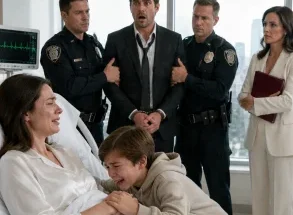
When he first brought it up, his voice was soft—almost rehearsed. “My mother shouldn’t be alone,” he said one evening, avoiding my eyes. “Since my father died… the house feels empty for her.”  I listened, because I understood loss and responsibility, but I also understood something he didn’t say out loud—marriage is not meant to erase your own life.
“I respect her,” I answered carefully, “but I don’t think moving in together is right for us.” It was a simple sentence, yet silence followed it like a shadow.  Something in him shifted in that moment, not loudly, not immediately, just enough for the air between us to feel different.
What happened next didn’t feel real at first. It was too fast, too sudden, a moment that didn’t belong in a conversation between two people who claimed to love each other. A sharp movement, a flash of disbelief, a sound I still can’t fully place in words  —and then stillness. Not peaceful stillness, but the kind that breaks something inside a room. I didn’t scream or move at first, because my mind refused to accept that the person in front of me had crossed a line I didn’t even know existed between us.
Then he simply turned away, as if nothing had happened, as if I wasn’t even there anymore. He lay down, pulled the blanket over himself, and within minutes his breathing slowed into sleep  , as though reality could be switched off just by closing his eyes.
I stayed awake, not because I knew what to do, but because I didn’t. Everything familiar had collapsed in a single moment, leaving only confusion, fear, and unanswered thoughts. So I did the only thing I could think of—I called his mother  .
.
Her voice was sharp even before I finished speaking, then it changed completely, not softer but colder, more alert. “What did you say happened?” she asked again, and I repeated it once, then again, until silence stretched between us. It wasn’t the kind of silence you wait through—it was the kind that decides things. Then she hung up.
An hour later, the knock came  , not polite, not uncertain, but final. She didn’t greet me or ask questions; she simply walked past me like a storm already in motion, and I followed because my body reacted before my thoughts could.
When the bedroom door opened, he was still asleep, and for a brief second everything looked normal again—until her voice shattered that illusion. “I raised you better than this,” she said, controlled at first, then burning  . He woke up confused, disoriented, until he saw her face and realized something was very wrong.
“What are you talking about?” he started, but she didn’t let him finish. Her words weren’t just anger, they were judgment—years of expectations collapsing into one moment of truth. “You don’t get to call yourself a husband if this is how you behave,” she said firmly, and the room seemed to shrink with every word. He tried to respond again, but she lifted her hand slightly—not to hit, just to silence him, and it worked.
Then she turned to me for the first time since arriving. Her expression wasn’t soft, but it was certain. “Listen carefully,” she said, and I did, because something in her tone demanded it. “There is no family where respect does not exist,” she continued, “and no home where fear replaces it.” Then she added more quietly, “You don’t fix relationships by breaking the person beside you.”
The silence that followed wasn’t empty—it was heavy, filled with understanding that arrived too late for excuses. Then she left the same way she came, without drama or final words, only footsteps fading into the night  .
.
He sat there afterward, not speaking or defending himself, just still, as if for the first time he was hearing his actions without the noise of justification around them. And me—I didn’t feel victory or revenge. I felt something quieter, clearer  , because sometimes life doesn’t change through dramatic endings, but through the moment someone else finally says what you were too shaken to name.
That night didn’t just break something. It revealed what had been unstable for a long time. And once you see it… you can’t unsee it.