My parents rushed to protect my sister, not my child.
I did not scream at them.
I did not beg them to care.
I called an ambulance, gathered every piece of proof, and one month later, when the judge read the sentence aloud, my entire family started screaming.
I will never forget that sound.
Not the birthday playlist drifting across the backyard.
Not the grill popping under burgers.
Not the sticky smell of frosting softening in the afternoon heat.
Not even my mother calling everyone toward the patio because she wanted one nice family picture before the cake melted.
The sound I will never forget was aluminum meeting bone.
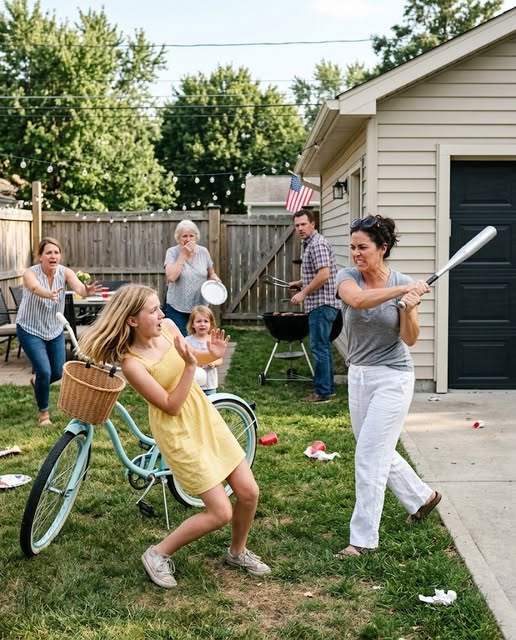
One second, my daughter Emma was standing near the garage in her yellow summer dress with one hand hovering near the bike she had saved for all year.
The next second, she was on the grass, folded around herself, gasping like the air had been ripped out of the world.
For one frozen moment, no one understood what had happened.
Then Emma tried to breathe.
That was when the party ended, even if the music kept playing.
My name is Anita Brooks.
I had turned forty that morning with the foolish little hope that one day could belong to me without my family finding a way to turn it into a trial.
My husband had strung lights along the fence the night before.
Emma had helped decorate cupcakes at the kitchen island, getting pink frosting on her thumb and pretending not to lick it off when she thought I was not watching.
We had grocery bags still on the counter, a cooler full of drinks by the porch, paper plates stacked under a napkin weight, and a small American flag clipped near the backyard gate because my husband never remembered to take it down after Memorial Day.
It was ordinary.
That is the part people never understand about the worst day of your life.
It usually begins with ordinary things.
My sister Vanessa arrived late, because Vanessa had never believed arrival times applied to her.
She came through the side gate wearing oversized sunglasses, white linen pants, and the kind of smile that made people shift around her mood before she had even said a word.
Her daughter Brooklyn came in behind her, already bored.
Brooklyn was not an evil child.
She was a child who had learned, very young, that wanting something loudly usually worked because her mother would make everyone else uncomfortable enough to give in.
She found Emma’s bike almost immediately.
The bike leaned carefully against the garage, away from the crowd.
Pale blue frame.
White tires.
A wicker basket Emma had bought with her own money.
She had saved birthday cash, allowance, and chore money for almost a year.
My husband and I helped cover the final amount, but Emma never treated that bike like a gift.
She treated it like proof.
She polished the frame after every ride.
She checked the tires before putting it away.
She parked it where no one would bump it with a lawn chair or drag a cooler against the pedals.
Brooklyn walked straight to it and said, “I want to ride that.”
Emma looked uncomfortable, but she stayed polite.
“I’m sorry,” she said. “I’m not letting anyone ride it yet.”
That should have been the end.
Her bike.
Her work.
Her answer.
But Vanessa heard the word no and treated it like an attack.
“Emma,” she snapped from across the yard, “let Brooklyn use it. Don’t be selfish on your mother’s birthday.”
Emma’s cheeks turned pink.
She looked around at the relatives who had suddenly gone quiet, then back at her aunt.
“It’s new,” she said softly. “I just don’t want anything to happen to it.”
Vanessa gave a cold little smile.
“You hear that, Brooklyn? Your cousin thinks her bike is too good for you.”
I stepped in before the moment could turn uglier.
“Vanessa, Emma said no. Brooklyn can ask another time.”
My sister’s smile vanished.
“You’re raising her to be greedy,” she said.
Greedy.
My daughter had spent a year earning something, protected it carefully, and said one calm word.
No.
In my family, that had always been enough to make you the villain.
My parents raised Vanessa and me in a house where peace meant doing whatever the loudest person wanted.
If Vanessa cried, I was told to share.
If Vanessa lied, I was told not to embarrass her.
If Vanessa broke something, I was asked why I had left it where she could reach it.
By the time we were adults, my parents called that love.
I called it training.
I had been trained to step aside.
Emma had not.
That was one of the things I was proudest of, even before I understood what it would cost her.
For a while, the party pretended to recover.
The music started again.
People went back to their drinks.
My father asked my husband about the grill as if nothing had happened.
My mother complimented the cupcakes.
Vanessa laughed too loudly near the patio table, but I could feel her anger sitting in the yard like a storm that had not moved on.
At 3:18 p.m., Emma went inside to use the bathroom.
I remember the time because later, when everything became dates and files and statements, my husband’s phone still had a video from 3:11 p.m. of everyone singing near the cake.
The side garage camera also saved motion clips by the minute.
That camera had been installed because packages kept going missing from our driveway.
I never imagined it would become the quietest witness at my daughter’s birthday party.
When Emma came back outside, Brooklyn was already on the bike.
Vanessa sat in a lawn chair nearby, sipping wine, watching with a smirk that told me everything.
She had not misunderstood.
She had waited.
Emma rushed forward, panic breaking through her politeness.
“Brooklyn, please get off,” she said. “I said no.”
Brooklyn whined, “Mom, she’s being mean.”
Vanessa stood.
I saw her face change.
It was quick, but I saw it.
Something ugly and satisfied moved across her expression before anger covered it.
She turned toward the garage and grabbed the aluminum baseball bat my husband had left near a bucket of softballs from the kids’ game earlier.
My blood went cold.
“Vanessa,” I warned.
But she was already moving.
Fast.
Focused.
“You little brat,” she hissed at Emma. “You think everything belongs to you?”
Emma froze.
She did not have time to step back.
The bat swung.
The sound cut through the party.
Emma dropped.
For half a second, the backyard became silent.
Then my husband ran toward her.
I ran too.
Someone dropped a plate.
Brooklyn started crying.
The grill kept making those small popping sounds.
The string lights swayed over the fence.
My mother’s hand stayed pressed against her necklace.
My father stared at the bat in the grass and then looked away from it, as if not seeing the evidence could make it stop being true.
Vanessa let the bat slip from her hand, then immediately pointed at my daughter lying on the grass.
“She attacked Brooklyn,” she shouted. “I was protecting my child.”
I stared at her.
Emma could barely breathe.
Her face had gone white.
Her hands clawed weakly at the grass.
She was fourteen years old.
A child.
And my sister was already building a lie over her body.
My mother rushed across the yard.
Not to Emma.
To Vanessa.
“Oh, honey,” she said, grabbing my sister’s arms. “Are you all right?”
Are you all right?
My daughter was on the ground gasping, and my mother was comforting the woman who had hit her.
My father stepped in front of me like I was the danger.
“Anita, calm down,” he said. “It was obviously an accident.”
An accident.
I looked at the bat in the grass.
I looked at Brooklyn standing untouched beside the bike.
I looked at Emma trying to inhale and failing.
Rage moved through me so fast I almost lost control.
For one ugly second, I pictured picking up that bat.
I pictured Vanessa stepping backward for once.
I pictured my parents finally looking afraid of the right person.
Then Emma made a small sound, and the fantasy vanished.
Anger could wait.
My daughter could not.
My husband shouted for someone to call 911.
I called myself because no one around me moved fast enough.
At 3:24 p.m., the dispatcher heard me say my sister had struck my daughter with a baseball bat.
At 3:31 p.m., the ambulance turned onto our street.
At 3:36 p.m., a paramedic knelt beside Emma while Vanessa stood ten feet away claiming she had protected Brooklyn.
The emergency room became a blur of white lights, rubber soles, sharp antiseptic, and words no mother should ever hear about her child.
Multiple fractured ribs.
Internal bleeding.
Possible lung complication.
Emergency surgery.
I sat in a plastic chair with my hands pressed together so hard my fingers went numb.
My husband cried silently beside me.
I kept seeing Emma on the grass in her yellow dress, eyes wide with confusion, as if she still could not understand why her aunt had done it.
She survived.
But the woman I had been before that party did not.
For three days, while Emma lay in a hospital bed with oxygen beneath her nose, my phone filled with messages from my family.
Vanessa said she had been under stress.
My mother said Emma had provoked the situation.
My father said pressing charges would destroy Vanessa’s life.
One cousin said Brooklyn was traumatized too.
Not one of them asked what it felt like to watch Emma wince every time she breathed.
Not one of them asked if she was scared.
Not one of them asked if she needed anything.
They did not want healing.
They wanted silence.
When Emma finally woke enough to speak clearly, she did not ask whether Vanessa was sorry.
She did not ask why Grandma had not visited.
She looked at me with tired eyes and whispered, “Am I in trouble?”
That broke something deep in me.
I leaned close, careful not to touch where she hurt.
“No, baby,” I said. “You are not in trouble.”
But someone was going to be.
I stopped answering family messages.
I stopped explaining.
I stopped handing them pieces of my pain so they could rearrange those pieces into excuses.
Instead, I started collecting proof.
Medical reports.
Hospital intake forms.
Photos of the bruising as the doctors instructed.
Witness names.
The 911 call log.
The police report.
The garage camera footage.
Text messages where Vanessa contradicted herself.
Every voicemail my parents left pressuring me to handle this privately.
Proof does not cry.
Proof does not get tired.
Proof does not soften itself so a guilty person can feel less exposed.
At 11:42 p.m. on the fourth night in the hospital, after Emma had finally fallen asleep, I sat under the harsh little light by her bed and scrolled through an old family group chat.
I was looking for one specific thing.
Years earlier, after too much wine at Christmas, Vanessa had bragged about a storage room.
Boxes.
Prescription bottles.
A side business she said was “none of the government’s business.”
At the time, I had been too tired to ask questions.
I had been tired of Vanessa’s boasting.
Tired of my parents pretending not to hear the parts that made them uncomfortable.
But I had not forgotten.
And Vanessa, arrogant as always, had sent photos because she thought everyone would admire how clever she was.
The photos were still there.
So were the messages.
Labels visible.
Dates visible.
Her own jokes beneath them.
For the first time since Emma was hurt, I smiled.
Not because I was happy.
Because I finally understood that Vanessa had handed me the thread that would unravel her whole life.
The next morning, I gave everything to the officer assigned to the case.
I did not accuse beyond what I could show.
I did not embellish.
I handed over screenshots, dates, names, and the storage-room photos exactly as they appeared.
The county prosecutor’s office later requested copies in a cleaner format, so my husband printed everything and put it in a folder with tabs.
Bat incident.
Hospital records.
Witness statements.
Messages.
Voicemails.
Storage room.
That was what my grief became.
A file.
A file can go places a daughter’s pain cannot.
It can sit on a desk.
It can be stamped.
It can be read into a record.
It can make people answer questions they have spent their lives avoiding.
Vanessa’s attorney tried to paint the backyard as chaos.
He said children were upset.
He said Vanessa reacted in a panic.
He said no one meant for Emma to be hurt.
But the garage camera showed Vanessa walking toward the bat.
It showed Emma with empty hands.
It showed Brooklyn already off balance on a bike she had been told not to touch.
It showed my sister raising the bat before Emma had even stepped into her space.
There are lies that sound believable until a timestamp enters the room.
My parents still tried.
My mother left a voicemail saying, “Please, Anita, don’t do this to your sister.”
My father texted, “You are going to tear this family apart.”
I stared at that message for a long time.
Then I typed back one sentence.
Vanessa did that when she hit Emma.
After that, I blocked him.
One month later, we walked into court.
Emma’s steps were slower than they used to be.
She held my hand with the same grip she had used when she was little and afraid of thunder.
My husband walked on her other side.
Vanessa stood near the front without sunglasses, without her smirk, without the bright arrogance she had worn in my backyard.
Her lawyer kept whispering to her.
She kept nodding like nodding could still make the world organize itself around her.
My parents sat behind her.
They glared at me as if I were the one who had swung the bat.
I did not look at them for long.
I looked at Emma.
She was still healing.
Still pale.
Still flinching when she took too deep a breath.
But she was there.
That mattered.
When the judge lifted the stapled packet from the bench, the courtroom went still.
He described the assault in plain words.
He described the injury.
He described the attempted blame.
He described the evidence that proved Emma had not attacked anyone.
Vanessa’s face changed with every sentence.
My mother started crying quietly, not for my daughter, but for the adult woman finally being named correctly in public.
Then the judge read the sentence.
He sentenced Vanessa to prison.
He denied the soft version of the story.
He ordered restitution tied to Emma’s medical costs.
He said the court had reviewed the attempts to pressure the victim’s family into silence and found them deeply troubling.
My mother made a sound like something had been torn out of her.
My father stood halfway up and shouted, “This is ridiculous!”
The bailiff told him to sit down.
But the judge was not finished.
He turned to the additional packet that had been submitted after the assault investigation began.
He stated that separate evidence had been referred for further review by the proper authorities.
He did not need to say every detail.
Vanessa understood.
My parents understood.
I understood.
The old photos.
The prescription bottles.
The storage room.
The side business Vanessa had laughed about because she thought family silence was the safest place in the world to hide.
My sister turned toward me then.
For the first time in my life, she did not look superior.
She looked betrayed.
That almost made me laugh.
People like Vanessa always think consequences are betrayal.
They do not see the harm as the rupture.
They see the refusal to hide it as the crime.
My mother whispered my name across the aisle.
“Anita.”
There was a time that would have pulled me toward her.
There was a time I would have explained myself, softened my voice, made my pain smaller so she could stand beside the wrong person without feeling too cruel.
That time was gone.
I put my arm around Emma and faced forward.
Vanessa started screaming when the bailiff moved closer.
My father shouted again.
My mother sobbed into her hands.
Brooklyn cried in the back row, confused and frightened, and for her I did feel sorrow.
She had been raised inside Vanessa’s weather.
She had learned entitlement from the person who should have taught her care.
But feeling sorry for a child did not require sacrificing mine.
Emma leaned against me when the courtroom noise rose.
Her hand found mine.
“Mom,” she whispered.
“I’m here,” I said.
And I was.
Fully.
Finally.
After court, my parents tried to corner me in the hallway.
My father said, “You went too far.”
My mother said, “She is your sister.”
I looked at both of them and thought about every family dinner where I had swallowed my hurt for peace.
Every holiday where Vanessa’s cruelty got explained away as stress.
Every time my daughter watched adults bend around a bully and call it love.
Then I said, “Emma is my daughter.”
My mother’s mouth trembled.
My father looked furious.
Neither of them had an answer.
There are some sentences that sound small until they close a door.
Emma is my daughter.
That was mine.
In the months that followed, Emma healed slowly.
Not cleanly.
Not like a movie.
She hated the breathing exercises.
She cried the first time she saw the yellow dress folded in the laundry room.
She refused to look at the bike for weeks.
My husband moved it into the garage and covered it with an old sheet because even something loved can become painful when it is standing too close to a memory.
We went to follow-up appointments.
We kept copies of every bill.
We met with the victim advocate in a plain office with a wall map of the United States and a coffee machine that sounded like it was fighting for its life.
Emma returned to school part-time.
Her friends made her cards.
One teacher quietly arranged for her to leave class early so she did not get bumped in the hallway.
Little by little, the world widened again.
One Saturday morning, Emma stood in the garage and stared at the covered bike.
I did not push.
I just stood near the doorway with a cup of coffee going cold in my hand.
After a long time, she pulled the sheet off.
The pale blue frame caught the morning light.
The wicker basket was still crooked from the day Brooklyn had climbed on it.
Emma touched the handlebar.
Then she looked at me.
“I still want it,” she said.
I nodded because my throat had closed.
“Then it’s still yours.”
She did not ride it that day.
She just wiped dust from the bell with the edge of her sleeve.
That was enough.
Healing is not always a grand return.
Sometimes it is a child touching something stolen from her and deciding the thief does not get to keep it.
Vanessa’s case did not give us back the birthday party.
It did not erase the sound.
It did not make my parents become the grandparents Emma deserved.
But it gave my daughter something my family had tried to take from her before and after the bat ever swung.
It gave her the truth in public.
It told her she was not greedy for saying no.
She was not difficult for protecting what she had earned.
She was not in trouble because an adult could not control her rage.
Near the end of summer, Emma rode the bike again.
Just down the driveway at first.
Then to the mailbox.
Then around the block with my husband walking beside her like a nervous parade marshal.
When she came back, her cheeks were flushed and her smile was small, but real.
The bell rang once.
Clear.
Bright.
Hers.
I thought then about the sound I would never forget.
The crack of aluminum meeting bone.
I will carry it for the rest of my life.
But I will carry another sound too.
A bicycle bell in a quiet neighborhood.
My daughter breathing.
My daughter saying no.
My daughter learning that no can be protected.
That day in court, my family screamed because the truth finally became louder than they were.
And for once, nobody asked Emma to make herself smaller so Vanessa could feel safe.