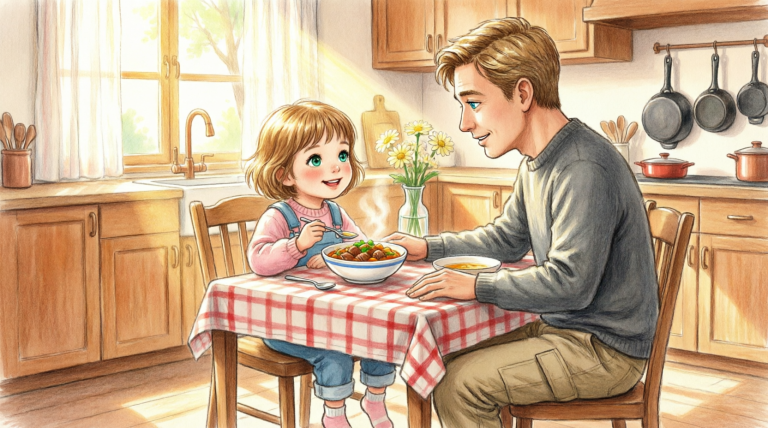
My sister left her five-year-old daughter with me for three days, and I thought I’d only have to put on cartoons and heat up some food. But on the first night, when I served her a bowl of homemade beef stew, the little girl didn’t even touch her spoon. Instead, trembling, she asked me: “Uncle… am I allowed to eat today?”
Part 2
I noticed an open seam on the doll’s belly.
It wasn’t a normal tear.
It had fresh, clumsy stitches made with black thread, as if someone had sliced it open and hurriedly sewn it back together. Ruby was clutching the doll tightly against her chest, but a tiny piece of white plastic was poking through her fingers.
A tracker.
I didn’t need Paula to explain a single thing to me. Sergio hadn’t guessed where my niece was. He had followed her.
“Ruby,” I said softly, “hand me the doll.”
She squeezed it tighter.
“He gets mad if I lose it.”
The knocks came again.
Three.
Slow.
“Robert,” Sergio called from outside. “Let’s not make a scene for the neighbors. Open up and let’s talk like family.”
Like family.
The phrase made my blood boil.
I took Ruby by the hand and led her into the kitchen, away from the front door. My house was located on a quiet street near South Congress, the kind of neighborhood where at night you can still hear the occasional car passing over the bridge, the echo bouncing off the walls. I had always considered it a safe area. Tonight, I understood that no street is safe if danger carries a copy of your key, a smile, and permission to enter.
“Paula,” I whispered into the phone, “call 911 right now. Go.”
“I already did,” she cried on the other end. “Robert, listen to me. He has keys to your house.”
I froze.
“What?”
“Months ago, he asked me for your spare copy ‘just in case something ever happened to you.’ I was such an idiot.”
I didn’t have time to reply.
The deadbolt clicked.
Sergio was putting the key in the lock.
I scooped Ruby up all at once and ran into the laundry room. I locked the door from the inside and shoved the washing machine with all my strength until it wedged tightly against the frame. Ruby didn’t scream. That was the worst part. A normal child would have cried, would have asked what was happening. She just balled herself up in my arms and placed her tiny hand over my mouth.
“Shh,” she whispered. “If we don’t make any noise, sometimes he goes away.”
Outside, the front door swung open.
Sergio’s footsteps entered my house as casually as if he were walking into his own backyard.
“Where are you, champion?” he said, using that warm, friendly tone he always put on during family dinners. “Look, I know you got scared. Paula exaggerates everything. You know how she is.”
Ruby began to tremble violently.
I dialed 911 with the speaker turned off.
A dispatcher answered. I gave her my address in a low whisper, doing the best I could. I said “domestic violence,” “minor involved,” “intruder inside my house,” “suspected camera in a child’s bedroom.” The woman didn’t interrupt me. She only instructed me to keep the line open and avoid confronting the aggressor.
Sergio was walking through the living room.
I heard him lifting things up.
The chair.
A glass.
The plate where Ruby had just eaten her dinner.
“Ah, so you did eat, princess,” he said.
Ruby closed her eyes and wet herself.
She didn’t make a sound.
I felt something inside me break forever.
“It’s okay,” I whispered into her ear. “It’s okay, my love. I’m right here with you.”
On the other side of the wall, Sergio reached the kitchen.
“Robert, don’t be ridiculous. That girl has behavioral issues. Paula can’t handle her. I was just instilling structure.”
The word structure made me sick to my stomach.
I knelt next to Ruby, took her doll, and found the uneven seam. She looked at me with sheer terror.
“I’m not going to throw it away,” I promised her. “I’m just going to take out something that shouldn’t be inside.”
Using a small pair of scissors from my sewing kit, I snipped the fabric belly open. Inside was old cotton stuffing, a tiny Ziploc bag, and a small, round tracking device. I stomped on it with my heel until it crunched.
Sergio went completely silent outside.
Then, he pounded on the laundry room door.
“That was a very bad idea.”
Ruby began to chant under her breath:
“I’m sorry, I’m sorry, I’m sorry.”
I wrapped my arms tightly around her.
“You have absolutely nothing to apologize for. Do you hear me? Nothing.”
Sergio shoved the door hard. The washing machine groaned against the floorboards.
“Open up.”
I didn’t answer.
“Open up, or I’ll tell everyone what Paula did. You think she’s innocent? You think your sister didn’t know?”
That sentence drove a painful wedge of doubt into my chest.
I looked at the phone. Paula was still on the parallel call, her breathing ragged, as if she were running.
“What did you do, Paula?” I asked.
It took her a long time to speak.
“I let him punish her.”
The silence that followed was worse than Sergio slamming against the door.
“Not like that,” she sobbed. “I swear to God I didn’t know about the camera. But I did let him send her to bed without dinner. He told me Ruby was manipulating me, that if I wasn’t firm, she would grow up ruined. I was so tired, Robert. I was afraid. I depended on him. And one day, I just stopped defending my daughter.”
I wanted to hate her.
In that moment, I did hate her.
But Ruby, who couldn’t fully comprehend everything, heard her mother weeping through the phone and whispered:
“Mommy is sad.”
That completely destroyed me.
Outside, a distant siren wailed.
Then another.
In Austin at night, sirens echo strangely between the old historic avenues and the highway grids. They sound close and far away at the same time, as if they were coming from Zilker Park and I-35 simultaneously. Sergio heard them too.
He stopped shoving the door.
“Robert,” he said, his friendly voice completely gone. “Think carefully about what you’re doing. That girl isn’t yours.”
I opened my phone’s camera app and started recording through the crack beneath the door.
“Say it again,” I replied. “Say it for the District Attorney.”
There was another silence.
Then Sergio laughed.
“You have nothing on me.”
Then Ruby, still wet and shaking, pulled away from me. She tugged at my sleeve.
“Uncle,” she said. “In the chair.”
“What?”
“Underneath the chair.”
I didn’t understand until she pointed her tiny finger toward the door.
The chair.
The one he used to block her door.
“What is underneath the chair, Ruby?”
She swallowed hard.
“The little black box. He hides it there when Mommy cleans.”
Sergio overheard.
He slammed against the door with such violence that the wood split slightly along the frame.
“Shut up!”
That word, screamed at a five-year-old girl, was what stripped away my remaining fear.
I didn’t open the door.
I didn’t go out.
I didn’t try to play the hero.
I simply put my body between the door and Ruby, while police cruisers screeched to a halt outside and neighbors began to peer out of their windows. Mrs. Higgins, the elderly lady from across the street who sold baked goods on weekends and always knew everything before anyone else, shouted from the sidewalk:
“The cops are here, you bastard!”
Sergio bolted toward the exit.
But he didn’t get far.
Two local police officers entered cautiously—one through the front door and the other through the side gate leading to the yard. They ordered him to the ground. Sergio threw his hands up immediately, instantly playing the victim of a misunderstanding.
“Officers, I’m her stepfather,” he said. “I came for the girl because they have her hidden away.”
“He is not her stepfather,” I yelled from the laundry room. “He doesn’t have custody. The child is terrified.”
When I finally managed to shift the washing machine and open the door, Ruby clung to my leg. An officer knelt down to talk to her, but she hid her face.
“Please don’t touch her,” I requested. “Please.”
A representative from the victim services unit arrived. She didn’t have the cold look of a bureaucrat. She brought a thermal blanket, water, and a voice that didn’t crowd the room. She asked Ruby if she wanted to sit down. She didn’t tell her “don’t cry.” She didn’t say “be brave.” She only said:
“You get to decide if you want to talk right now or later.”
Ruby looked at her as if she were being offered an entirely new language.
Part 3
Half an hour later, my house looked like a crime scene from a television show. Yellow tape, flashing lights, neighbors standing around in bathrobes, the harsh overhead light of the dining room shining down on the now-cold beef stew. Sergio was sitting on the curb, handcuffed, wearing the exact same crisp blue shirt he wore when he brought flowers to our family gatherings.
He was no longer smiling.
Paula arrived around two in the morning.
She hadn’t been in Dallas.
She had been hiding at a coworker’s house in West Lake Hills, where she had spent the day gathering the courage to file a report. She stepped out of a cab with her hair loose, no makeup, and a wrinkled blouse. The moment she saw Ruby, she broke down completely.
“My baby girl.”
Ruby didn’t run to her.
She stayed glued to my side.
Paula understood.
She stopped three paces away and sank to her knees on the pavement.
“Forgive me,” she said. “Forgive me, Ruby. I was supposed to protect you.”
The little girl stared down at the ground.
“Am I allowed to eat today, Mommy?”
Paula clapped her hand over her mouth to stifle a scream.
I had to look away, staring up at the city skyline, because if I looked at my sister, I was going to say something that wouldn’t help anyone. The city remained beautiful and indifferent, with its flashing lights and clean streets, as if the world could simply go on being lovely while a child had to ask permission to feed herself.
The victim services advocate spoke with Paula. Shortly after, representatives from Child Protective Services arrived. They threw around legal terms that I could barely process: failure to protect, child abuse, emergency protection orders, psychological evaluation, legal representation for minors.
Paula handed over her phone.
That was where the worst of it lay.
It wasn’t just the hidden camera.
There were text messages from Sergio to a friend, mocking the punishments. Photos of the list. Audio clips where he told Paula that a child “either breaks early or grows up useless.” And a video of Ruby crying behind a locked door while he wedged a chair against it from the outside, telling her that good girls don’t cause problems.
They didn’t let me see any more than that.
Thank God.
The police searched Paula’s house that very same morning; she authorized the entry. I rode with Ruby in the ambulance for a medical evaluation, though she refused to let go of my shirt fabric. At the Children’s Hospital, they checked her stomach, her hydration levels, and the small bruises that she automatically explained away as “I fell.”
Every “I fell” felt like a stone crushing my chest.
At six in the morning, the city began to wake up.
A pale grey light filtered through the hospital window. Outside, someone was selling hot coffee and breakfast pastries to family members who had spent the night waiting for news. That smell of warm dough made me cry without warning, because I thought of all the times a person buys food without a second thought, and of Ruby asking if I would let her eat tomorrow, too.
She was sleeping on the cot wrapped in a pink blanket.
She was squeezing my finger.
Paula sat on the other side, not touching her. Her eyes were swollen, carrying the look of someone who had just seen the full extent of her own guilt, stripped of all excuses.
“They aren’t going to let me keep her, are they?” she asked.
“I don’t know.”
“It’s better this way,” she said, her voice trembling. “They shouldn’t let me have her back until I learn how to be her mother.”
It was the first right thing I had heard her say in a long time.
The days that followed were a blur of state offices, formal statements, and absolute exhaustion. We went to the Family Justice Center, then to the District Attorney’s office, then to CPS. I learned that justice doesn’t arrive like it does in the movies, with dramatic music and a clean resolution. It arrives with photocopies, signatures, endless waiting rooms, psychologists who speak in quiet tones, social workers who look you dead in the eye, and a little girl who draws a picture of a house with no doors.
Sergio tried to fight the charges.
He claimed it was all just discipline.
He claimed Paula was unstable.
He claimed I wanted to take Ruby away just to punish my sister.
But the black recording device beneath the chair held a digital memory. And inside that memory was his voice. His calm, everyday voice. The one that dictated when a little girl could eat and when it was simply her water day.
He was formally indicted and held for trial.
I didn’t understand all the legal jargon, but I understood perfectly when the CPS attorney told me:
“For now, Ruby is not returning to that home.”
My legs felt weak with relief.
Paula signed every single document she was required to sign. She accepted court-ordered psychological therapy, protective orders, and constant supervision. She didn’t fight the temporary guardianship order. She looked at me as we walked out of the family court building and said:
“Love her better than I could.”
“That won’t be very difficult to beat,” I replied.
It hurt her.
It hurt me to say it, too.
But it was the truth.
Ruby stayed with me.
In the beginning, she would hoard bread underneath her pillow. Folded tortillas inside her clothes drawers. A banana hidden behind her coloring supplies. The child psychologist told me not to scold her, explaining that her body was still processing the fact that food wouldn’t suddenly disappear as a punishment.
So, every single night, I left a small basket right next to her bed.
An apple.
Some crackers.
A small cup of water.
And a note written in large block letters:
“YOU CAN EAT WHENEVER YOU ARE HUNGRY.”
The first time she read it, she looked up and asked:
“Even if it’s nighttime?”
“Even if it’s nighttime.”
“Even if I’m not perfectly good?”
“Even if you act exactly like a normal kid.”
She didn’t smile.
But that night, she went to sleep with the note tucked beneath her pillow.
Weeks passed.
One Sunday, I took her to the local Farmers’ Market. The air was filled with chatter, flowers, smoking brisket, vendors selling fresh produce, and kids begging for fresh-squeezed orange juice. Ruby walked glued to my side, but she was no longer asking for permission just to look around. She stopped in front of a Tex-Mex food stand and pointed at some fresh cheese.
“Am I allowed to try some?”
The words “am I allowed” still squeezed my chest tight, but this time, her voice sounded different.
It wasn’t terror.
It was an old habit slowly breaking apart.
“Yes,” I told her. “And you can also say, ‘I want to.’”
Ruby crinkled her nose, concentrating hard.
“I want to try some.”
I bought her a small plate.
She ate slowly.
She blew on it.
She chewed.
Nobody took a single thing away from her.
Afterward, we walked down toward Congress Avenue Plaza. The trees provided a deep shade, and a street musician was playing a violin near a bench. The historic stone storefronts looked freshly washed by the afternoon sun. Ruby had a purple balloon tied to her wrist and a brand-new doll tucked inside her backpack—one with no strange seams, and no dark secrets hidden inside.
“Uncle,” she said suddenly.
“What’s up, sweetie?”
“Is my mommy bad?”
I sat down with her on a bench.
I took my time responding, because easy lies do their own kind of damage.
“Your mommy did some bad things,” I told her. “Very bad things. She didn’t protect you when she was supposed to protect you.”
Ruby looked up at her balloon.
“And Sergio?”
“Sergio is dangerous. And he is never going to get anywhere near you again.”
“Never?”
“I am going to do everything humanly possible to make sure it’s never.”
She thought about that for a moment.
Then, she asked:
“Am I good?”
I felt that familiar knot tighten in my throat.
I lifted her up into my arms and set her on my lap, looking out toward the plaza—at the people walking past buying ice cream, at the tourists taking photos, at the city that just kept moving forward.
“Ruby, you don’t have to earn your food. Or hugs. Or a bed to sleep in. Or leaving the lights turned on. Or having someone protect you. You don’t earn those things. You have a right to them simply because you are a child.”
Her eyes welled up with tears.
“Even if I make a mistake?”
“Especially when you make a mistake.”
She wrapped her arms around my neck.
She wasn’t stiff anymore.
Her tiny body completely relaxed against my chest, as if she could finally rest, even if just a little bit. She cried out loud without covering her mouth. I let her cry. The sounds of the plaza continued all around us—distant bells ringing and footsteps echoing on the pavement.
That night, when we got back home, I made a fresh batch of beef stew.
The exact same one.
With potatoes, carrots, and rice.
I set two plates on the table along with a warm tortilla wrapped in a cloth napkin. Ruby climbed up onto her chair. She looked down at the steaming stew. Then, she looked up at me.
For a split second, I feared that old question would return.
But it didn’t.
She picked up her spoon.
She blew on it.
And right before taking a bite, she said:
“Tomorrow I want eggs and beans.”
I laughed.
I couldn’t help myself.
“Tomorrow we are having eggs and beans.”
Ruby took her first spoonful. Then another. She ate peacefully, her legs swinging back and forth beneath the chair, getting a tiny bit of broth on her pajamas.
When she finished, she left her spoon inside the bowl and wiped her mouth with her sleeve.
“Uncle.”
“Tell me, sweetie.”
“I was actually hungry today.”
I looked at her.
She looked right back at me.
And then, she smiled.
It wasn’t a huge smile. It wasn’t a miraculous cure. It was barely a sliver of light peaking into a house that had been locked in darkness for far too long.
But through that sliver of light, I swear to you, life finally began to find its way back in.
Part 4 The weeks following the arrest felt like walking through a dense, suffocating fog. Every morning, I woke up with a start, my heart hammering against my ribs.
Part 4
The weeks following the arrest felt like walking through a dense, suffocating fog.
Every morning, I woke up with a start, my heart hammering against my ribs.
I would immediately rush down the hall to check on Ruby.
She was always there, curled up in the center of her bed.
She slept with the lights on, a habit we had not yet been able to break.
The basket of food remained by her bedside, untouched on some nights, completely devoured on others.
I learned to read her moods by the crumbs left behind.
The legal process began with a brutal, grinding slowness.
Discovery was a nightmare of paperwork and invasive questions.
Sergio’s defense attorney was a sharp, aggressive man named Vance who specialized in dismantling families.
He filed motions claiming I was an unstable bachelor with a history of erratic behavior.
He painted Paula as a negligent, emotionally fragile mother who had fabricated the entire narrative out of spite.
He even attempted to subpoena my medical records, looking for anything to discredit my character.
I sat in my lawyer’s office, staring at the stack of documents, feeling a cold rage simmer in my chest.
Paula sat across from me, her hands trembling as she clutched a cup of lukewarm tea.
She had lost weight.
Her eyes were hollowed out by guilt and the relentless stress of the impending trial.
She was attending court-mandated therapy three times a week.
Her therapist, a stern but compassionate woman named Dr. Aris, was helping her unpack decades of deeply ingrained trauma.
One afternoon, Paula came to my house and asked to speak with me in the kitchen.
She closed the door, ensuring Ruby was occupied with her coloring books in the living room.
She looked at me, her chin trembling, and finally spoke the words she had been holding back for years.
She told me about our mother, Evelyn.
She told me how Evelyn had systematically stripped away her self-esteem from the moment she could walk.
Evelyn had taught Paula that a woman’s primary duty was to maintain the peace, no matter the cost.
A woman was to be agreeable, quiet, and endlessly forgiving.
Sergio had recognized this vulnerability immediately and weaponized it.
He had isolated Paula from her friends, controlled the family finances, and slowly convinced her that her own perceptions of reality were flawed.
He called it gaslighting, though Paula didn’t know the term until Dr. Aris explained it.
He would move objects in the house and accuse her of losing them.
He would deny saying cruel things he had just whispered in her ear.
He made her believe she was going crazy, making her entirely dependent on his version of the truth.
When Ruby was born, Sergio’s control tightened.
He framed Ruby’s normal childhood defiance as a severe behavioral disorder that required his unique brand of discipline.
Paula had tried to intervene, but Sergio would turn the aggression toward her, threatening to leave her destitute.
He reminded her constantly that no one else would ever want her.
He told her she was a failure of a mother, and that he was the only one willing to stay and fix their broken family.
I listened to my sister unravel, and my heart broke into a million jagged pieces.
I wanted to go back in time and shake her, to scream at her to see the monster she was living with.
But I also knew that the trap of psychological abuse is designed to be inescapable.
I reached across the table and took her hand.
I told her that none of this was her fault.
I told her that surviving was the only thing that mattered right now.
She cried, a deep, guttural sound that seemed to tear through the walls of the kitchen.
It was the first time she had allowed herself to truly grieve the years she had lost.
Meanwhile, the prosecution was building our case.
Detective Miller, a seasoned investigator with a gentle demeanor, had uncovered something disturbing.
The tracking device found in Ruby’s doll was not a generic consumer product.
It was a specialized, high-end GPS tracker often used in corporate espionage or high-risk asset monitoring.
Miller traced the purchase back to a shell company, but the credit card used was linked to an account Sergio controlled.
More chillingly, Miller discovered that Sergio had been tracking Paula’s phone as well.
He knew her every move, every deviation from her routine.
He had been playing a long game, documenting her supposed instability to build a flawless custody case.
His end goal was not just control over Ruby.
It was total financial domination.
Evelyn, our mother, had set up a modest trust fund for Ruby years ago, intended for her education and well-being.
As Ruby’s legal guardian, Sergio would have had access to those funds.
He was not just a monster; he was a calculating predator who viewed his stepdaughter as an investment to be managed and liquidated.
When Miller showed me the financial records, the room spun.
The sheer, cold-blooded calculation of it made me physically ill.
I thought of Ruby asking if she was allowed to eat.
I thought of her wetting herself in silence to avoid making a sound.
I thought of the tiny, terrified girl who hoarded crackers under her pillow.
I made a silent vow in that sterile police station.
I would burn Sergio’s entire life to the ground before I let him anywhere near her again.
Part 5
The pre-trial hearings were a masterclass in psychological warfare.
Vance, Sergio’s attorney, was relentless in his attempts to paint me as the true villain of the story.
He dug into my past, unearthing a tragedy I had kept buried for over two decades.
When I was twelve years old, I had a younger cousin named Sarah who lived with us for a summer.
Sarah’s home life was volatile, and my parents had taken her in to give her a safe haven.
I was a child myself, desperate to be helpful, desperate to be the good nephew.
But I missed the signs.
I saw the bruises and accepted the lies about falling down the stairs.
I heard the shouting at night and told myself it was just an argument.
One evening, Sarah ran away into the night, terrified and alone.
She was found three days later, but the damage was done.
She was placed in the foster system, and I never saw her again.
The guilt of that failure had shaped my entire adult life.
It was the reason I became a social worker, the reason I checked on my neighbors, the reason I was so fiercely, obsessively protective of Ruby.
Vance brought this up in a pre-trial motion, suggesting that my trauma was making me project my past failures onto Sergio.
He argued that I was hysterical, overreacting to normal parental discipline because of my own unresolved guilt.
Reading those words in the legal filing felt like a physical blow to the stomach.
I sat in my car in the courthouse parking lot, gripping the steering wheel until my knuckles turned white.
I wanted to scream.
I wanted to drive my car through the courthouse doors and confront Vance myself.
But I took a deep breath, closed my eyes, and remembered Ruby’s face.
I could not let my past dictate her future.
I had to be the shield she needed, no matter what they threw at me.
Paula was struggling immensely with the depositions.
She had to sit in a room with Vance, who asked her leading, humiliating questions about her parenting.
He asked her if she believed she was a fit mother.
He asked her if she thought she deserved to have her daughter taken away permanently.
After one particularly brutal session, Paula came to my house in a state of absolute panic.
She was hyperventilating, pacing the living room, convinced that she was going to lose Ruby forever.
I made her sit on the couch and handed her a glass of water.
I told her to look at me.
I reminded her of the evidence we had.
I reminded her of the recordings, the tracker, the text messages.
I told her that the truth was on our side, even if the process felt like walking through fire.
She looked at me with tear-filled eyes and asked if Ruby would ever forgive her.
I didn’t lie to her.
I told her that forgiveness is a journey, not a destination.
I told her that Ruby’s healing would take time, and that Paula’s job was to show up, every single day, and prove through actions that she was changing.
That night, I went to check on Ruby.
She was awake, sitting up in bed, staring at the wall.
I sat on the edge of her mattress and asked her what was wrong.
She looked at me, her small face solemn and wise beyond her years.
She asked me if bad people can become good people.
My heart clenched.
I told her that people can change, but only if they do the hard work to fix what they broke.
I told her that her mommy was doing that hard work right now.
Ruby nodded slowly, processing the information.
She reached out and took my hand, her tiny fingers wrapping around my thumb.
She said she hoped her mommy could learn.
I kissed her forehead and told her I hoped so too.
The next day, Detective Miller called me with a breakthrough.
During a secondary search of Sergio’s home, conducted with a refined warrant, they found a hidden compartment in his home office desk.
Inside was a locked metal box.
When they drilled it open, they found a journal.
It was not just a diary; it was a meticulous log of his psychological operations.
He had documented every time he manipulated Paula, every time he starved Ruby, every time he planted a seed of doubt.
He wrote about it with chilling, clinical detachment.
He referred to Ruby as the project and Paula as the asset.
He detailed his plans to use the trust fund to buy a property in another state, completely cutting off the family.
This journal was the smoking gun.
It proved premeditation, malice, and a level of calculated cruelty that no jury could ignore.
When I read the excerpts provided by the prosecutor, I felt a cold, grim satisfaction.
Sergio had written his own confession.
He had documented his own evil.
And now, it was going to be the instrument of his destruction.
Part 6
The trial began on a rainy Tuesday in November.
The courtroom was packed with reporters, social workers, and a few curious neighbors.
The air was thick with tension and the smell of wet wool and floor wax.
Sergio sat at the defense table, wearing a tailored gray suit that cost more than my car.
He looked calm, composed, and utterly confident.
He caught my eye as I walked in and offered a small, condescending smile.
It took every ounce of my self-control not to lunge across the room and strangle him.
I took my seat behind the prosecutor, my jaw clenched so tightly it ached.
The judge, a stern woman named Judge Harrison, called the court to order.
The opening statements were a clash of two entirely different realities.
The prosecutor, a sharp, no-nonsense woman named ADA Lin, laid out the facts with surgical precision.
She spoke of the tracker, the hidden camera, the starvation, and the journal.
She painted a picture of a calculated predator who hid behind the facade of a concerned stepfather.
Then it was Vance’s turn.
He stood up and paced in front of the jury box, his voice dripping with faux sympathy.
He argued that this was a tragic case of a blended family gone wrong.
He claimed Sergio was a dedicated father figure trying to bring structure to a chaotic household.
He suggested that Paula was an unstable woman who had turned her daughter into a weapon to punish her husband.
He implied that I was an overbearing uncle who had orchestrated the entire investigation to seize control of the family.
It was a slick, persuasive performance designed to sow doubt.
I watched the jurors’ faces, searching for any sign of how they were receiving his words.
Some looked skeptical, while others seemed to be absorbing his narrative.
The first few days of the trial were a grueling parade of expert witnesses.
Child psychologists testified about the long-term effects of food deprivation and psychological terror on a developing brain.
They explained how Ruby’s hoarding behavior and her constant need for permission were classic trauma responses.
Digital forensics experts took the stand to explain the GPS tracker and the hidden camera.
They demonstrated how the camera had been positioned to capture Ruby’s bed, and how the audio recordings had been systematically deleted and recovered.
Each piece of evidence was a hammer blow to Sergio’s defense.
But Vance fought back fiercely.
He cross-examined every witness, trying to find minor inconsistencies to exploit.
He tried to discredit the psychologist by asking if children sometimes lie to get attention.
He tried to confuse the tech expert with jargon about cloud backups and data corruption.
It was exhausting to watch, but ADA Lin held her ground, shutting down his attempts to muddy the waters.
Then came the day I had been dreading and anticipating in equal measure.
It was time for the forensic interview with Ruby to be presented.
Because of her age and the sensitive nature of the case, Ruby would not testify in open court.
Instead, a video of her interview with a specialized child advocate would be played for the jury.
I sat in the courtroom, my hands clasped tightly together, bracing myself.
The lights dimmed, and the screen flickered to life.
There was Ruby, sitting in a brightly colored room with soft toys and a gentle interviewer named Sarah.
Ruby looked small, her legs dangling from the oversized chair.
She was holding the new doll I had bought her, the one with no seams.
Sarah asked her gentle, open-ended questions.
She asked Ruby to tell her about the rules in her house.
Ruby’s voice was barely a whisper, but the microphones picked it up clearly.
She talked about the list of rules.
She talked about water days.
She talked about the chair blocking the door.
When Sarah asked her about the doll, Ruby’s demeanor changed.
She looked down at her lap, her shoulders hunching inward.
She said that Sergio put a secret inside the doll’s tummy.
She said he told her it was a magic button that would keep her safe, but it made her feel sick.
She said she was scared to tell anyone because he said bad things would happen to her mommy if she did.
A collective, sharp intake of breath echoed through the courtroom.
I felt a tear slide down my cheek, hot and fast.
I didn’t wipe it away.
I let it fall.
On the screen, Ruby looked up at Sarah, her eyes wide and impossibly sad.
She asked if her uncle was going to be mad at her for breaking the doll.
Sarah assured her that her uncle loved her very much and would never be mad.
Ruby nodded, but she didn’t look convinced.
The video ended, and the lights came back on.
The courtroom was utterly silent.
Even Vance looked momentarily stunned by the raw, unfiltered innocence of the child’s testimony.
I looked at Sergio.
His jaw was clenched, a muscle ticking in his cheek.
For the first time, his mask of calm confidence slipped, revealing a flicker of genuine panic.
He knew the jury had seen the truth.
Part 7
The trial entered its second week, and the atmosphere in the courtroom grew increasingly volatile.
Sergio’s defense team was scrambling, realizing that the video testimony had severely damaged their narrative.
Vance called a surprise witness, a private investigator he had hired.
The PI testified that he had observed me acting erratically outside Paula’s house in the months leading up to the arrest.
He claimed I was pacing, muttering to myself, and peering through the windows.
It was a desperate attempt to paint me as a stalker, an unstable man obsessed with controlling his sister’s life.
ADA Lin tore the witness apart on cross-examination.
She forced him to admit that he had been paid a substantial retainer by Sergio.
She made him admit that his observations were taken entirely out of context, ignoring the fact that I was often there to drop off groceries or check on Ruby after school.
The jury saw right through the tactic.
But the damage was done in the sense that it prolonged the agony and forced me to relive my own anxieties.
I had been anxious.
I had suspected something was wrong long before the arrest.
I had felt a growing, inexplicable dread whenever I left Ruby in Sergio’s care.
That intuition had saved her, but in the courtroom, it was being twisted into a symptom of madness.
After the court adjourned that day, I found Paula waiting for me in the hallway.
She looked exhausted, her eyes red-rimmed and swollen.
She had been attending every single day of the trial, sitting in the back row, forcing herself to hear the lies being told about her.
It was part of her therapy, a form of exposure to confront the reality of what she had allowed to happen.
She walked up to me, her hands shaking.
She told me she couldn’t take it anymore.
She said hearing them talk about her like she was a monster was breaking her.
She wanted to quit, to settle, to just take whatever supervised visitation they offered and disappear.
I grabbed her by the shoulders, gently but firmly.
I looked her dead in the eyes.
I told her that she did not get to quit.
I told her that Ruby was watching, even if she wasn’t in the room.
I told her that every time she showed up, every time she endured this pain, she was proving to her daughter that she was finally fighting for her.
I reminded her of the little girl who asked if she was allowed to eat.
I asked Paula if she wanted that to be the legacy of her motherhood.
Paula broke down, sobbing into my shoulder.
I held her, letting her cry, letting her release the pressure that had been building for years.
When she finally pulled away, she wiped her face with the back of her hand.
Her expression had changed.
The fragility was gone, replaced by a hard, determined resolve.
She told me she was ready for the next step.
She told me she was going to take the stand.
The prospect of Paula testifying was terrifying.
Vance would undoubtedly try to destroy her credibility, using her past admissions of negligence against her.
But Paula insisted.
She said she had to look the jury in the eye and tell them the truth, without excuses, without deflection.
The night before her testimony, I went to Ruby’s room.
She was asleep, but I sat by her bed for a long time, just watching her breathe.
I thought about the long road ahead.
The trial was ending, but the healing would take years.
There would be nightmares, setbacks, and difficult conversations.
But as I looked at her peaceful face, I knew we would face it together.
I whispered a promise to her, a vow that no one would ever hurt her again.
I didn’t know if she heard me, but I needed to say it out loud.
The next morning, the courtroom was packed to capacity.
Paula walked to the witness stand, her posture straight, her head held high.
She wore a simple navy-blue suit, looking professional and grounded.
She placed her hand on the Bible and swore to tell the truth.
ADA Lin began the direct examination gently, allowing Paula to tell her story in her own words.
Paula spoke about her upbringing, her vulnerabilities, and how Sergio had exploited them.
She did not shy away from her failures.
She admitted that she had ignored the signs.
She admitted that she had let him isolate her.
She admitted that she had allowed him to punish Ruby because she was too afraid to stand up to him.
The honesty was staggering.
It was not the testimony of a defensive, guilty parent.
It was the testimony of a survivor taking full accountability.
When it was Vance’s turn to cross-examine, he came out swinging.
He tried to trap her, asking if she was just making up this narrative of abuse to save herself from prison.
He asked if she really expected the jury to believe she was a victim when she was the adult in the room.
Paula looked at him, her gaze steady and unflinching.
She said, “I was a victim of his manipulation, but I was also an enabler of his abuse.”
She looked directly at the jury.
“I failed my daughter. I will carry that guilt for the rest of my life.”
Then, she turned her head and looked directly at Sergio.
For the first time in years, she did not look away.
She did not shrink.
She looked at the man who had controlled her, and her voice rang out, clear and strong.
“But I am not afraid of you anymore.”
The courtroom was so silent you could hear a pin drop.
Sergio’s face drained of color.
He looked down at the table, unable to meet her gaze.
Vance tried to recover, asking another question, but the momentum had shifted entirely.
Paula had taken back her power.
She had broken the spell
The climax of the trial arrived with the closing arguments.
The air in the courtroom was electric, charged with the weight of the preceding weeks.
Vance went first, delivering a passionate, albeit desperate, plea for reasonable doubt.
He tried to reframe the journal as the ramblings of a stressed man, not a blueprint for abuse.
He argued that the tracker was a safety measure, not a tool of surveillance.
He painted a picture of a flawed but loving family that had been torn apart by an overzealous uncle and a vengeful ex-wife.
It was a compelling performance, but it felt hollow, lacking the anchor of truth.
Then, ADA Lin stood up.
She did not pace.
She did not raise her voice.
She stood perfectly still at the podium and spoke directly to the jury.
She reminded them of the facts.
She reminded them of the tracker hidden in a five-year-old’s doll.
She reminded them of the camera hidden in the bedroom.
She reminded them of the audio recordings of a child crying behind a locked door.
She held up a printed copy of Sergio’s journal.
She read a single, chilling excerpt aloud.
“The asset is responding well to the deprivation protocol. Compliance is increasing.”
She let the words hang in the air, heavy and suffocating.
She looked at each juror, one by one.
She asked them to look at the defense table, at the man who wrote those words.
She asked them if this was the behavior of a concerned stepfather, or a calculating predator.
She told them that justice was not about punishing a flawed family.
It was about protecting a child who had no voice, no power, and no one to turn to except the people in this room.
She concluded with a simple, powerful statement.
“Do not let him get away with it.”
When she sat down, the tension in the room was palpable.
The jury was dismissed to deliberate.
The waiting was agonizing.
Hours stretched into days.
We were told it was a complex case, and they needed time to review the evidence.
I spent the waiting time at home with Ruby.
We fell into a new, fragile routine.
We went to the park.
We baked cookies, making a huge mess with the flour.
We read books, and for the first time, she started to laugh at the silly voices I made for the characters.
It was a laugh that sounded like wind chimes, a sound I realized I had been starving for.
One afternoon, while we were drawing at the kitchen table, Ruby looked up at me.
She asked if the bad man was going to come back.
I put my pencil down and looked her in the eyes.
I told her that there were very smart people working right now to make sure he never could.
I told her that I would stand in front of the door every single night to keep him out.
She nodded, seemingly satisfied with the answer.
She went back to her drawing, which depicted a large house with a bright yellow sun and three stick figures holding hands.
It was a masterpiece.
On the fourth day of deliberations, we received a call.
The jury had reached a verdict.
The drive to the courthouse was a blur of gray skies and pounding rain.
Paula rode with me, her hands clasped tightly in her lap.
We walked into the courtroom, our hearts beating in unison.
Sergio was already there, looking pale and drawn, his expensive suit hanging loosely on his frame.
The bailiff called the court to order.
The jury filed in, their faces unreadable.
The clerk stood and read the verdict.
On the charge of aggravated child abuse, we find the defendant guilty.
On the charge of unlawful surveillance, we find the defendant guilty.
On the charge of endangering the welfare of a minor, we find the defendant guilty.
The word guilty echoed through the room, ringing like a bell.
I let out a breath I felt like I had been holding for months.
Paula buried her face in her hands, her shoulders shaking with silent sobs.
This time, they were tears of relief.
The judge turned to Sergio.
She spoke to him with cold, unyielding authority.
She told him that his actions were a profound betrayal of trust.
She sentenced him to fifteen years in state prison, with no possibility of parole for the first ten.
As the bailiffs moved to handcuff him, Sergio finally broke.
He turned to Paula, his eyes wild and desperate.
He started to speak, to beg, to blame her.
But Paula did not look at him.
She kept her eyes fixed straight ahead, her chin held high.
She had nothing left to say to him.
He was led out of the courtroom, the heavy wooden doors closing behind him with a final, resounding thud.
It was over.
Part 9
The aftermath of the trial was not a sudden, magical fix.
Healing is not a straight line; it is a messy, winding path with setbacks and steep climbs.
But the heavy, suffocating cloud of imminent danger had finally lifted.
Sergio was gone.
The legal guardianship was officially granted to me, with a carefully structured, court-monitored visitation plan for Paula.
The first few months were about rebuilding the foundation of Ruby’s world.
We worked with a specialized trauma therapist who used play therapy to help Ruby process her experiences.
There were difficult days.
There were nights when she woke up screaming from nightmares, convinced that the chair was blocking the door.
On those nights, I would sit on the floor beside her bed, holding her hand until her breathing slowed and the morning light crept through the blinds.
I never told her to stop crying.
I never told her it was just a dream.
I simply validated her fear and reminded her that she was safe now.
Paula’s journey was equally arduous.
She threw herself into her recovery with a ferocity that surprised everyone, including herself.
She completed her intensive outpatient program.
She found a stable job at a local library, a quiet environment that gave her the space she needed to heal.
She attended every single supervised visitation with Ruby.
At first, the visits were stiff and awkward.
Ruby would cling to me, hesitant to engage with her mother.
Paula respected those boundaries.
She never forced affection.
She simply showed up, bringing a book or a small craft project, and let Ruby set the pace.
Slowly, the ice began to thaw.
One Saturday, during a visit at the park, Ruby dropped her ice cream cone.
She froze, her eyes widening in panic, waiting for the inevitable punishment.
Before I could even move, Paula was there.
She knelt down, pulled a napkin from her pocket, and gently wiped Ruby’s hands.
She smiled warmly and said, “Oops. Accidents happen. Let’s go get another one.”
Ruby stared at her, processing the lack of anger.
Then, a small, tentative smile broke across her face.
She took Paula’s hand, and they walked to the ice cream stand together.
I watched them from a bench, tears blurring my vision.
It was a small moment, but it was a monumental victory.
It was proof that Paula was learning, that she was rewriting the script of her motherhood.
We also had to deal with the extended family.
Our mother, Evelyn, attempted to reach out, sending letters filled with veiled criticisms and suggestions that we were making a mountain out of a molehill.
She suggested that Sergio was just strict, and that we were ruining Ruby with permissiveness.
I wrote her a single, definitive letter in response.
I told her that she was no longer welcome in our lives.
I told her that her toxic ideology had nearly cost my niece her life, and I would not allow it to poison our future.
I never heard from her again, and the silence was a profound relief.
As the first anniversary of the trial approached, I decided it was time for a new tradition.
I wanted to create a memory that was entirely ours, untainted by the past.
I planned a weekend trip to the coast, to a small beach town a few hours away.
It was just the three of us: me, Paula, and Ruby.
It was a test, a step toward normalizing our new family dynamic.
The drive was filled with music and laughter.
Ruby sat in the back seat, singing along to the radio, her feet kicking happily.
When we arrived, the ocean was a brilliant, sparkling blue.
We rented a small cottage with a view of the water.
That evening, we built a bonfire on the beach.
The air was crisp, smelling of salt and woodsmoke.
We roasted marshmallows, and Ruby got chocolate all over her face.
She laughed, a loud, uninhibited sound that carried over the crashing waves.
Paula sat beside me on a log, watching our daughter.
She looked at me, her eyes reflecting the firelight.
She thanked me.
She thanked me for not giving up on her, for not giving up on Ruby.
I told her that she did the hard work.
I told her that she saved herself, and in doing so, she saved her daughter.
We sat in comfortable silence, watching the sparks rise into the night sky.
For the first time in a very long time, I felt a sense of peace.
Part 10
Five years have passed since that night in the laundry room.
Five years since the tracker, the fear, and the suffocating silence.
Today, Ruby is ten years old.
She is tall for her age, with a fierce intellect and a kindness that radiates from her.
She is a straight-A student, the captain of her school’s debate team, and an avid reader.
She still has moments of anxiety, especially when things feel out of control, but she has learned healthy coping mechanisms.
She knows how to ask for help.
She knows that her voice matters.
Paula and I share joint custody now, an arrangement that works beautifully because of the immense work Paula has put into her healing.
She is a different woman than the one who cowered in the kitchen all those years ago.
She is strong, grounded, and fiercely protective of her daughter.
She volunteers at the local Family Justice Center, helping other women navigate the terrifying early days of leaving an abusive partner.
She uses her story, not as a badge of shame, but as a beacon of hope for those still trapped in the dark.
Sergio remains in prison.
I do not think about him often.
He is a ghost, a cautionary tale that no longer holds any power over our lives.
We won.
Not just in the courtroom, but in the quiet, everyday moments that make up a life.
Last weekend, we went back to the Farmers’ Market on South Congress.
It has become our favorite Saturday tradition.
The air was filled with the same sounds and smells as that day years ago: the chatter of vendors, the scent of roasting nuts, the distant strumming of a guitar.
Ruby walked ahead of us, holding a purple balloon, just like she did when she was five.
She stopped at a stall selling fresh, handmade jewelry.
She looked at a delicate silver necklace with a small, engraved pendant.
She turned to us, her eyes bright.
She didn’t ask for permission.
She didn’t ask if she was allowed.
She simply said, “I want to buy this with my allowance.”
Paula and I looked at each other, a silent conversation passing between us.
We smiled.
“Go ahead, sweetheart,” I said.
She bought the necklace and immediately put it on.
She walked back to us and hugged us both, her arms wrapping tightly around our waists.
As we walked back to the car, the sun began to set, casting a warm, golden glow over the city.
I looked at my sister, and I looked at my niece.
I thought about the long, dark road we had traveled to get here.
I thought about the fear, the tears, the endless legal battles, and the quiet moments of doubt.
But then I looked at Ruby, swinging her balloon, completely at ease in the world.
I remembered the sliver of light I had seen in her eyes all those years ago when she finally smiled over a bowl of beef stew.
That sliver of light had not just survived.
It had grown.
It had become a sunrise.
And as we drove home, the city lights twinkling around us, I knew with absolute certainty that we were going to be okay.
We were more than okay.
We were free.
The illusion of peace is a fragile and deceptive thing.
It shatters without warning, often when you least expect it.
We had settled into a rhythm that felt almost normal, a delicate ecosystem of healing and routine.
Ruby was thriving in her new environment, and Paula was making remarkable strides in her therapy.
I had begun to believe that the darkest chapters of our lives were permanently closed.
Then, on a rainy Tuesday morning, a thick, cream-colored envelope arrived in the mail.
It bore no return address, only my name and the address of the house typed in a sterile, formal font.
I opened it at the kitchen counter, the smell of brewing coffee suddenly turning sour in my stomach.
Inside was a legal notice, drafted by a law firm I did not recognize.
It was a petition for visitation rights, filed by a woman named Margaret Vance.
Margaret was Sergio’s older sister.
The document claimed that we were actively alienating Ruby from her extended family.
It alleged that Paula was an unfit mother and that I was an unstable guardian hoarding the child.
It demanded immediate, unsupervised visitation rights, citing a supposed “blood right” to the child.
My hands began to tremble, the paper rattling softly against the granite countertop.
I felt a cold, familiar dread pool in the center of my chest.
Sergio was in prison, but his toxic influence was reaching out from behind bars, using his family as a proxy.
I called Paula immediately, my voice tight with barely contained panic.
She arrived at the house within twenty minutes, her face pale and drawn.
We sat at the kitchen table, the legal document lying between us like a live grenade.
Paula read the words, her breathing becoming shallow and rapid.
She looked up at me, her eyes wide with a resurgence of the old, paralyzing fear.
She asked me if they could actually take her away.
She asked if the court would listen to Sergio’s sister over us.
I reached across the table and took her hands, forcing her to look at me.
I told her that this was a tactic, a desperate attempt to regain control.
I assured her that the court had already seen the truth about Sergio’s family.
I reminded her that Margaret had never once visited Ruby when Sergio was in the picture.
I told her we would fight this, just as we had fought everything else.
But as I spoke the words, I could feel the weight of the battle settling onto my shoulders.
The war was not over.
It had merely changed its shape.
Part 12
The stress of the new legal threat began to exact a heavy toll on my own psyche.
I had spent years being the rock, the unyielding shield for both my sister and my niece.
But rocks erode under constant, relentless pressure.
I started experiencing sudden, sharp panic attacks that would strike without warning.
I would be driving to work, and suddenly my chest would tighten, my vision blurring at the edges.
My heart would hammer against my ribs like a trapped bird, and I would have to pull over to gasp for air.
I knew I was approaching a breaking point, but I refused to show weakness.
I convinced myself that I did not have the luxury of falling apart.
One evening, after a particularly grueling day of depositions regarding Margaret’s petition, I found myself sitting in my car in the driveway.
I could not bring myself to go inside.
I sat in the dark, the engine off, staring at the warm glow of the kitchen window where Ruby was doing her homework.
I felt a profound, crushing sense of exhaustion.
The next day, Paula noticed the dark circles under my eyes and the tremor in my hands.
She did not ask questions.
She simply handed me a business card for a therapist who specialized in secondary trauma and caregiver burnout.
She told me that I could not pour from an empty cup.
Reluctantly, I made the appointment.
Sitting in Dr. Evans’ office for the first time felt like stepping into a confessional.
The room was quiet, smelling faintly of lavender and old paper.
Dr. Evans was a calm, grounded man with a voice that seemed to lower the temperature in the room.
He asked me to talk about the root of my fear.
I tried to deflect, to talk about the current legal case, but he gently steered me back.
He asked me about the past.
He asked me about the summer my cousin Sarah stayed with us.
The words caught in my throat, thick and suffocating.
I had not spoken Sarah’s name aloud in over two decades.
I told him about the bruises I had seen and ignored.
I told him about the shouting I had heard and rationalized.
I told him about the night she ran away, and the hollow, echoing guilt that had defined my entire adult life.
I confessed that I was terrified of failing Ruby the same way I had failed Sarah.
Dr. Evans listened without judgment, his expression one of deep, quiet empathy.
When I finished, the room was silent except for the ticking of a clock on the wall.
He told me that my vigilance was not a symptom of madness, but a testament to my love.
He explained that I was not failing Ruby; I was actively rewriting the ending of my own trauma.
He told me that it was okay to be tired.
He told me that it was okay to ask for help.
For the first time in twenty years, I allowed myself to cry in front of another person.
It was a messy, ugly release of grief and fear, but when it was over, I felt a fraction of the weight lift.
I realized that to protect Ruby, I first had to protect myself.
While I was navigating my own internal battles, Ruby faced a challenge of her own in the outside world.
She was now in the fourth grade, a critical year for social and academic development.
Her teacher, a well-meaning but deeply traditional man named Mr. Harrison, implemented a new classroom reward system.
The system involved a chart where students earned stickers for good behavior, which could be traded for treats.
The treats were exclusively food-based: candy bars, cookies, and soda.
For a neurotypical child, this was a harmless, fun incentive.
For Ruby, it was a psychological minefield.
The first time the chart was introduced, Ruby came home unusually quiet.
She refused to eat her dinner, pushing her plate around with a fork.
When I gently asked her what was wrong, she began to cry, her small body shaking with silent sobs.
She confessed that she had not earned a sticker that day because she had forgotten her homework.
She believed that because she had no sticker, she did not deserve to eat dinner.
My heart shattered into a million jagged pieces.
The trauma was not just in the past; it was actively shaping her present reality.
I immediately called the school the next morning and requested an urgent meeting with Mr. Harrison and the principal.
I arrived at the school with Paula by my side, a united front of fierce, protective energy.
Mr. Harrison was defensive, insisting that the reward system was standard practice and highly effective.
He suggested that Ruby was simply being overly sensitive and needed to learn to deal with minor disappointments.
Paula, who would have shrunk away from such a confrontation a year ago, stepped forward.
Her voice was calm, but it carried an undercurrent of steel that commanded absolute attention.
She looked Mr. Harrison directly in the eyes and explained the reality of Ruby’s trauma.
She detailed the history of food deprivation and psychological manipulation without revealing unnecessary, graphic details.
She explained that for Ruby, food was not a reward; it was a basic human right that had been weaponized against her.
She stated clearly that the current system was actively harming her daughter’s mental health.
Mr. Harrison tried to interrupt, but Paula held up a hand, silencing him.
She proposed a compromise: a reward system based on privileges, such as choosing a book or leading the line, rather than food.
The principal, recognizing the validity of Paula’s argument and the potential liability, immediately agreed.
Mr. Harrison was instructed to implement the change for Ruby, and eventually, for the entire class.
As we walked out of the school, I looked at my sister with a newfound sense of awe.
She had not backed down.
She had not apologized for her daughter’s needs.
She had stood tall and fought for her child.
When we picked Ruby up later that day, Paula knelt down and explained the new system to her.
She told Ruby that she was proud of her, and that she would never be punished with hunger again.
Ruby looked at her mother, a flicker of genuine trust shining in her eyes.
It was a small victory in the grand scheme of things, but it was a monumental step in reclaiming Ruby’s sense of safety.
Part 14
The custody hearing regarding Margaret’s petition was scheduled for a cold, gray morning in late February.
The courtroom felt smaller this time, the air thick with a different kind of tension.
Margaret had hired a new attorney, a slick, aggressive man named Mr. Sterling, who specialized in grandparent and extended family visitation rights.
Sterling’s strategy was to paint Paula and me as a conspiratorial duo, deliberately keeping Ruby from her “loving aunt.”
He called Margaret to the stand, where she presented herself as a grieving, concerned relative who had been unfairly shut out.
She spoke of her love for Sergio, claiming he was a misunderstood man who only wanted the best for his family.
She cried on the stand, a performance designed to elicit sympathy from the judge.
I sat behind Paula, my jaw clenched so tightly my teeth ached.
I wanted to scream, to expose the hypocrisy of a woman who had never sent a single birthday card to her niece.
But I remained silent, trusting our legal team to dismantle the facade.
Our attorney, a sharp woman named Ms. Davies, began her cross-examination.
She did not raise her voice.
She simply asked for the dates and times of Margaret’s attempts to contact Ruby.
Margaret stumbled, unable to provide a single concrete example of reaching out before the petition was filed.
Ms. Davies then introduced evidence of Margaret’s financial ties to Sergio.
Records showed that Margaret had been sending money to Sergio’s legal defense fund, directly violating the terms of his probation.
The judge’s expression hardened, her patience wearing thin.
But Sterling was not done.
He attempted to call a surprise witness, a former neighbor of Sergio and Paula, to testify about Paula’s “erratic” behavior.
Just as the witness was being sworn in, the courtroom doors opened.
A woman walked in, accompanied by a victim advocate.
She was in her late thirties, with a tired but resolute expression.
She approached Ms. Davies and handed her a folder.
Ms. Davies reviewed the documents, her eyes widening slightly.
She turned to the judge and requested a brief recess, stating that new, highly relevant evidence had just come to light.
The judge granted the recess, and the courtroom erupted into hushed whispers.
I looked at Paula, who was staring at the new woman with a mixture of confusion and dawning realization.
We had no idea who she was, but her arrival felt like a turning point.
The universe, it seemed, was finally aligning in our favor.
During the recess, Ms. Davies introduced us to the woman.
Her name was Elena.
She was Sergio’s first wife, a fact he had meticulously hidden from Paula and everyone else in the family.
Elena’s presence was a revelation, a missing puzzle piece that suddenly made the entire picture clear.
She sat with us in a small, private conference room, her hands wrapped around a cup of tea.
She spoke with a quiet, steady dignity, but her eyes held the deep, familiar scars of survival.
She told us her story.
She had been married to Sergio for five years, a period she described as a masterclass in psychological warfare.
He had isolated her, controlled her finances, and systematically eroded her self-worth.
When they had a daughter, the abuse escalated.
Elena described the same tactics: the hidden cameras, the tracking devices, the starvation disguised as discipline.
She had eventually escaped, taking her daughter and fleeing to another state, changing their names to hide from him.
She had lived in constant fear that he would find them.
When she saw the news about Sergio’s arrest, she knew she could no longer live in silence.
She had reached out to the prosecutor’s office, providing a sworn affidavit and a trove of documented evidence from her own past.
She explained that she had come to the hearing today to ensure that no other child would fall victim to his family’s enabling behavior.
Paula listened to Elena’s story, tears streaming silently down her face.
But these were not tears of despair; they were tears of profound validation.
For years, Sergio had convinced Paula that she was the crazy one, that her perceptions were flawed.
Hearing Elena recount the exact same patterns of behavior was the ultimate proof that Paula had not been imagining things.
She reached out and took Elena’s hand, squeezing it tightly.
She thanked her, her voice thick with emotion, for having the courage to come forward.
When we returned to the courtroom, the dynamic had shifted entirely.
Ms. Davies presented Elena’s affidavit to the judge.
The evidence of Sergio’s long-standing, documented pattern of abuse, corroborated by a previous victim, was devastating to Margaret’s case.
Mr. Sterling, realizing the ship was sinking, attempted to object, but the judge overruled him immediately.
She looked at Margaret with a gaze of absolute disdain.
She stated that the court would not be used as a tool to further the agenda of an abuser.
She dismissed the petition for visitation with prejudice, meaning it could never be filed again.
Furthermore, she issued a permanent restraining order, barring Margaret and any associates of Sergio from having any contact with Ruby or Paula.
As the gavel came down, the sound was like a thunderclap, sealing our victory.
I looked at Paula, and for the first time in years, I saw a genuine, unburdened smile on her face.
The ghost of Sergio’s family had been permanently exorcised from our lives.
Part 16
With the legal threats finally neutralized, we were able to focus on something we had been putting off: celebrating.
Ruby was turning eleven years old, a milestone that felt incredibly significant.
In the past, her birthdays had been somber, controlled affairs dictated by Sergio’s rigid rules.
This year, we wanted to give her a day that was entirely hers, filled with joy and zero expectations.
We asked Ruby what she wanted to do, and to our surprise, she asked for a sleepover.
Not just any sleepover, but a sleepover with just the three of us: me, Paula, and her.
She wanted to build a fort in the living room, eat junk food, and watch movies until we fell asleep.
It was a simple request, but it carried the weight of a profound desire for normalcy and connection.
We spent the entire weekend preparing.
We bought blankets, pillows, and an absurd amount of snacks.
We ordered a custom cake shaped like a galaxy, complete with edible stars and a purple frosting that matched her favorite color.
On the night of the sleepover, we transformed the living room into a massive, cozy fortress.
We strung fairy lights inside the fort, creating a warm, magical glow.
Ruby’s eyes lit up when she saw it, a genuine, unfiltered expression of delight that made my heart swell.
We spent the evening eating pizza, watching animated movies, and laughing until our sides hurt.
At one point, Ruby accidentally knocked over a bowl of popcorn, spilling it all over the rug.
She froze, her eyes widening in panic as she looked at Paula, bracing for the inevitable anger.
The old conditioning was still there, lurking in the shadows.
But Paula did not yell.
She did not sigh in frustration.
She simply laughed, grabbed a handful of popcorn from the floor, and ate it.
She looked at Ruby and said, “Well, I guess the floor is having a snack too.”
Ruby stared at her for a moment, processing the lack of punishment.
Then, a giggle escaped her lips, followed by a full, belly-deep laugh.
She joined Paula in eating the floor popcorn, and I joined them, the three of us sitting on the rug, covered in butter and salt.
Later that night, as we lay in the fort, Ruby turned to Paula.
She asked her if she was a real family now.
Paula’s breath hitched, and she pulled Ruby close, kissing the top of her head.
She told Ruby that they had always been a real family, even when things were hard.
She told her that real families are not defined by perfection, but by the willingness to keep trying, to keep loving, and to keep showing up.
Ruby nestled into Paula’s side, her breathing slowing as she drifted off to sleep.
I watched them, a quiet tear slipping down my cheek.
It was the most beautiful thing I had ever seen.
Comment to get the end of store