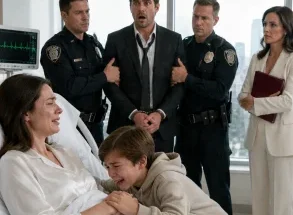
The call came at 2:21 p.m., while I was standing in the break room at work with a vending machine sandwich in one hand and my phone in the other.
The school secretary said my name in that careful voice adults use when they already know your day is over.
“Mr. Harper, you need to come to the school right away.”
I asked if Lily was hurt.
There was a pause just long enough to make my stomach drop.
“She’s with the nurse,” the secretary said. “The principal will explain when you arrive.”
That was how it started.
Not with the truth.
Not with a question.
With a sentence soft enough to sound polite and serious enough to make me leave work without clocking out.
By the time I reached the elementary school, the front parking lot was full of pickup trucks, minivans, and the long yellow buses lining up for dismissal.
A small American flag snapped on the pole by the office entrance.
Parents were already forming the pickup line, holding paper coffee cups, waving at kids, checking phones, living in the normal world I had apparently stepped out of twenty minutes earlier.
Inside, the office smelled like floor wax, copier toner, and old coffee.
The principal was waiting with a face that looked professionally calm and personally terrified.
Then I saw the Ashfords.
Mrs. Ashford stood by the desk in a camel-colored coat that probably cost more than my rent.
Mr. Ashford had a leather folder tucked under one arm.
Their son Damian sat in the chair beside them with a blue ice pack pressed against his jaw.
His face was swollen.
His mouth looked wrong.
I knew immediately that whatever had happened was serious.
What I did not understand was why everyone in the room looked at me like I had brought the danger with me.
“Your daughter violently assaulted our son,” Mrs. Ashford said.
She said my daughter’s name like she was reading a charge in court.
Lily Harper.
Seven years old.
Fifty pounds in wet sneakers.
The same child who saved pennies in a peanut-butter jar so she could buy dog treats for the shelter drive.
The same child who still asked me to make her pancakes shaped like clouds on Saturday mornings.
Mr. Ashford laid his folder on the principal’s desk.
“We are filing a civil suit,” he said. “The starting figure is $500,000. We are also pressing criminal charges.”
I remember looking at the folder more than his face.
Cream paper.
Silver clip.
Everything lined up perfectly.
People with money learn early that fear looks more official when it comes in a folder.
The principal pushed a school incident report toward me.
There were three witness statements attached.
There was an injury note from the nurse.
There was Officer Caldwell’s county juvenile intake sheet, the first official paper I had ever seen with my daughter’s name next to words that made my hands go cold.
Assault.
Processing.
Fingerprints.
I asked to see Lily.
Mrs. Ashford said, “That is not your first concern right now.”
I looked at her then.
I think she expected me to shout.
For one ugly heartbeat, I wanted to.
I pictured that folder sliding off the desk and hitting the floor.
I pictured the legal pages scattering across the carpet.
I pictured Mr. Ashford bending down in front of everyone to gather them back into order.
Instead, I folded my hands together until the knuckles hurt.
“My daughter is seven,” I said. “She is my first concern.”
Officer Caldwell looked tired.
Not cruel.
Not eager.
Just tired in the way people look when a process has already started and they don’t know how to stop it.
“Sir,” he said, “based on the witness statements and the injury, I have to take her to the station for processing.”
“Prints?” I asked.
He did not answer quickly enough.
That was answer enough.
The hallway to the nurse’s office felt longer than it had ever felt on parent-teacher nights.
Construction-paper tulips covered the cinderblock walls.
Crayon suns smiled above the coat hooks.
Somewhere, a class was singing the alphabet.
It was unbearable, that ordinary sound still happening while my child was being turned into paperwork.
The nurse’s office smelled like antiseptic and latex gloves.
Lily sat on the exam table with her small legs dangling over the side.
Her right hand was wrapped in thick white gauze.
There were dried red specks near the knuckles.
She looked up when I came in.
I expected tears.
I expected panic.
What I saw was worse.
She looked steady.
Too steady.
Not proud.
Not cruel.
Certain.
The nurse touched my sleeve.
“She won’t explain,” she whispered. “She just keeps asking if Tommy is okay.”
I knew Tommy’s name.
Every Tuesday, Lily came home from reading-buddy time talking about him.
Tommy liked dinosaurs.
Tommy hated loud bells.
Tommy had a brace under his shirt that some older kids laughed at.
Lily had walked him to the cafeteria once because he was scared of the crowd.
After that, he started calling her “the brave one.”
I had thought it was adorable.
I had not understood that my child had been describing a pattern.
I sat beside her and took her uninjured hand.
It was cold and damp.
“Honey,” I said, “you have to tell me what happened.”
She looked past me.
Officer Caldwell stood in the doorway.
Behind him stood the Ashfords, still armored in certainty.
Damian leaned into his mother’s side with the ice pack against his jaw.
Lily lifted her bandaged hand.
The room changed.
It was not dramatic like movies make it.
No music.
No gasp from everybody at once.
Just the tiny shift of adults realizing a child might know something they had all chosen not to ask.
“He hurt Tommy first,” Lily said.
The nurse’s mouth opened.
Officer Caldwell’s hand stopped near his belt.
Mrs. Ashford said, “Absolutely not.”
But Damian did not look at his mother.
He looked at the floor.
Lily kept going.
“He pulled the straps on Tommy’s brace. Tommy couldn’t breathe right. I told him to stop three times.”
I felt my own grip tighten around her fingers.
“What did you do after that?” Officer Caldwell asked, softer now.
Lily swallowed.
“He laughed. Then he pushed Tommy against the cafeteria table. Tommy fell down. I pushed Damian away.”
Damian made a sound.
It was not pain.
It was warning.
His father touched his shoulder.
“Do not say another word,” Mr. Ashford murmured.
That was the first time I saw the Ashfords as afraid.
Not worried about Damian’s injury.
Afraid of sequence.
Afraid of the order of events.
A child can be blamed for a blow.
It is harder to blame her for why she threw it.
Then Tommy appeared at the end of the hall.
He was smaller than I expected.
He had on a green dinosaur hoodie, one sleeve pulled halfway over his hand.
His mother stood behind him, crying quietly, one palm pressed flat to the wall like she needed the building to hold her up.
Tommy pointed at Damian.
“She told him to stop,” he said.
His voice shook so hard I could barely hear it.
But the hallway heard.
The counselor lowered her legal pad.
The principal looked down at the incident report as if it had betrayed him.
Officer Caldwell closed his notebook.
“What happened next, Tommy?” he asked.
Tommy looked at Lily.
She nodded once.
Damian had grabbed the back strap of Tommy’s brace and yanked it upward.
Tommy said he felt a sharp pressure in his ribs and could not take a full breath.
He dropped his dinosaur folder.
Lily stepped between them.
Damian shoved her.
She fell into the cafeteria bench.
When he reached for Tommy again, she swung.
Not at his jaw on purpose.
Not with some violent plan.
She swung with a bandaged little hand and the blind terror of a child trying to stop another child from being hurt.
Damian’s face hit the metal edge of the serving line as he stumbled backward.
That was what broke his jaw.
Not Lily’s tiny fist.
The metal edge.
The school had not written that part down.
Not at first.
A cafeteria aide had seen it but had been busy moving children out.
Two second graders had tried to tell the counselor, but one kept crying and the other could not remember the right words.
By 3:04 p.m., the first report had already made Lily the aggressor.
By 3:22 p.m., the Ashfords had turned that report into a threat worth half a million dollars.
People talk about truth like it wins because it is clean.
Most of the time, truth wins only if somebody survives long enough to say it in the right room.
Officer Caldwell asked for the cafeteria footage.
The principal’s face went pale.
“We have cameras in the hallway outside the cafeteria,” he said. “Not inside the serving area.”
“Pull it,” Officer Caldwell said.
Mrs. Ashford objected immediately.
Her husband objected more calmly, which somehow sounded worse.
Officer Caldwell looked at them and said, “Your son is injured. Another child may also be injured. A third child is wearing a medical brace that may have been interfered with. I am not processing a seven-year-old until I know what I am processing.”
That was the first full breath I took since the call.
Tommy’s mother asked if she could take him to urgent care.
The nurse said his breathing sounded shallow.
Officer Caldwell said he wanted medical documentation before anyone left.
Because Damian’s jaw injury was serious, an ambulance was called.
Because Tommy had a brace and was complaining about chest pain, a second ambulance was called too.
Because Lily’s hand was swelling under the gauze, the nurse told me to get her X-rayed.
That is how we all ended up in the same hospital corridor before sunset.
Damian went one way.
Tommy went another.
Lily sat beside me under the bright waiting-room lights, her shoes not touching the floor, her injured hand resting on a folded towel.
She did not cry until she asked me, “Am I bad?”
That question did something to me that the $500,000 threat had not.
I pulled her close, careful of her hand.
“No,” I said. “You are not bad.”
“But I hurt him.”
“You stopped him.”
“But I hurt him.”
There are moments as a parent when the truth is too complicated for the age of the child holding it.
So I gave her the part she could carry.
“You told an adult to stop him first. You tried to protect Tommy. We will tell the truth about everything else together.”
At 6:18 p.m., a surgeon came into the hallway.
He was not Damian’s father.
He was not Tommy’s doctor.
He was the oral and maxillofacial surgeon called in to evaluate Damian’s jaw.
He walked with the quick, focused stride of someone used to emergencies.
The Ashfords stood when they saw him.
Mrs. Ashford started talking before he reached them.
“My son was assaulted by that girl,” she said, pointing across the corridor at Lily.
The surgeon looked in the direction of her finger.
His expression changed.
Not with anger.
With recognition.
He walked past the Ashfords.
He came straight to Lily.
I stood up so fast my chair scraped the floor.
The surgeon crouched in front of my daughter and smiled in a way that made Lily blink.
“You’re Lily,” he said.
She nodded.
He reached into the pocket of his white coat and pulled out a folded piece of printer paper.
It was a drawing.
A dinosaur in a superhero cape.
Under it, in crooked second-grade letters, it said: TO DR. KIM, FROM TOMMY AND LILY.
Tommy’s mother had given it to him months earlier after a procedure related to Tommy’s brace care.
The surgeon had kept it taped near his desk.
“You drew the cape,” he said to Lily.
Lily’s mouth fell open.
He held out a pen.
“Would you sign it for me?”
Nobody moved.
The Ashfords stared.
Officer Caldwell stared.
The principal, who had driven over with the school paperwork, stared like he had just watched the room tilt.
Lily looked at me.
I nodded because I did not trust my voice.
With her left hand, slowly and awkwardly, she wrote her name on the corner of the drawing.
L-I-L-Y.
Dr. Kim stood and turned to the adults.
“I am going to examine Damian,” he said. “But before anyone uses my medical findings to terrorize a child, I want every statement in this hallway to reflect what I just heard.”
Mr. Ashford said, “Doctor, with respect, you have no idea what happened.”
Dr. Kim looked at Tommy’s mother.
Then at Tommy.
Then at Lily’s bandaged hand.
“I know enough to ask why a child in a brace was brought here short of breath and why the smallest child in this hallway is the only one who tried to explain it.”
The lawsuit did not vanish that night.
Real life is not that neat.
The Ashfords still called their lawyer.
The school still had to amend the report.
Officer Caldwell still had to write his own supplemental statement.
Tommy was checked for bruising around the brace area.
Lily had a hairline fracture in two small bones of her hand.
Damian’s jaw required surgery.
Pain was still pain.
Injury was still injury.
But the story was no longer theirs alone.
By the next morning, the hallway footage showed Damian following Tommy toward the cafeteria entrance.
It showed Lily stepping between them.
It showed Damian shoving Lily hard enough that she disappeared out of frame.
It showed Damian stumbling backward seconds later, clutching his mouth, while a cafeteria aide rushed toward the children.
It did not show everything.
It showed enough.
The amended school incident report removed the word “unprovoked.”
Officer Caldwell did not take Lily’s fingerprints.
Tommy’s mother filed her own statement.
The school district opened a review of how bullying reports involving Tommy had been handled.
The Ashfords’ $500,000 demand became a letter nobody mentioned again in front of my child.
Weeks later, Lily still worried about Damian.
That was the part that broke me in quiet ways.
She asked if his mouth hurt.
She asked if he could eat soup.
She asked if Tommy would be scared to come back to school.
The brave ones are not always the loud ones.
Sometimes they are small enough that adults talk over them until somebody notices their hand is bleeding.
At the spring open house, Tommy found Lily by the classroom map of the United States and handed her a new dinosaur sticker.
“For your cast,” he said.
Her hand was healing by then.
There was a tiny scar near one knuckle.
She stuck the dinosaur on the blue wrap and held it up like a medal.
Across the room, the principal watched them with the haunted expression of a man who had learned that paperwork can hurt a child almost as badly as a shove.
Dr. Kim sent the signed drawing back in a clear sleeve with a note.
Tell Lily I am keeping the autograph copy in my office.
She asked me what an autograph was.
I told her it was what people ask for when they think someone did something worth remembering.
She thought about that for a while.
Then she said, “Tommy was scared.”
I said, “I know.”
She said, “Nobody was listening.”
I looked at my daughter then, at her small hand, at the dinosaur sticker, at the tired little set of her shoulders.
By 2:17 p.m. that day, my trust in the school had been reduced to reports and statements and forms.
By the end of it, an entire hallway had learned what my daughter already knew.
Sometimes the smallest person in the room is the only one brave enough to tell the truth before it becomes official.