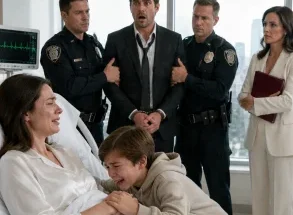
My son forgot to hang up, and I heard him call me a burden.
So while he and his wife were smiling their way through Italy and France, planning a future that already included my house, I quietly sold the £875,000 home his father and I spent thirty-two years paying off, packed everything without a word, and came back just in time to watch his key stop working in my front door.
The first thing I noticed was not his face.
It was the sound of metal scraping against metal.
Daniel had always been impatient with locks, drawers, traffic lights, queues, anything that suggested the world might not move when he wanted it to.
Now he stood on my front step with his airport jacket creased at the elbows, one hand gripping the handle of a hard-shell suitcase, the other pushing his silver key into a lock that had been changed three days earlier.
It would not turn.
Melissa stood beside him with two shopping bags hanging from her wrist and her sunglasses still on, though the sky was flat and grey and the pavement was wet from a late afternoon shower.
She was smiling at first.
That neat little smile she wore whenever she wanted a room to think she was calm, clever, and slightly above everyone in it.
Then Daniel tried the key again.
The smile faded.
He removed it, checked it, shoved it back in, and twisted harder.
Nothing moved.
The door stayed shut.
He looked at the brass handle, then at the lock, then at the front window, as if the house itself had suddenly become disloyal.
I was parked across the road in a hired truck with my hands folded in my lap.
My own key was there too, resting against my palm, though it opened nothing now.
For the first time in weeks, that felt like freedom rather than loss.
Three weeks earlier, the house had still been mine in every visible way.
Frank’s armchair sat by the window, angled towards the garden because he used to say the birds were better than anything on television.
The kettle with the cracked lid still clicked too loudly after boiling.
A faded tea towel hung over the oven handle.
In the utility cupboard, pencil marks climbed the inside wall, each one labelled by year, each one proving Daniel had once been a boy who ran through that hallway with muddy shoes and jam on his sleeve.
Frank and I bought that house when we were too young to understand how long thirty-two years could feel.
We paid for it through overtime, careful budgets, meals stretched across two nights, and holidays we kept saying we would take when things were easier.
Things were never easy.
They were ours, though.
That mattered.
After Frank died, the house seemed to breathe differently.
Every cupboard had a memory in it.
Every quiet morning had an empty chair.
I learned to make one cup of tea instead of two, which sounds small until you have done it after decades of reaching for the second mug without thinking.
Daniel began visiting more often after the funeral.
At first, I thought grief had softened him.
He brought groceries.
He changed light bulbs.
He checked the boiler pressure with a seriousness Frank would have found funny.
Melissa came with him sometimes, carrying soup in tidy containers and speaking in a voice so gentle it almost had no edges.
Everyone told me I was fortunate.
A son who came round.
A daughter-in-law who helped.
A family keeping watch.
For a while, I believed it.
Then the comments began arriving in little paper cuts.
“This place is a lot for one person, Mum.”
“You must get lonely rattling around here.”
“Those stairs are not ideal.”
“You ought to think ahead before thinking gets harder.”
Melissa would open her phone at my kitchen table and show me pictures of retirement flats with cream walls, clipped lawns, and smiling residents sitting in chairs that looked chosen by a committee.
“Some of them are lovely,” she would say.
Daniel would nod as if she had offered me a gift.
I would wrap my hands around my mug and say I was fine.
In Britain, “I’m fine” can mean many things.
Mine meant, please stop trying to move me out of the only place where your father still feels near.
They did not hear it.
Or perhaps they heard it perfectly and chose not to care.
Daniel started talking about paperwork.
Not kindly, either.
Practically.
Coldly.
He mentioned bills, maintenance, tax, the roof, the garden, insurance, all the adult words that become weapons when spoken by someone waiting for you to feel small.
Melissa would glance at the hallway, then at the stairs, then at me.
She always looked around my home as though she were already deciding which walls would come down.
The day before their Europe trip, Daniel rang while I was upstairs folding laundry.
I missed the call.
A minute later, I saw he had left a voicemail.
I pressed play without thinking.
I expected a reminder about flights, passports, or the spare key he still kept on his ring from when Frank was ill.
Instead, I heard a car door slam.
Then Melissa laughed.
Not the soft kitchen laugh.
Her real one.
Sharp, quick, and pleased with itself.
Then Daniel spoke.
“She’s a burden, Mel. She just doesn’t see it. We’ve held our lives back long enough.”
The towels slipped from my arms.
For a few seconds, I did not move.
The recording kept going.
Melissa said, “Once the house is sorted out, everything gets easier.”
Not once Mum feels settled.
Not once Mum is safe.
Once the house is sorted out.
That was when the air seemed to leave the room.
People imagine betrayal arrives with shouting.
Sometimes it arrives in the ordinary sound of your child forgetting to end a call.
I sat on the bed for a long time after the message ended.
The towels were still on the floor.
The house was quiet except for the soft hum of the airing cupboard and the distant hiss of rain against the window.
I kept hearing the word burden.
It was not only cruel.
It was organised.
It had a future attached to it.
That night I walked through every room in the dark.
I touched the banister Frank had sanded smooth one summer when money was tight and we could not afford to replace it.
I stood in Daniel’s old bedroom, where the outline of a poster remained faintly marked on the wall.
I put my hand on the kitchen counter where Frank used to dry the dishes with that same tea towel even after I told him it needed washing.
I cried there, quietly, because I did not want the neighbours to hear and because some habits of dignity remain even when your heart is breaking.
By morning, the crying had done what crying can do.
It had emptied the first shock out of me.
What remained was colder.
Clearer.
I made tea and did not drink it.
Then I opened Frank’s old files.
Frank had kept papers the way some people keep photographs.
Everything labelled.
Everything folded.
Receipts for repairs, mortgage statements, insurance letters, bank documents, solicitor correspondence from years before.
I went through them slowly at the dining table while the kettle cooled behind me.
Then I remembered Daniel’s storage box in the loft.
He had left it there years earlier when he and Melissa moved into their own place.
Old paperwork, university bits, computer cables, the kind of clutter adult children abandon because they assume their parents’ houses are free storage forever.
Inside, under a bundle of faded envelopes, I found printed emails and notes.
At first, I did not understand what I was reading.
Then the words began joining hands.
Power of attorney.
Confusion.
Safety.
Transition.
Capacity.
Future arrangements.
There were no signatures that gave him control.
There was no final document that trapped me.
But there was a shape.
A plan.
A way of speaking about me that made me sound less like a person and more like a problem waiting for sensible people to solve.
I was not becoming forgetful.
I was grieving.
I was not unsafe.
I was inconvenient.
They had been building a story around me, little by little, so that when the time came, everyone might nod and say it was for the best.
That was the hour I stopped asking myself how my son could do it.
I began asking what I was going to do before he succeeded.
I rang an estate agent who understood discretion.
No sign outside.
No cheerful public listing for neighbours to gossip over.
No open house with strangers opening cupboards while I pretended not to mind.
I rang Frank’s solicitor.
I rang the bank.
I checked every account, every document, every detail I had once avoided because Frank had always liked dealing with paperwork.
Grief had made me quiet.
It had not made me stupid.
The house was worth £875,000.
Daniel knew that figure too well.
He had mentioned it once at Sunday lunch with the casual tone of a man discussing weather.
I had watched Melissa’s eyes flick towards him when he said it.
That memory returned while I signed papers in the solicitor’s office, my hand steadier than I expected.
Selling was not easy.
Not emotionally.
Not after thirty-two years.
Every box felt like an ending.
The movers came while Daniel and Melissa were away.
Their holiday pictures appeared online in little bright bursts.
Daniel beneath old stone streets.
Melissa with wine in one hand.
Both of them smiling in front of views I did not need to name to understand the performance.
Under one photo, someone wrote, “You both deserve this.”
I looked at that sentence for a long time.
Then I wrapped Frank’s framed photograph in newspaper and placed it carefully in a box.
The movers were kind.
One of them carried Frank’s chair as if it mattered, which it did.
Another asked whether I wanted to keep the pencil-marked strip from inside the utility cupboard.
I had not thought of that.
For a moment, I nearly said no.
Then I fetched a small screwdriver.
The strip came away in my hands, marked with Daniel’s height at six, eight, twelve, fifteen.
Proof that I had not imagined loving him.
Proof that motherhood can be real even when gratitude is not.
I rented a small place near the water.
Not grand.
Not impressive.
Mine.
There was room for Frank’s chair, my books, the old lamp, and enough silence for me to decide what my life would be without waiting for Daniel to approve it.
Before I left the house for the last time, I stood in the kitchen and listened.
Empty houses make strange sounds.
They reveal every pipe, every floorboard, every little settling noise hidden for years beneath footsteps and voices.
I placed one white envelope on the bare counter.
Daniel’s name was written on the front.
I did not write angrily.
That surprised me.
Anger had brought me to action, but it was not the feeling that held my pen.
What held it was the memory of his voicemail.
The calmness.
The ease with which he had turned his mother into an obstacle.
I locked the door behind me for the final time.
Then the locks were changed.
When Daniel and Melissa returned, I was already across the road in the truck.
I had not planned to watch.
At least, that is what I told myself.
But some endings require a witness.
They came from the airport looking tired and satisfied.
Daniel’s suitcase rolled badly over the wet pavement.
Melissa had that travel glow people get when they want everyone to know they have been somewhere expensive.
He stepped up to the door without hesitation.
That hurt more than I expected.
The entitlement was not loud.
It was muscle memory.
He believed the door would open because doors had always opened for him here.
Then the key failed.
Once.
Twice.
A third time, harder.
Melissa said something.
Daniel snapped back.
A neighbour’s curtain shifted across the road.
A delivery van slowed, then moved on.
The whole scene remained painfully ordinary: wet pavement, luggage, a front step, a man discovering that possession and access are not the same thing.
Eventually, after calls and fussing and more anger than sense, they got inside.
I had arranged it that way.
I wanted him to see the house.
Not from outside.
Not as a rumour.
I wanted him to walk through the absence.
The front door opened, and Daniel entered first.
Melissa followed, lifting one shopping bag so it would not brush the damp step.
They disappeared into the hallway.
For a few seconds, nothing happened.
Then Melissa reappeared in the doorway and looked back at the empty road as if checking whether they had walked into the wrong house.
Daniel moved deeper inside.
I could picture each room through his eyes.
No family photographs on the wall.
No Frank’s chair by the window.
No kettle.
No tea mugs.
No utility cupboard full of pencil marks.
No evidence of the woman he had decided was too slow, too lonely, too useful to be left in peace.
Only bare walls and the echo of decisions made without him.
Then he reached the kitchen.
He stopped.
Even from across the road, I knew the exact moment he saw the envelope.
His shoulders tightened.
Melissa came up behind him and leaned slightly to one side.
Daniel picked it up.
For the first time that afternoon, his hands were not forceful.
They were careful.
Almost afraid.
He stared at his name on the front.
Perhaps he recognised my handwriting.
Perhaps he remembered birthday cards, school notes, lists on the fridge, all the small written proof of a mother who had carried his life in details.
Then he slid one finger beneath the flap.
I sat across the road without moving.
The rain had started again, lightly tapping the windscreen.
My phone was on the passenger seat.
Frank’s photograph was in a box behind me.
The second envelope was in my lap.
Inside the kitchen, Daniel unfolded the first page.
His expression changed before he reached the end.
Melissa stepped closer.
She looked irritated first, then uncertain.
Then frightened.
The house had not betrayed him.
The lock had not failed.
The key had simply told the truth before I had to.
For years, I had thought love meant keeping the door open.
That day, I understood it could also mean changing the lock.
Daniel read on.
Melissa gripped the counter.
And across the road, with the rain sliding down the glass between us, I lifted the second envelope and waited for my son to look up.
He did.
Not immediately.
He read the letter twice, because Daniel had always believed that if he repeated an unpleasant thing enough times, he could find the line that made it less true. He did that as a boy with bad school reports. He did it as a young man with bank statements. He did it after Frank’s funeral when the death certificate arrived and he stared at it as though a bureaucratic error might bring his father back.
Now he read my words again, slower.
His mouth parted.
Melissa snatched the paper from him before he could fold it.
Her eyes moved quickly over the page.
Then her head lifted and turned toward the window.
For one wild second, I thought she had seen me.
But no.
She was looking at the empty street, at the rain, at the neighbourhood that had once been a future asset in her mind and was now only a collection of houses where people would soon know they had been locked out of mine.
Daniel walked to the front window.
He held his phone to his ear.
Mine lit up on the passenger seat.
Daniel.
I watched the name pulse across the screen.
Once.
Twice.
Again.
I did not move.
The voicemail began before the call even finished ringing.
Then another call.
Then another.
Inside the house, Daniel paced.
Melissa stood in the kitchen with my letter in her hand and fury hardening every line of her body. She was not crying. That came later, I knew, if it came at all. Melissa was still in the stage where loss feels like insult.
My phone buzzed with a message.
Mum, where are you?
Then:
This is insane.
Then:
Call me now.
Then:
You can’t sell the house without telling me.
I nearly smiled at that one.
Nearly.
I looked at the second envelope in my lap.
It was addressed to Arthur Greer, my solicitor, though I had not sealed it.
Inside was a copy of the voicemail transcript, the printed emails from the loft box, and a short note in my own handwriting:
If Daniel attempts to challenge my capacity or the sale, proceed.
I had not wanted to use it.
I still didn’t.
A mother’s love does strange things, even after betrayal. It will let you build a wall, then stand behind it holding the gate key and hoping the person outside will not force you to prove it works.
Daniel forced it within six minutes.
A police car turned into the road.
Slowly.
Not lights.
Not siren.
Just authority, arriving in a shape Daniel hoped might belong to him.
Of course he had called them.
When a man discovers he cannot open a door, he often looks for another man with a uniform to open it for him.
Two officers stepped out.
One was young, tall, and narrow through the shoulders. The other was older, a woman with grey at her temples and a face that suggested she had already heard enough domestic nonsense for one lifetime.
Daniel came out first.
He pointed toward the house.
Melissa came after him, clutching the letter.
Her sunglasses were gone now.
Her eyes were bright with calculation.
I opened the truck door before they could finish writing the first version of the story.
The rain touched my hair as I stepped down.
The older officer saw me first.
So did Daniel.
For a moment, relief moved across his face.
That hurt too.
Not because I wanted him frightened.
Because his relief was not for me.
It was for his expectation that I would now make the problem easier.
“Mum,” he called, stepping off the path. “Thank God. What the hell is going on?”
The officer turned.
“Mrs…?”
“Eleanor Whitaker,” I said. “This was my house until the sale closed last week. The current owner takes possession tomorrow. My son has entered with permission only to retrieve a letter left for him. He does not live here. He has no legal claim to this property.”
Daniel stared at me.
“You were across the road?”
“Yes.”
“You watched me?”
“Yes.”
Melissa laughed then.
Sharp.
Unpleasant.
“Oh, this is theatre. You staged this.”
I looked at her.
“No, Melissa. Theatre requires an audience. I needed a witness.”
The older officer’s eyes moved between us.
Daniel flushed.
“Mum, this is ridiculous. You disappeared without telling anyone. We were worried.”
“Worried?” I asked.
I reached into the truck and took out my folder.
I had learned many things from Frank, but the best one was this: if you expect people to behave badly, bring copies.
Inside were the closing documents, the estate agent’s letter, the solicitor’s certificate confirming I had acted independently, a recent doctor’s letter confirming I was of sound mind, and the printed transcript of the voicemail.
I handed the folder to the officer.
Daniel went pale.
He knew what was inside before she opened it.
Melissa did not.
Not yet.
The officer read the first page.
Then the second.
Then her face changed.
Not dramatically.
Professional faces rarely do.
But something in the set of her mouth became less neutral.
“Mr. Whitaker,” she said, “this appears to be a civil matter. Your mother has the right to sell her property.”
Daniel’s jaw tightened.
“She is vulnerable.”
The word came out too quickly.
There it was.
The story he had been building, now dragged into daylight before it was properly dressed.
The officer looked at him.
“Is she?”
“My father died. She’s been unstable. She doesn’t know what she’s doing.”
I felt something cold move through me.
Not shock.
Confirmation.
The second envelope grew heavier in my hand.
Melissa stepped beside him.
“We have been trying to help her for months. She’s been resistant. Secretive. Paranoid, frankly. Selling a house without telling your only child is not normal.”
I looked at the officer.
“May I?”
She nodded.
I reached into the folder and took out the transcript.
Then I read aloud.
“She’s a burden, Mel. She just doesn’t see it. We’ve held our lives back long enough.”
The rain seemed louder after that.
Daniel looked away.
Melissa’s face hardened.
“That was a private conversation taken out of context.”
“Was once the house is sorted out also out of context?” I asked.
The younger officer glanced down.
Perhaps to hide his reaction.
The older officer did not.
She looked at Daniel the way one adult looks at another adult who has decided to disappoint her professionally.
“Mrs. Whitaker,” she said, “are you safe?”
“Yes.”
“Do you have somewhere to stay?”
“Yes.”
“Are you here voluntarily?”
“Yes.”
“Did anyone pressure you to sell the property?”
“No.”
Daniel made a sound.
The officer held up one hand without looking at him.
I continued before he could speak.
“I sold my house because I discovered my son and daughter-in-law were preparing to challenge my independence and take control of decisions that belong to me.”
“That is not true,” Daniel snapped.
I turned toward him.
“Then why did I find notes in your box about capacity and transition planning?”
The words hit him.
Melissa looked at him then.
Not at me.
At him.
For the first time, a little crack appeared between them.
Good.
The older officer closed the folder.
“Mrs. Whitaker, do you wish to make any formal complaint today?”
Daniel’s face changed.
Fear entered.
Not enough.
But some.
I thought of the second envelope.
Of Arthur.
Of Frank’s chair.
Of Daniel at six, standing against the utility wall while I marked his height.
Of Daniel grown, calling me a burden.
“No,” I said. “Not today. But I want it documented that I am alive, safe, competent, and not missing. I also want it documented that my son and his wife attempted to portray my legal sale of property as evidence of instability after I refused their influence.”
The officer nodded.
“That can be noted.”
Daniel stepped toward me.
“Mum, please. Can we not do this in the street?”
I looked at him.
Once, that voice would have undone me.
Please.
Mum.
A boy inside a man’s body, asking me to make the world gentle again.
“No,” I said. “We are already doing it in the street because you called the police.”
His face reddened.
Melissa whispered, “This is humiliating.”
I turned to her.
“Yes.”
She flinched.
“Humiliation is unpleasant when you are not the one arranging it for someone else.”
The young officer coughed.
The older one pretended not to hear.
Daniel looked around then, finally noticing the curtains, the neighbour at the corner, the old woman across the road pretending to deadhead flowers in the rain.
“Everyone is watching,” he said.
I stepped closer.
“Good.”
His eyes snapped to mine.
“For months, you and Melissa tried to move me quietly out of my own life. Quietly into a smaller room. Quietly into paperwork. Quietly into a story where I was confused enough to be managed. So yes, Daniel. Let them watch me be clear.”
The words left me steadier than I felt.
Daniel’s face worked.
I saw anger.
Then shame.
Then something more frightening.
Calculation.
He looked at the officer.
“I want a welfare check done. Properly. Not here. I want her assessed.”
The second envelope stopped being optional.
The older officer’s voice cooled.
“You may contact adult social services if you believe there is genuine risk. However, based on the documentation presented and Mrs. Whitaker’s statements, I see no immediate safeguarding concern.”
Melissa said, “Of course there’s a concern. She sold a major asset in secret.”
The officer looked at her.
“Selling one’s own home is not a crime.”
Melissa opened her mouth.
Closed it.
Daniel turned to me.
“If you don’t tell me where you’re living, I’ll have to assume you’re being influenced.”
There it was.
The threat.
Soft.
Legal-shaped.
Wrapped in concern.
I looked down at the second envelope.
Then held it out to the older officer.
“Would you please note that this envelope contains evidence to be delivered to my solicitor if my son attempts to challenge my capacity, harass me, or interfere with my finances?”
Daniel stared at it.
“What is that?”
I did not answer him.
The officer did.
“It sounds like paperwork, Mr. Whitaker.”
The line was so dry that for one absurd second I nearly laughed.
Melissa stared at the envelope as if it might explode.
In a way, it had already detonated.
The officers left after ten more minutes.
They advised Daniel and Melissa to vacate the property because the legal ownership had changed and lingering could create problems with the incoming owners.
That language pierced Melissa more than anything I said.
Incoming owners.
Meaning not them.
Not now.
Not someday.
Daniel stood on the path after the police left, his suitcase still near the step, rain darkening his jacket.
“Mum,” he said.
His voice was smaller now.
I was almost undone by it.
Almost.
But behind him, Melissa stood with my letter in one hand and resentment in both eyes.
Whatever Daniel felt, she still believed I had stolen something from them.
That was enough to keep me steady.
“I am leaving now,” I said. “You may contact Arthur Greer if there is anything legal to discuss. You may not come to my new home. You may not attempt to access my accounts. You may not call medical services, social services, or police under false pretences without expecting a formal response.”
Daniel swallowed.
“Where are you living?”
“No.”
Just that.
No explanation.
No apology.
No softening.
No.
He flinched as though the word had physical weight.
Maybe because I had so rarely used it without padding.
Melissa scoffed.
“So that’s it? You sell the family home and run away?”
I turned to her.
“The family home was paid for by Frank and me. You visited. That is not the same as ownership.”
Her face went white.
Then red.
Daniel whispered, “Dad would be ashamed.”
That was the cruelest thing he could have chosen.
And because he chose it, something inside me settled forever.
I stepped closer to him.
“No, Daniel. Your father would be heartbroken. There is a difference. Shame belongs to the person who did wrong. Heartbreak belongs to the person who still loves them after seeing it.”
His eyes filled.
I saw it.
But I did not rush to comfort him.
I had spent enough years protecting him from the weight of himself.
I got into the truck.
Started the engine.
And drove away before the mother in me could open the door again.
That night, in my flat by the water, I placed the second envelope on my desk.
Still unsealed.
I made tea.
One cup.
I sat in Frank’s chair, which now faced the window rather than the garden because there was no garden here, only a strip of water grey under evening clouds and gulls dipping low over the surface.
The flat smelled faintly of cardboard and furniture polish.
Not home yet.
But safe.
Safe has a scent too, I think.
It is quieter than comfort at first.
Sharper.
Like air after a storm.
My phone rang until midnight.
Daniel.
Melissa.
Daniel again.
Then an unknown number.
Then Daniel.
I turned the sound off.
At 12:17, a message arrived from him.
Mum, I said something terrible. I know that. But you didn’t have to destroy everything.
I stared at the word destroy.
Then typed:
I did not destroy everything. I stopped maintaining what was already broken.
I did not send it.
Not yet.
Instead, I copied it into a note.
That would become my habit for months: writing the answer I wanted to send, saving it, and letting silence do the work my words used to do for free.
The next morning, Arthur called at nine exactly.
“Eleanor,” he said. “I received a call from Daniel at 8:06.”
Of course he had.
“What did he want?”
“To know whether the sale could be reversed.”
I laughed.
It came out sharper than expected.
“And?”
“I told him no.”
“And what did he say?”
Arthur paused.
“He asked whether you were truly of sound mind.”
There it was.
The knife, no longer hidden behind polite handles.
My hand tightened around the phone.
“What did you say?”
“I told him I would be happy to provide him with copies of the capacity letter he was already shown by police, along with my own certification that you acted independently. I also reminded him that frivolous allegations could have legal consequences.”
“Did he threaten you?”
“No. He became quiet. Melissa spoke then.”
I closed my eyes.
“What did she say?”
“She asked whether you had been influenced by someone else.”
“Who?”
“She implied perhaps me. Or an estate agent. Or a neighbour. Anyone except herself, apparently.”
Despite everything, I smiled.
Arthur sighed.
“Eleanor, I need to ask: do you want to escalate?”
I looked around the flat.
At the boxes.
At Frank’s photograph.
At the strip of pencil-marked wood leaning against the bookcase.
At the second envelope on the desk.
“Not unless they force me.”
“They may.”
“I know.”
Arthur’s voice softened.
“I also have something else.”
“What?”
“Frank left a letter with me years ago.”
The room seemed to go still.
“What?”
“He gave it to me after his first heart scare. He said I’d know when you needed it. I believe that time is now.”
For a moment, I could not speak.
Frank.
Even dead, somehow, still reaching through paper.
“When can I have it?” I whispered.
“I can bring it this afternoon.”
“No,” I said. “I’ll come to you.”
I needed to move toward it.
Some letters should not be delivered like bills.
Arthur’s office was above a chemist on the high street, with narrow stairs and a smell of old paper, dust, and peppermint from downstairs. I had been there many times with Frank. Wills. Mortgage paperwork. Daniel’s first flat guarantee, which I now regretted more than was useful.
Arthur was older than I remembered.
Or maybe I had become someone who finally noticed age.
He wore a brown jacket and had a pen behind one ear, the same ridiculous habit Frank used to tease him for.
When he saw me, he did not say sorry.
I appreciated that.
Sympathy can become exhausting when people hand it to you like something else to carry.
He simply said, “Tea?”
“Yes.”
He made it himself in two mismatched mugs.
Then he took a cream envelope from his desk drawer.
My name was written across the front.
Eleanor.
Frank’s handwriting.
My throat closed.
“He told me,” Arthur said softly, “not to give this to you too soon. He said grief makes people obedient to the wrong voices.”
I laughed once through sudden tears.
“That sounds like him.”
“It does.”
Arthur handed me the envelope.
I held it for a long time before opening it.
Inside was one sheet of paper.
My dearest Ellie,
If Arthur is giving you this, it means I am gone, and someone is trying to make your life smaller in the name of care.
I stopped reading.
My breath failed.
Arthur turned slightly toward the window, giving me privacy without leaving me alone.
I continued.
I know you. You will say you are fine. You will make tea for people who came to discuss your future as if you are not sitting in the room. You will soften your no until it sounds like maybe. You will worry about Daniel’s feelings even when he forgets yours.
Do not.
Our son is not a bad man, but he has been allowed too much certainty that love means access. Some of that is my fault. Some of it is yours. Most of it now belongs to him.
Do not give him your house because he confuses inheritance with affection.
Do not let grief turn you into furniture.
If the house comforts you, keep it.
If it cages you, sell it.
If anyone tells you I would have wanted you to sacrifice your peace for family harmony, tell them your dead husband said they were being an idiot.
I covered my mouth.
A laugh broke through the sob.
Arthur smiled toward the window.
I read on.
You are not a burden.
You carried me when my heart first failed.
You carried Daniel before he knew how to walk.
You carried this house when money was thin and hope was thinner.
Foundations are only called burdens by people who forget they are standing on them.
Rest, Ellie.
Choose yourself.
And if our boy becomes angry that the door has closed, remember this: a locked door is not always rejection. Sometimes it is the first honest lesson a child receives too late.
I love you beyond every room we ever shared.
Frank.
By the end, the paper was trembling in my hands.
For several minutes, I could not move.
Grief returned, not as a blade this time but as a hand on my shoulder.
Frank had known me.
Not the useful version.
Not the wife who remembered appointments and stretched budgets and kept birthday candles in the second drawer.
Me.
The woman beneath the carrying.
Arthur placed a box of tissues on the desk without comment.
“Did he know?” I asked.
“That Daniel might become difficult?”
I nodded.
Arthur sighed.
“He worried Daniel expected life to arrange itself around him. Frank blamed himself for some of that.”
“Did he blame me?”
“No,” Arthur said. “He loved you. Which means, I think, that he saw you more clearly than you sometimes wanted.”
I folded the letter carefully.
“Can Daniel know about this?”
“That is yours to decide.”
Mine.
That word still felt new.
I placed Frank’s letter into my handbag, beside the second envelope.
One letter defending me from the living.
One letter loving me from the dead.
I walked out of Arthur’s office taller than when I entered.
For two weeks, Daniel sent messages that moved through predictable weather.
Anger.
Mum, you’ve made your point.
Fear.
Melissa says we may have to change our plans now. We were counting on future security.
Apology.
I’m sorry I said burden. I was stressed.
Guilt.
Dad would want us to talk.
Concern.
I’m worried about you living alone somewhere you won’t even name.
Then anger again.
This is cruel.
I answered none of them.
I forwarded everything to Arthur.
I told myself silence was strength.
Sometimes it was.
Sometimes it was simply pain with discipline.
Melissa did not stay silent.
She sent one email.
Long.
Polished.
Venom wrapped in grammar.
Eleanor,
I am sorry you overheard a private conversation and chose to interpret it in the most hurtful possible way. Daniel has been under enormous pressure since Frank passed, trying to manage his own grief while also supporting you. It is unfair that one unfortunate phrase has been used to justify such extreme behaviour.
I stopped there and made tea.
Then returned.
You should understand that adult children often have to make difficult decisions when parents become resistant to necessary change. No one wanted to take anything from you. We wanted to make sure the family home remained in the family and that you were properly cared for.
The family home.
Not your home.
Not Frank’s and mine.
The family home.
I continued.
Your secrecy is alarming. Selling a major asset, cutting off communication, and refusing to provide your address are not signs of stability. I hope you will reconsider before Daniel has no choice but to pursue formal steps to ensure your safety.
There it was.
Formal steps.
The phrase had a lawyer’s coat on, but its bones were threat.
I forwarded it to Arthur.
Then, for the first time since leaving the house, I responded.
Melissa,
I did not interpret Daniel’s phrase. I heard it.
I did not cut off communication. I ended access.
I did not sell the family home. I sold my home.
If you or Daniel pursue formal steps based on false claims about my capacity, I will respond with all available evidence, including the voicemail, your email, the documents found in Daniel’s box, my solicitor’s records, and the police incident report.
Do not contact me again except through Arthur Greer.
Eleanor Whitaker
I read it twice.
Then sent it.
My hands shook afterward.
Not because I regretted it.
Because every woman raised to be agreeable feels the body panic the first time she writes a clean boundary and refuses to add warmth.
Melissa did not reply.
Daniel did.
Just one line.
Mum, what documents?
So he had not told her.
Interesting.
The first legal letter arrived nine days later.
It did not come from Daniel.
It came from a solicitor representing Melissa.
That detail mattered.
It claimed concern regarding undue influence, questioned the speed of the sale, requested information about my current address and wellbeing, and suggested that Daniel, as my only child, had a legitimate interest in ensuring I had not been manipulated.
Arthur read it aloud in his office.
Then removed his glasses.
“They are fishing.”
“For what?”
“Anything. Your address. Your accounts. Confirmation that you are frightened. Evidence that you will react emotionally.”
“I am reacting emotionally.”
“Yes,” he said. “But not foolishly. There is a difference.”
We prepared a response.
Short.
Firm.
Brutal in its politeness.
Mrs. Whitaker acted independently and with full legal capacity. The sale is complete. Your client and her husband have no legal interest in the property or in Mrs. Whitaker’s personal residence. Any further allegations implying incapacity without evidence will be treated as harassment and addressed accordingly.
Arthur also attached the doctor’s letter and the police incident reference.
No voicemail yet.
Not unless necessary.
“Why hold it back?” I asked.
“Because,” Arthur said, “we do not fire every cannon when the enemy is still testing the field.”
“Frank would have liked that.”
“Frank said that.”
Of course he had.
By then, neighbours had begun calling.
Not many.
Enough.
Mrs. Patel from two doors down left a message saying she hoped I was all right.
Mr. Grayson, who had once borrowed our ladder and never returned it, rang to say Daniel had been asking questions about whether anyone knew where I had gone.
I thanked him and asked if he still had the ladder.
He hung up rather quickly.
Then came the church ladies.
There is no investigative unit more persistent than women with casseroles and moral concern.
One called to say Melissa had mentioned I was “not quite myself.”
Another asked whether I had moved to be closer to “support services.”
A third said, in a whisper heavy with drama, “Your Daniel is very worried.”
That was when I realised Melissa had begun the social version of the capacity challenge.
If the legal route failed, they would build the rumour first.
Confused widow.
Secretive.
Unstable.
Influenced.
Difficult.
It angered me more than the solicitor’s letter.
Law has rules.
Gossip wears perfume and sits beside you at funerals.
So I did something the old Eleanor would never have done.
I invited four neighbours, two church women, Mrs. Patel, and Sandra from book club to tea at my new flat.
Not all at once.
In pairs.
Carefully.
I let them see the place.
The water view.
Frank’s chair.
My books.
The strip of pencil-marked wood.
The kettle.
The neat stack of legal papers on my desk.
I poured tea.
Served shortbread.
And when one of them asked softly whether I had left suddenly because I was “overwhelmed,” I said, “No, I left because I discovered my son and his wife were planning to manage me out of my own home.”
Silence.
Then I played the voicemail.
Not loudly.
Not triumphantly.
Just enough.
By the end of the week, the rumour changed direction.
Quiet towns do not always care about truth.
But they adore a corrected scandal.
Melissa found that out at Waitrose when Mrs. Patel reportedly looked her straight in the eye and moved her trolley without greeting her.
This, according to Sandra, was “social execution in aisle three.”
I laughed for five minutes.
Then cried for ten.
Because none of it was funny.
And all of it was.
Three months after the sale, Daniel came alone.
I knew because the buzzer rang downstairs at 7:12 on a Thursday evening and the building manager called up to say, “There is a Mr. Daniel Whitaker here. He says he is your son. He does not have an appointment.”
The manager sounded proud of that last sentence.
My new building had become the first place in my adult life where my boundaries had staff.
I stood by the window overlooking the water.
My first instinct was to say no.
Then my second.
Then my third.
But behind all three, something else moved.
Not hope.
Not forgiveness.
Curiosity.
“What does he look like?” I asked.
The manager paused.
“Wet.”
It was raining again.
Of course it was.
“And?”
“Unwell, if I may say.”
“You may.”
“He is carrying flowers.”
I closed my eyes.
Flowers.
Men always bring flowers when they do not know which part of the damage requires structural repair.
“Send him up,” I said.
The lift opened six minutes later.
Daniel stepped out holding a bunch of lilies wrapped in paper. He looked thinner. His hair had grown too long near the collar. His coat was damp. His eyes found mine and stayed there, uncertain.
“Mum,” he said.
“Daniel.”
He glanced at the hallway behind him.
“You didn’t tell me which flat.”
“You were escorted up.”
The sentence did its work.
He nodded.
“Yes. Right.”
I opened the door but did not step aside yet.
“Is Melissa here?”
“No.”
“Does she know you are here?”
A flicker.
“Yes.”
“Did she send you?”
“No.”
I studied him.
For once, he did not fill the silence.
That was new.
Finally, I stepped aside.
He entered carefully, like a man walking through a church after breaking a window.
His eyes moved around the flat.
Frank’s chair.
The books.
The water beyond the glass.
The pencil-marked wood leaning near the shelf.
He saw that last thing and stopped.
I watched his face change.
“Is that…”
“Yes.”
He walked toward it slowly.
At six.
At eight.
At twelve.
At fifteen.
His fingers hovered near the marks but did not touch.
“I didn’t know you kept it.”
“I nearly didn’t.”
He swallowed hard.
“Thank you.”
“For what?”
His eyes filled before he could answer.
“For keeping proof I was loved before I became…”
He stopped.
Coward, perhaps.
Greedy.
Cruel.
Useful only to himself.
I did not rescue him from the sentence.
He had to choose his own word.
He lowered his hand.
“Before I became someone who hurt you.”
Good.
Not enough.
Good.
He placed the flowers on the table awkwardly.
“I’m sorry,” he said.
I looked at them.
Lilies.
Frank always said lilies smelled like hospitals trying to be elegant.
“Flowers are not an apology.”
“I know.”
“Do you?”
He nodded.
Then, after a pause, “I’m learning.”
That word mattered.
Learning is humbler than knowing.
I put the kettle on because my body still understood crisis as a thing to be served tea. This time, though, I did it because I wanted tea, not because Daniel needed soothing.
He sat at the small table by the window.
He looked too large for the chair.
Or perhaps he finally looked the size he had always been, without the house making him bigger.
“What do you want?” I asked.
He stared at his hands.
“I want to say I’m sorry without making you responsible for making me feel better afterward.”
I poured water into the pot.
Steam rose between us.
“That is a decent start.”
He breathed out.
“I called you a burden.”
“Yes.”
“I let Melissa talk about your home like it was our future.”
“Yes.”
“I found paperwork online about power of attorney.”
“You printed it.”
He looked up sharply.
“You found that?”
“Yes.”
His face crumpled slightly.
“I didn’t start anything.”
“You started thinking.”
He looked down.
“Yes.”
That was the first real confession.
Not the voicemail.
Not the flowers.
That.
Yes.
“I told myself it was practical,” he said. “I told myself Dad would want me to make sure you were taken care of.”
“Your father wrote me a letter.”
Daniel froze.
“What?”
I had not planned to say it.
But truth, once invited, has a habit of walking into the room with muddy shoes.
“He left it with Arthur years ago.”
Daniel’s mouth opened.
Closed.
“What did it say?”
“That the house was mine. That I should keep it if it comforted me and sell it if it caged me.”
Daniel’s eyes filled.
“He said that?”
“Yes.”
He looked toward Frank’s chair.
“And about me?”
I took the tea to the table.
“That if you became angry that the door closed, I should remember a locked door can be the first honest lesson a child receives too late.”
Daniel lowered his head.
His shoulders shook once.
I did not touch him.
He cried quietly into his hands for a full minute.
When he looked up, his face was wet, embarrassed, younger.
“I miss him,” he whispered.
“So do I.”
“I wanted the house because it felt like keeping him.”
“No,” I said gently. “You wanted the house because it was valuable. You missed your father too, but do not dress greed in grief and call it holy.”
He flinched.
Good.
Some sentences need to land hard to be useful.
“You’re right,” he whispered.
I sat across from him.
“I know.”
He almost smiled through tears.
Then didn’t.
“There are debts,” he said.
There it was.
The room seemed to cool.
“Yours?”
“Mine and Melissa’s.”
“How much?”
He hesitated.
“Daniel.”
“Nearly one hundred and eighty thousand.”
The number entered the room and sat down.
I closed my eyes.
Credit cards.
Loans.
Trips.
Renovations.
Restaurants.
The performance of success, now itemised.
“Did you plan to use the house?”
He did not answer immediately.
I watched him choose whether to become honest or familiar.
“Yes,” he said finally.
The word hurt.
But not as much as a lie would have.
“How?”
“Melissa thought we could persuade you into a retirement flat. Sell the house later. Help manage the proceeds. Use part as an investment against our debts. She said it would still be your money. Technically.”
Technically.
The graveyard of decency.
“And you?”
He wiped his face.
“I let myself believe if the money eventually supported everyone, it was not taking.”
I looked at him for a long moment.
“When you were ten, you stole five pounds from my purse to buy football cards.”
His head lifted, startled.
“You remember that?”
“Yes. Do you remember what your father said?”
Daniel looked toward the water.
“He said taking something quietly and planning to be nice later does not make it less stolen.”
“Exactly.”
His face folded inward.
For a moment, I saw the child at the kitchen table, ashamed, angry, still learning the shape of right and wrong.
Then the man returned.
“I became someone I wouldn’t have wanted near you,” he whispered.
“Yes.”
The truth sat between us.
No shouting.
No courtroom.
No Melissa.
Just mother and son and the wreckage of a plan that had depended on my obedience.
“What happens now?” he asked.
I looked at the lilies.
Then at him.
“You go home. You tell Melissa you told me the truth. You separate your finances from whatever fantasy she still has about my money. You speak to a debt adviser. You do not contact Arthur unless you are withdrawing all questions about my capacity in writing.”
He nodded.
“And us?” he asked.
I felt the old ache.
There was no answer that would not hurt.
“For now,” I said, “we have tea in public once a month.”
His face fell.
“Public?”
“Yes.”
“I’m your son.”
“And I am the mother you tried to make legally smaller.”
He closed his eyes.
When he opened them again, he nodded.
“Once a month.”
“You may not bring Melissa.”
“I know.”
“You may not ask where I live again.”
“I know.”
“And you may not expect forgiveness to arrive on your schedule because you finally grew a conscience.”
That one hurt him.
But he took it.
“Okay,” he said.
Quietly.
No argument.
No bargaining.
Maybe that was the first sign.
After he left, I threw the lilies away.
Not immediately.
That would have been too theatrical.
I waited until morning.
Then I carried them to the bin outside, still wrapped in paper, their scent too heavy in the small kitchen.
The first public tea was a disaster.
Of course it was.
We met in a cafe near the station, because I wanted movement around us and exits visible. Daniel arrived early, wearing a jumper I had bought him three Christmases earlier. That annoyed me. Then saddened me. Then annoyed me again because grief is rarely polite enough to stay in one lane.
He stood when I approached.
I said, “Don’t.”
He sat.
Good.
For forty minutes, he tried too hard.
He asked about my flat, then caught himself and apologised.
He asked if I needed anything, then caught himself and apologised.
He said Melissa wanted to apologise, then saw my face and apologised.
By the end, the table was full of apologies and untouched scones.
I stood.
“This is exhausting.”
His face collapsed.
“I’m trying.”
“I know. That is the problem. You are trying in my direction.”
He frowned.
“I don’t understand.”
“You are still using me as the place where your change has to be seen.”
The sentence surprised both of us.
It had come from somewhere deeper than thought.
Daniel sat back.
I continued.
“If you are sorry, be sorry when I am not watching. If you are changing, change in the rooms I am no longer cleaning. If you are going to become better, do not make me the audience for every step.”
He stared at me.
Then looked down at his hands.
“You’re right.”
This time, the words did not sound like surrender.
They sounded like the beginning of work.
Our next tea was better.
Not good.
Better.
He told me he had contacted a debt charity.
He did not say it proudly.
He did not wait for praise.
That mattered.
He told me Melissa was angry.
That mattered less.
By the third month, Daniel and Melissa separated.
He told me at the cafe, hands wrapped around his mug.
“She said I chose you over our marriage.”
“Did you?”
“No,” he said slowly. “I think I chose reality over the story we were both living in.”
That was annoyingly wise.
I blamed therapy.
He moved into a small rented flat over a newsagent.
No garden.
No guest room.
No illusion of inheritance hiding in the walls.
He sold the car.
Cancelled memberships.
Started taking lunch to work.
The first time he mentioned packing his own sandwiches, I almost said, I used to do that for you.
But I didn’t.
Not every memory has to be served.
Melissa fought the separation in the beginning.
Not because she loved him more than before.
Because he had stopped being useful in the way she required.
That was Daniel’s version, and I believed it only halfway. People often tell the truth about others before they tell it about themselves.
Her solicitor sent one final letter implying I had caused marital breakdown through manipulation and financial alienation.
Arthur responded with two sentences:
Mrs. Whitaker is not responsible for your client’s marriage, debts, expectations, or disappointment. Do not contact her again.
I had it framed.
Not really.
But I considered it.
Six months after the house sale, the buyers invited me back.
I did not know whether to go.
The invitation arrived on thick cream paper from the couple who had bought the house. Their names were Priya and James Harcourt. They had two children, a dog, and, apparently, manners enough to write by hand.
Dear Mrs. Whitaker,
We hope this is not intrusive. We found something while renovating the utility cupboard and believe it belongs with you. If you would be comfortable visiting, we would be glad to return it.
With warm regards,
Priya and James Harcourt
I called Arthur first.
He said, “Not everything is litigation, Eleanor.”
“That sounds dangerous.”
“That is because you are becoming fond of controlled environments.”
He was right.
Still, I went.
Sandra from book club came with me because she said women over seventy should never walk into emotional ambushes unaccompanied.
“I’m sixty-eight,” I told her.
“Emotionally, after this year, you are at least ninety.”
Fair.
The house looked different already.
The front door had been painted dark blue.
There were plants in pots beside the step.
A small red tricycle leaned near the path.
Inside, the hallway smelled of fresh paint and toast.
Not my smell.
Not Frank’s.
A new family’s.
It hurt.
Then it helped.
Priya Harcourt was in her thirties, with tired eyes and a baby on her hip. James appeared behind her with a golden retriever nosing his leg.
“We’re so grateful you came,” Priya said.
She did not call me brave.
She did not say it must be hard.
She simply stepped aside and let me enter at my own pace.
That kindness nearly undid me.
The utility cupboard had been stripped for renovation. The old pencil-marked section was gone because I had taken it, but behind one loose board near the floor, they had found a small tin.
Frank’s biscuit tin.
Blue.
Dented.
I had forgotten it existed.
Priya handed it to me.
“We didn’t open it.”
Sandra muttered, “Good girl.”
I took it with both hands.
In the kitchen, which no longer looked like mine and therefore could not betray me, I opened the tin.
Inside were photographs.
Old ones.
Daniel as a baby in the bath, laughing with both fists in the air.
Frank holding Daniel on his shoulders in the back garden.
Me at thirty-six, hair longer, face tired but bright, standing beside a birthday cake shaped like a train.
And at the bottom, a cassette tape.
Labelled in Frank’s handwriting:
Daniel, age 5, singing.
I sat down.
No one spoke.
Not even Sandra.
The new family’s little girl wandered into the kitchen carrying a biscuit and looked at me curiously.
“Are you sad?” she asked.
Priya gasped softly.
“Lily.”
“It’s all right,” I said.
I looked at the child.
“Yes,” I said. “But not only sad.”
She nodded as if that made perfect sense.
Children often understand mixed feelings better than adults.
I took the tin home.
For three days, I did not listen to the tape.
Then Daniel came for tea.
Public tea had become private tea only after eight months, and only because he had stopped asking for it.
He sat at my kitchen table, thinner, quieter, with tired eyes and a steadiness that had begun to seem less borrowed.
I placed the cassette between us.
He stared.
“What is that?”
“Your father hid it in a biscuit tin and forgot where.”
Daniel touched the label.
His mouth trembled.
“I don’t have anything that old.”
“I know.”
I had bought a small cassette player online because apparently memory now required adapters.
I pressed play.
At first, static.
Then Frank’s voice.
“Go on, lad. Sing it properly.”
A tiny voice, high and uncertain, began singing Jingle Bells in the wrong key and at the wrong speed. Then laughter. My laughter. Frank’s. Daniel’s. The tape crackled with the sound of a kitchen thirty-five years gone.
Daniel covered his face.
I closed my eyes.
For a few minutes, betrayal had no chair in the room.
There was only a child singing badly and parents laughing because joy does not know it is temporary.
When the tape ended, neither of us moved.
Then Daniel whispered, “I ruined so much.”
I opened my eyes.
“Yes.”
He flinched.
But he stayed.
“And still,” I said, “that song happened.”
He looked at me.
“That matters?”
“Yes. It does not erase anything. But it matters.”
He cried then.
Not to be comforted.
Not for forgiveness.
Because grief finally had a place to stand beside guilt without pretending to be useful.
I reached across the table and took his hand.
Only for a moment.
Then let go.
That was all either of us could bear.
A year after the sale, I drove past the old house alone.
The Harcourts had changed the garden.
Frank’s roses were gone, which hurt until I saw what had replaced them.
Vegetables.
Sunflowers.
A wooden climbing frame.
A small greenhouse near the back.
The armchair window now held a row of children’s paintings taped to the glass. The utility cupboard, no doubt, no longer held pencil marks. The kitchen, perhaps, had new tiles. The stairs still creaked. I liked to think so.
I parked at the end of the road and watched for only a minute.
Then Lily, the little girl from the kitchen, ran across the front garden chasing the dog.
She laughed with her whole body.
That sound healed something the sale had not.
The house had not died.
It had changed hands.
So had I.
The second legal crisis came from Melissa.
Of course it did.
Nearly eighteen months after the sale, when her divorce from Daniel had become less profitable than she hoped, she filed a statement claiming Daniel had hidden expected inheritance from her during their marriage and that his “family estate interest” should be considered during the financial settlement.
Family estate interest.
Arthur read the phrase aloud and removed his glasses.
“I hate creative solicitors,” he said.
I laughed.
Then stopped when I realised he was not joking.
“She wants my money?”
“She wants to argue Daniel expected future wealth from you, and that expectation shaped their financial decisions.”
“Meaning they spent money because they assumed I would die conveniently?”
Arthur leaned back.
“In less blunt terms, yes.”
I stared out his office window.
It was raining.
Again.
Rain had become almost comic in this story, as if the sky insisted on providing atmosphere.
“What do we do?”
Arthur smiled.
“We make the expectation look as ugly as it is.”
Court again.
This time family court.
Not mine, technically.
But my name sat inside their divorce like a jewel Melissa still hoped to pry loose.
Daniel looked ill when I arrived.
He had asked me not to come.
Not because he wanted to protect Melissa.
Because he was ashamed.
I came anyway.
Sandra came too.
She wore red lipstick and a coat bright enough to alert passing aircraft.
“You look like trouble,” I told her.
“I am.”
Melissa arrived in camel-coloured wool, understated jewellery, and the expression of a woman prepared to be reasonable until reason failed to benefit her.
She saw me.
Her face tightened.
“Eleanor,” she said.
“Melissa.”
“I wish this hadn’t become necessary.”
“It didn’t. You made it.”
Her solicitor called me as a witness because he believed I would be emotional.
That was his first mistake.
He asked about conversations with Daniel regarding the house.
He asked whether Daniel had expected to inherit.
He asked whether Frank had ever described the house as something Daniel would “have someday.”
I answered carefully.
“Yes, Daniel may have expected it. No, expectation is not ownership. Yes, families often speak loosely. No, I never promised him my home. Yes, Frank loved Daniel. No, Frank did not intend for Daniel to treat me as a bridge between grief and equity.”
The judge looked up at that.
Melissa’s solicitor tried to smile.
“Mrs. Whitaker, would you agree that your sudden sale of the property significantly altered Daniel’s financial future?”
“No.”
He blinked.
“No?”
“Daniel’s financial future was altered by Daniel and Melissa’s debts. My sale merely prevented them from using me to solve them.”
A quiet sound moved through the room.
The solicitor shifted.
“Is it fair to say you acted out of hurt?”
“Yes.”
He looked pleased.
“For revenge?”
“No.”
“Then why?”
I looked at Daniel.
He looked down.
Then I looked at Melissa.
“Because my son and his wife were preparing to make my grief look like incompetence. They discussed me as an obstacle and my home as a future resource. Hurt opened my eyes, but self-respect moved my feet.”
No one spoke.
The judge made a note.
Melissa stared at the table.
Her solicitor tried one more time.
“Do you dislike my client?”
“Yes.”
He looked startled.
Honesty often has that effect.
“Do you believe that affects your testimony?”
“No. If anything, disliking her has required me to be more precise.”
Sandra coughed into her hand.
The judge’s mouth twitched.
Daniel testified after me.
That was the true turning point.
He stood, took the oath, and looked like a man walking voluntarily toward the worst room in himself.
His solicitor asked him plainly, “Did you believe you would inherit your mother’s home?”
Daniel swallowed.
“Yes.”
“Was that belief based on any legal promise?”
“No.”
“Did you discuss that expectation with your wife?”
“Yes.”
“Did you make financial decisions based on that expectation?”
A long silence.
Melissa looked at him.
He did not look back.
“Yes,” he said. “We did.”
The judge looked up.
Daniel continued before another question could come.
“But that was our arrogance. Not my mother’s responsibility.”
The room changed.
I felt it.
So did Melissa.
Her solicitor stood.
“Mr. Whitaker, you are under considerable emotional pressure from your mother’s actions.”
Daniel looked at him.
“No. I was under pressure from my own debts and my own entitlement. My mother did not create either one.”
Melissa’s face went white.
Daniel’s voice shook, but he continued.
“My wife and I spoke about my mother’s house as if it were part of our long-term security. It wasn’t. We spoke about her moving as if it were sensible planning. It was not. We spoke about her capacity because that would have made our plan easier to defend.”
The judge was writing quickly now.
“And did you believe your mother lacked capacity?” his solicitor asked.
Daniel closed his eyes.
“No.”
“Did you ever believe it?”
He opened them.
“No. I wanted to.”
That sentence was worse than yes.
Sharper.
More truthful.
“I wanted to because then I would not have to admit she understood exactly what we were doing.”
I looked down.
My hands were trembling.
Sandra placed one hand over mine.
Melissa whispered, “Daniel.”
He finally looked at her.
“I’m sorry,” he said. “But I won’t make her smaller again to make our marriage look less ugly.”
That was when I forgave something.
Not all.
Not the whole wound.
But something.
The judge ruled that my assets, my sale, and any speculative inheritance were irrelevant to the division of Daniel and Melissa’s marital debts. The house was mine when sold. The proceeds were mine. Daniel’s expectation had no legal weight.
Melissa left court without speaking to me.
But at the door, she turned to Daniel and said, “You chose her.”
Daniel shook his head.
“No. I chose the truth. That is new for me. I can see why it confused you.”
Sandra whispered, “Well, damn.”
I nearly laughed.
Outside, Daniel approached me.
He looked emptied out.
Not victorious.
Just exposed.
“I should have said all that sooner,” he said.
“Yes.”
“I’m sorry.”
“I know.”
He nodded.
Then, for the first time since all of this began, he did not ask what happened next.
That mattered.
He had finally learned that repairing harm did not entitle him to immediate access to the person harmed.
Two years after the house sale, I began volunteering at a local advice centre for older people.
It started as one morning a week.
Then two.
Then three.
Arthur called it “turning trauma into administration,” which was rude and accurate.
People came in with folders.
Questions.
Fears.
Daughters who wanted access “just in case.”
Sons who said Mum was not coping because she refused to sell.
Grandchildren who cared and grandchildren who counted.
Widows who cried because they could not remember the online banking password and had been told that forgetting one password meant they were losing themselves.
I learned to say the same sentences slowly.
You are allowed to ask for help without giving up control.
A power of attorney should protect your wishes, not replace them.
Grief is not incapacity.
Loneliness is not incompetence.
Concern is not ownership.
I said those sentences so often they became a kind of prayer.
One afternoon, a woman named Margaret came in with her daughter.
Margaret was seventy-eight, small, perfectly dressed, and silent. Her daughter talked for her.
“Mum gets overwhelmed,” the daughter said. “We need to sell her place before she digs in. She doesn’t understand the market.”
Margaret stared at her hands.
I asked, “Margaret, what do you want?”
The daughter answered.
“She wants—”
I lifted one hand.
“Margaret?”
The older woman looked up, startled by the sound of her own name being returned to her.
“I want,” she said slowly, “to stay until spring.”
Her daughter sighed.
“Mum—”
“Until spring,” Margaret repeated, stronger now.
I smiled.
“Then let’s discuss what staying safely until spring requires.”
Margaret cried.
Her daughter looked angry, then ashamed, then afraid.
Sometimes daughters have to learn too.
After they left, I sat in the empty room and thought of Frank’s letter.
Do not let grief turn you into furniture.
I wrote that line on a card and pinned it behind my desk.
Not with his name.
Just the sentence.
People began asking about it.
Some cried before sitting down.
I understood.
The advice centre eventually asked me to speak at a community event.
I nearly refused.
Then Sandra said, “If you can face Melissa in court, you can face folding chairs and weak coffee.”
Hard to argue.
The event was held in a church hall with a Union Jack in one corner, a leaking radiator, and biscuits arranged on paper plates. Fifty people came. Mostly women. A few men. A few adult children looking suspicious.
Daniel came too.
He sat at the back.
Alone.
When I saw him, my heart moved in that complicated way it had developed around him: love with scar tissue.
I began with the voicemail.
Not the recording.
The story.
“My son forgot to hang up,” I said. “That is how I learned I had become a burden in the home I had spent my life building.”
No one moved.
I spoke for thirty minutes.
About grief.
About paperwork.
About houses.
About being called difficult when you finally become clear.
About children who confuse future inheritance with present authority.
About the need for every older person to have someone in their life who does not benefit from their silence.
Then I said, “If you remember nothing else, remember this: a locked door is not cruelty when someone has been entering without respect.”
At the end, people stood.
Not everyone.
Enough.
Daniel did not stand at first.
Then he did.
Slowly.
His face was wet.
Afterward, he waited until others had spoken to me. That also mattered. Old Daniel would have claimed me first.
When the hall emptied, he approached.
“You were good,” he said.
“I was honest.”
“That too.”
He looked at the card on the table with Frank’s line printed on it.
“Dad said that?”
“Yes.”
“I wish he had said it to me.”
I looked at him.
“Would you have listened?”
He thought about it.
“No.”
That answer was honest enough that I touched his arm.
Just briefly.
His face changed.
Not triumph.
Not relief.
Gratitude.
Small.
Controlled.
We were learning new measurements.
By the third year, Daniel had become someone I could have lunch with.
Not every week.
Not at my flat unless invited.
But lunch.
He had changed jobs. Less pay. Less performance. More sleep. He and Melissa were divorced. He was in therapy. He volunteered occasionally at a debt advice charity, not in a leadership role, which I considered a miracle of restraint.
One afternoon, over soup at a cafe near the station, he said, “I’m seeing someone.”
I nearly dropped my spoon.
He smiled faintly.
“Not Melissa.”
“I gathered.”
“Her name is Ruth. She’s a primary school teacher. She has no patience for self-pity.”
“I like her already.”
“I haven’t told her everything.”
I put the spoon down.
He looked at me.
“I know. I need to.”
“Yes.”
“I’m afraid she’ll think I’m a monster.”
“Are you asking me to reassure you?”
He stopped.
Then slowly shook his head.
“No. I think I’m telling you the fear so I don’t let it make the decision.”
That was new.
That was very new.
“What decision?”
“To lie by omission.”
I looked at him for a long moment.
“Then tell her.”
He nodded.
“I will.”
He did.
Ruth did not run.
She also did not soften it.
Months later, when I met her, she shook my hand and said, “Daniel told me he hurt you very badly.”
I looked at him.
He looked uncomfortable but stayed still.
“Yes,” I said.
Ruth nodded.
“Thank you for meeting me anyway.”
“I am still deciding whether that was wise.”
She smiled.
“Fair.”
I liked her.
Not because she forgave him.
Because she did not assume I should.
Ruth eventually became part of our small, strange, repaired-but-not-restored family.
She never called me Mum.
Good.
She never asked about the house.
Better.
The first Christmas we spent together, she brought a pudding, two board games, and a small potted rosemary plant.
“For remembrance,” she said.
I placed it by the window.
Daniel watched me, and I saw him understand: gifts could be accepted when they did not contain expectation.
I never moved again.
Not from the flat by the water.
At first, I thought it was temporary. A place to recover. A room after the house. But slowly it became home.
The walls filled.
Frank’s photograph stayed on the shelf.
The pencil-marked strip hung in the hallway, not hidden.
The cassette tape lived in a small box beside the player.
Arthur’s letters occupied one folder.
Daniel’s early messages another.
Not because I wanted to punish him forever.
Because history without records becomes whatever the loudest person needs it to be.
I painted the kitchen yellow.
A foolish colour, Sandra said.
A brave colour, Ruth said.
A terrible colour, Daniel said, then immediately apologised.
I kept it.
The flat had a balcony just large enough for two chairs and several pots. I grew rosemary, basil, thyme, and one stubborn lavender plant that refused to thrive but also refused to die.
Sandra said that made it family.
On summer evenings, I sat outside and watched the water take the sunset in pieces.
I still missed the garden.
I still missed Frank.
I still missed the Daniel who sang Jingle Bells badly.
Missing is not the same as wanting back.
That distinction took me years to learn.
The Harcourt children sent me drawings sometimes.
Lily drew the house with exaggerated flowers and a dog larger than the car.
Her brother, Tom, drew a dinosaur eating the roof.
I put both on the fridge.
Daniel saw them once and became very quiet.
“They love it,” I said.
He nodded.
“I’m glad.”
And I believed him.
Five years after the sale, Daniel asked if we could visit the old house together.
Not to reclaim it.
Not to stand outside and mourn.
Priya Harcourt had invited us to a small summer gathering. She said Lily wanted “the lady who lived here before” to see the sunflowers.
I asked Daniel whether he was sure.
He said, “No. But I think avoiding it gives the house too much power.”
That sounded like therapy again.
Annoyingly useful.
We went on a Saturday.
The house was full of children, adults, music, food, and the kind of happy mess Melissa would have called chaotic.
Lily ran to me and hugged my waist.
“You came!”
“I did.”
She looked at Daniel.
“Who’s he?”
“My son.”
She studied him with the grave judgement of a child.
“You used to be little here?”
Daniel smiled sadly.
“Yes.”
“Did you draw on walls?”
“Only with permission.”
I laughed.
“That is not entirely true.”
Lily gasped.
Daniel looked at me.
I shrugged.
“Historical accuracy matters.”
Priya served tea in the garden.
The sunflowers had indeed grown tall, their yellow faces turned toward the light. Frank’s roses were gone, but the soil had not been wasted. That comforted me.
Daniel stood near the utility cupboard for a long time.
The marks were gone.
The wall repaired.
No trace of him there now.
He touched the fresh paint.
“I thought seeing it gone would hurt more,” he said.
“Does it?”
“Yes. But differently.”
“How?”
He looked toward the garden, where Lily was chasing the dog and Tom was trying to feed crisps to a sunflower.
“It proves I grew somewhere. It doesn’t have to keep proving it forever.”
That sentence stayed with me.
Some memories should be preserved.
Some should be allowed to release the room.
Before leaving, Priya handed me a jar of homemade jam.
Lily had made the label.
Mrs. Whitaker’s Old House Jam.
I laughed.
“That is a terrible brand name.”
Lily beamed.
“It’s special.”
It was.
On the drive home, Daniel was quiet.
Then he said, “Thank you for selling it.”
I looked at him.
“Don’t become noble too quickly. You hated it for a long time.”
“I did,” he said. “But if you hadn’t sold it, I might never have had to see what I’d become.”
I looked out the window.
The road curved past fields and brick walls and ordinary houses full of ordinary betrayals and ordinary love.
“I wish you had seen it another way,” I said.
“So do I.”
That was enough.
Years made us gentler.
Not innocent.
Gentler.
I fell once in the bathroom at seventy-four and broke my wrist. Daniel came to the hospital, pale with old fear. I saw the panic in him: the old urge to manage, arrange, take over.
He took one breath.
Then another.
Then asked, “What do you want me to do?”
I nearly cried from the correctness of it.
“I want you to ring Sandra and bring my reading glasses.”
“Anything else?”
“No.”
He did exactly that.
No more.
No less.
When the nurse asked if he was my next of kin, he looked at me first.
I nodded.
Then he said yes.
That is what trust looked like now: not absence of fear, but consent restored.
Later, at my flat, he cooked soup badly while I sat at the table with my wrist in plaster.
“This is awful,” I said after tasting it.
“I followed a recipe.”
“Whose?”
“Ruth’s.”
“Then you followed it badly.”
He laughed.
So did I.
The laughter did not erase the past.
It simply proved the past no longer occupied every chair.
When Arthur died, I attended the funeral with Daniel.
The church was full of people who had trusted that old man with wills, divorces, house sales, family wars, and secrets. His daughter spoke beautifully about his belief that paper could protect people when memory became unreliable.
I cried then.
For Arthur.
For Frank.
For the second envelope.
For the way a good solicitor can become a kind of quiet guardian when families turn language into weapons.
After the service, Daniel and I stood outside beneath a tree.
“He saved us,” Daniel said.
I looked at him.
“Arthur?”
“Yes.”
“He protected me from you.”
Daniel nodded.
“I know.”
Then he added, “And he protected me from becoming worse.”
That was generous.
Also true.
I later donated to the advice centre in Arthur’s name.
They named the small consultation room after him.
The Arthur Greer Room.
On the wall, beneath his name, they placed a line from Frank’s letter because I asked them to:
Do not let grief turn you into furniture.
People touched the plaque sometimes before meetings.
As if for luck.
As if for courage.
Perhaps those are the same thing.
Melissa remarried.
A man with money, according to gossip.
Sandra sent me a photo from social media because Sandra had never met gossip she did not consider evidence.
Melissa looked beautiful.
Older.
Still polished.
Still smiling like she knew where every exit was.
I felt almost nothing.
That surprised me.
Then pleased me.
Indifference is underrated.
Years before, I might have resented her happiness or feared her return. Now she was simply someone from a chapter I no longer lived in.
Daniel saw the photo too.
Ruth showed him, apparently, because Ruth believed emotional maturity should not depend on avoiding the internet.
He told me at lunch.
“How did you feel?” I asked.
He thought about it.
“Sad for who I was with her. Grateful I’m not anymore. Hopeful she doesn’t damage him the way we damaged each other.”
“That is mature.”
“I hated it.”
“I know.”
Growth often feels like losing the pleasure of old bitterness.
At seventy-eight, I finally published a small book.
Not a memoir exactly.
Not a self-help book either.
A series of essays.
The title was The Locked Door.
Clare—no relation to me, just a young editor assigned by the publisher—wanted something softer.
“Maybe After the House?” she suggested.
“No.”
“Learning to Let Go?”
“Absolutely not.”
“Room for One?”
“I’m not dead.”
She gave up.
The Locked Door remained.
The book contained the story of the voicemail, the house, Frank’s letter, the court, the advice centre, and the long, complicated road toward a different kind of relationship with Daniel.
I changed names except mine and Frank’s.
Daniel asked me not to change his.
That shocked me.
“Are you sure?”
He nodded.
“If you change mine, people may think you’re still protecting me.”
“I am protecting you some.”
“I know. Don’t.”
So Daniel remained Daniel.
Melissa became Marianne, because I was not a saint.
The book sold modestly at first.
Then a journalist wrote about it.
Then came interviews.
Radio.
A newspaper feature.
Letters.
So many letters.
Women wrote from flats, farmhouses, care homes, hospital beds, daughters’ spare rooms, sons’ converted garages, and houses they were afraid to sell or afraid to keep.
One wrote:
My daughter says I am difficult. Your book made me realise I am only clear.
I pinned that one above my desk.
Daniel read the book slowly.
He told me so.
One chapter a week.
After the chapter about the police outside the house, he called.
Not to apologise again.
To say, “I had forgotten the neighbours watching.”
“I hadn’t.”
“I know.”
Silence.
Then he said, “I’m sorry that for years, being seen was the only way you could be believed.”
That was one of the best apologies he ever gave.
Specific.
Unadorned.
Not asking for comfort.
The book changed my life in small ways.
People recognised me occasionally.
In the chemist.
At the train station.
Once in the biscuit aisle.
A woman squeezed my hand and whispered, “I changed my will.”
I said, “Good for you,” and meant it.
The best thing the book did, though, was alter the family myth permanently.
Daniel could no longer tell himself it had been one mistake.
I could no longer tell myself it had been only cruelty.
The record became more complex.
More painful.
More human.
More useful.
On my eightieth birthday, Daniel organised a dinner.
He asked first.
He gave me three restaurant options.
He did not surprise me.
This, more than anything, convinced me he had learned.
Ruth came.
Sandra came, wearing a sequined jacket because she said eighty required visible warning.
Priya and James Harcourt sent sunflowers.
Arthur’s daughter came.
So did two women from the advice centre, one of whom had stayed in her home until spring and then moved to a flat she chose herself.
Daniel gave a speech.
I braced myself, because old habits survive even when new ones grow around them.
He stood with a glass of water.
Not wine.
He had stopped drinking after the divorce, though he never made a performance of it.
“My mother taught me many things,” he began. “Some I learned as a child. Some I refused to learn until I had caused damage.”
The room quieted.
“When she sold the house, I thought she had taken something from me. It took me years to understand she had taken herself back.”
I looked down.
Ruth took my hand under the table.
Daniel continued.
“I used to think inheritance meant what parents leave behind when they die. Now I think the greater inheritance is what they refuse to pass on while living. My mother refused to pass on silence. She refused to pass on self-erasure. She refused to let me inherit her peace at the cost of her personhood.”
His voice shook.
“She changed the locks. Thank God she did.”
People laughed softly.
I cried.
Sandra muttered, “About time.”
Daniel looked at me.
“I love you, Mum. Thank you for teaching me no before I became a man who could no longer hear it.”
That broke me.
Not because it erased the wound.
Because it proved the wound had taught someone to stop cutting.
Later that night, after everyone left, Daniel drove me home.
At the flat, he walked me to the lift.
“Do you want help upstairs?” he asked.
“No.”
“Okay.”
He handed me the leftover cake.
I looked at him.
“You don’t want some?”
“I do. But Ruth said if I take it home, I’ll eat it standing over the sink like a divorced raccoon.”
“Ruth is wise.”
“She is.”
The lift opened.
Before stepping in, I said, “Daniel.”
“Yes?”
“I’m proud of who you are becoming.”
His face changed.
At fifty-something years old, my son looked suddenly like the boy who had brought me a school drawing and waited to know whether it mattered.
“Thank you,” he whispered.
I stepped into the lift.
The doors closed.
That night, I placed the birthday cards on the mantel.
Frank’s photograph watched over them.
The flat was quiet.
My wrist ached from age.
My feet hurt from shoes I should not have worn.
My heart felt tired but full.
The locked door had not left me alone.
It had taught the right people to knock.
In my final years, I did not become soft.
People expected that.
Women grow old and everyone assumes we will become gentle, forgiving, simple, decorative.
I became clearer.
I loved Daniel.
I did not give him my passwords.
I adored Ruth.
I did not let her organise my medicines until I asked.
I missed the old house.
I did not wish to live there.
I missed Frank every day.
I did not make a shrine from my grief.
I kept the cassette tape, the pencil strip, the blue biscuit tin, the second envelope, the police incident number, Frank’s letter, and a copy of my book on the shelf beside my desk.
Not because I lived in the past.
Because evidence matters.
At eighty-three, I was invited to speak at a national conference on ageing, autonomy, and family care.
I nearly declined because the title alone sounded like something that should be held in a room with bad sandwiches.
Then I saw the keynote topic:
When Concern Becomes Control.
I went.
The hall was large, modern, full of social workers, solicitors, doctors, charity leaders, council officers, academics, and adult children who had probably come hoping for guidance and found a mirror.
I stood at the podium with my notes.
Then ignored them.
“My son forgot to hang up,” I began.
You could feel the room lean in.
Not toward scandal.
Toward recognition.
I told them what I had learned.
That capacity is not measured by whether a person agrees with their children.
That grief has been mistaken for decline too often.
That adult children can love parents and still feel entitled to their assets.
That protection without consent can become polite captivity.
That no older person should have to prove competence simply because someone younger wants access.
I ended with Frank’s line.
“Do not let grief turn you into furniture.”
Then I added my own.
“And do not let anyone call you furniture because they have grown comfortable sitting on you.”
The applause came slowly at first.
Then louder.
I saw people crying.
Taking notes.
Avoiding eye contact with themselves.
Afterward, a young man approached me.
He was maybe thirty-five.
Well-dressed.
Nervous.
“My mother sent me your book,” he said.
I smiled.
“That sounds like a warning.”
He laughed, then grew serious.
“She says I treat her like a project.”
“Do you?”
He looked down.
“I thought I was helping.”
“Those are not opposites.”
His eyes lifted.
He looked wounded.
Good.
Wounds are sometimes where understanding enters.
“What should I do?” he asked.
“Ask her what help feels like to her. Then survive the answer.”
He nodded slowly.
“Thank you.”
I watched him leave and thought of Daniel.
Not all sons become safer.
But some do.
That has to be enough hope for the work to continue.
When I was eighty-five, Daniel and Ruth moved closer to me.
Not into my building.
I would have thrown them into the water.
A street away.
They asked before doing it.
“We’re not moving to monitor you,” Daniel said quickly.
I raised an eyebrow.
“We like the area,” Ruth said. “Also, your son worries and I prefer his worry within walking distance but not in my kitchen.”
I liked Ruth more every year.
They visited on Sundays.
Sometimes I cooked.
Sometimes Daniel brought food.
Sometimes we ordered curry and argued about whether Frank would have liked naan with garlic.
He would have pretended not to and eaten half.
The old pain became less of a wall and more of a scar one could touch without bleeding every time.
One Sunday, Daniel found me looking at the second envelope.
Still unsealed after all those years.
He stood in the doorway.
“You kept it.”
“Yes.”
“Why?”
I thought about that.
At first it had been a weapon.
Then a shield.
Then evidence.
Now?
Now it was a relic of the day I learned my own seriousness.
“Because it reminds me that I was prepared to defend myself,” I said.
He nodded.
“Do you still need it?”
“No.”
“Will you throw it away?”
“No.”
He smiled faintly.
“That sounds like you.”
“It is me.”
He came closer.
“Can I read it?”
I considered.
Then handed it to him.
He opened the envelope slowly.
Read the note.
Saw the transcript.
The documents.
The instructions to Arthur.
His face went quiet.
When he finished, he placed everything back with care.
“You were ready to fight me.”
“Yes.”
“I wish I had not made that necessary.”
“So do I.”
He handed it back.
“I’m glad you were ready.”
That sentence meant more than I expected.
The son who once resented my locked door was now grateful I had built one strong enough to stop him.
That was not a perfect ending.
Those do not exist.
But it was a good sentence to live near.
At eighty-seven, I began recording the old stories.
Not for publication.
For myself.
For Daniel.
For whoever came after us.
I recorded the Jingle Bells tape onto a digital file.
I recorded myself telling the story of Frank’s first disastrous attempt at wallpapering.
I recorded how Daniel once tried to run away at seven and packed only biscuits and one sock.
I recorded the story of the locked door too.
Not with anger.
With clarity.
Daniel listened to it with me one evening.
When it ended, he sat very still.
“I sound awful in that story,” he said.
“You were awful in that part.”
He nodded.
“But not all parts.”
“No.”
He looked at me.
“Thank you for leaving room for the whole truth.”
That, I realised, was what we had spent years building.
Not a return to the old relationship.
Not forgiveness that erased.
Not distance that froze.
The whole truth.
Daniel had been loved.
Daniel had hurt me.
Daniel had changed.
I had loved him.
I had enabled him.
I had stopped.
All true.
All in the room.
The last time I saw the old house, I was ninety.
Priya Harcourt wrote to say they were moving north for James’s work and asked whether I wanted to visit before they sold.
I almost said no.
Then said yes.
Daniel drove me.
He was older now too, though I still sometimes saw him as six, eight, twelve, fifteen, all the pencil marks alive under his skin.
The house looked beautiful.
Worn.
Loved.
The Harcourts had raised their children there for more than a decade. Lily was nearly grown. Tom no longer fed crisps to sunflowers, as far as anyone admitted.
The house had held another family.
Good.
Inside, Priya made tea.
Lily showed me the garden.
There were still sunflowers.
The kitchen had been redone.
The utility cupboard was a pantry now.
No trace remained of Daniel’s marks except the strip in my flat.
I stood in the hallway a long time.
Daniel stood beside me.
“Does it hurt?” he asked.
“Yes.”
“Do you regret it?”
“No.”
He smiled.
“I knew that answer.”
“Then why ask?”
“Because sometimes I like hearing you choose yourself out loud.”
I looked at him.
He was smiling, but his eyes were wet.
I took his hand.
Longer this time.
Not because I forgot.
Because I remembered everything and chose the moment anyway.
Before leaving, I touched the banister.
The one Frank had sanded.
Still smooth.
Still there.
I whispered goodbye.
Not to the house.
To the woman who had once believed she had to remain inside it to prove her love.
She had done well.
She had left.
On the drive home, rain began.
Of course.
Daniel turned the wipers on.
For a long time, neither of us spoke.
Then he said, “Mum?”
“Yes?”
“When you were in the truck that day, watching the key fail…”
I looked out at the wet road.
“Yes?”
“Did you hate me?”
I thought carefully.
Age had made me slower to answer, but better at it.
“No.”
He exhaled.
“Did you want me to suffer?”
“No.”
“What did you want?”
I watched the rain move across the glass.
“I wanted you to understand that my life was not a door you could open whenever your own became uncomfortable.”
He nodded.
“Do I understand now?”
I looked at him.
“Yes.”
His eyes stayed on the road.
“Good.”
A simple word.
A long journey inside it.
When I died, I did not leave Daniel the flat.
I left it to be sold, with part of the proceeds going to the advice centre.
Daniel knew.
He helped arrange it.
No anger.
No shock.
No inheritance wound reopened.
In my will, I left him the pencil-marked strip, the cassette tape, the biscuit tin, and Frank’s letter, with one instruction:
Do not turn these into proof that you were owed anything. Let them remind you that you were loved before you learned entitlement, and that love survived only because it changed shape.
I left Ruth my yellow kettle because she always admired it even though it whistled like a distressed bird.
I left Sandra my red scarf and a note calling her bossy from beyond the grave.
I left Arthur’s room at the advice centre a donation large enough to fund legal consultations for women whose children had begun saying concern with too many teeth.
And I left a sealed envelope for Daniel.
Inside was one page.
My dear boy,
You once thought a locked door meant your mother had rejected you.
I hope by now you know it meant she had finally returned to herself.
I loved you when you were small.
I loved you when you were wrong.
I loved you while I protected myself from you.
That last kind of love was the hardest. It was also the most honest.
Do not spend the rest of your life trying to be forgiven by a dead woman. Spend it making sure no one who loves you has to disappear to stay close.
Leave room.
Knock.
Wait.
Listen when the answer is no.
That will be enough.
Mum.
Daniel read it, Ruth later told me, sitting in Frank’s old armchair by the window of his own home.
He cried.
Then he laughed.
Then he placed the letter beside Frank’s.
Two voices.
Both telling him, in different ways, to become safe.
Years after my funeral, Daniel spoke at the advice centre.
He was an old man by then.
Older than Frank had ever become.
He stood in the Arthur Greer Room beneath the line from Frank’s letter and told a room full of adult children:
“My mother saved herself from me. At the time, I thought she had destroyed our family. She had not. She had refused to keep mistaking access for love. I am here because she changed the locks before I became worse.”
Someone asked him what finally changed him.
He said, “The first thing was consequences. The second was time. The third was that my mother stopped comforting me for feeling guilty. That forced me to become responsible instead.”
Then he looked at the card on the wall.
Do not let grief turn you into furniture.
And he added, “If you are worried about your parent, ask what they want before deciding what they need. If they say no, listen. If their no frightens you, examine what you were hoping to take.”
That was my inheritance.
Not the house.
Not the money.
Not even the book.
That sentence.
Carried forward by the son who once could not turn his key.
If I could tell the woman in the truck one thing, the woman sitting across the road with the second envelope in her lap and rain on the windscreen, I would tell her this:
Do not be ashamed of watching.
Do not be ashamed of needing to see the moment your absence becomes real.
For years, you watched everyone else enter rooms you maintained.
You watched them eat food you cooked, spend money you saved, grieve in chairs you dusted, and plan futures that quietly erased you.
That day, you watched a door stay closed.
There was justice in that.
Not cruel justice.
Clean justice.
A key failed.
A story failed.
A son failed to inherit what he had not honoured.
And a woman who had been called a burden discovered she was still strong enough to lift herself out of the life that had mistaken her for one.
The house went on.
Daniel went on.
I went on.
Not without grief.
Not without scars.
But without waiting by the door for someone else to decide whether I was allowed to live fully inside my own name.
My son forgot to hang up, and I heard the truth.
So I sold the house.
Changed the locks.
Kept the evidence.
Read Frank’s letter.
Built a smaller life that became larger than the rooms I left behind.
And if that makes me difficult, secretive, dramatic, or selfish in someone else’s version, so be it.
I no longer live in someone else’s version.
I live where my key works.
I live where my no is heard.
I live where grief is not used against me.
I live where the kettle sings only for one cup when I want one cup, and two when I invite someone in.
The door is mine now.
And that is not loneliness.
That is freedom.