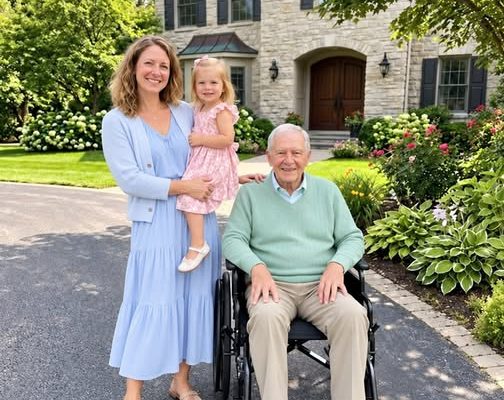
My fingers closed around the little brass key, but suddenly it felt heavier than the entire house.
The lawyer—Mr. Bennett—watched me carefully from across Richard’s old sitting room.
Outside, rain streaked the windows in thin gray rivers. Only yesterday, the same windows had reflected black umbrellas, solemn faces, and the slow procession of people leaving Richard’s f/u/neral.
Now the house was almost silent.
Almost.
I could still hear Emily upstairs moving around in her bedroom.
I could still smell Richard’s cedarwood aftershave lingering faintly near his favorite chair.
I could still imagine him there, wrapped in his old blue blanket, complaining that television reporters used too many dramatic pauses.
And now a stranger was telling me that the man I had slept beside for five years had planned something behind my back from the very beginning.
I looked again at the photograph.
Richard.
My foster mother.
The group home.
Then I turned it over and read those seven words again.
She never loved my money. Now tell her.
“What exactly am I supposed to find in this box?” I asked.
Mr. Bennett folded his hands.
“I’m not authorized to tell you.”
“Not authorized by whom? Richard is d/e/@/d.”
The words hurt as soon as they left my mouth.
Mr. Bennett’s face softened.
“Richard gave me very specific instructions. He said you had to see the contents yourself.”
I laughed once, but there was no humor in it.
“Of course he did.”
Mr. Bennett said nothing.
I stood.
For five years, I had believed I understood the man I married.
Richard liked black coffee with one spoonful of honey.
He hated socks in bed.
He cried secretly during old war movies and denied it every single time.
He kept every drawing Emily gave him, even the ridiculous one where she had drawn him as a purple dinosaur wearing a crown.
He used to call her Little Bishop because she loved chess.
He called me Honey even when we argued.
And when his legs stopped working properly, he would grip my hand before I pushed his wheelchair down the garden path and whisper, “Don’t let me become smaller just because my world got smaller.”
That was Richard.
Or so I had thought.
Now I didn’t know who he had been.
And worse—
I didn’t know who my first husband had been either.
“Where is this box?” I asked.
Mr. Bennett stood and buttoned his coat.
“First National Trust. Downtown branch.”
“I want to go now.”
“That’s what Richard expected.”
I looked at him sharply.
The faintest hint of amusement touched his face.
“He knew you well.”
“No,” I whispered. “Apparently, he knew me better than I knew him.”
Forty-five minutes later, I was sitting in the back of a taxi with the brass key digging into my palm.
I had called our neighbor, Mrs. Harper, and asked her to stay with Emily.
Emily was six now.
Old enough to understand that Richard wasn’t coming home.
Too young to understand anything else.
She had cried herself to sleep for three nights in a row before the f/u/neral.
When I told her I needed to go out with Mr. Bennett, she asked one question.
“Is it something Grandpa Richard left?”
My throat tightened.
Emily had started calling him Grandpa Richard when she was three.
Richard had never corrected her.
Neither had I.
“Yes,” I told her.
She stared at me with those enormous brown eyes she had inherited from her father.
“Then come back.”
I nearly broke right there.
“I will.”
She held out her little finger.
“Promise?”
I hooked mine around hers.
“Promise.”
Now, watching the city blur past through the wet glass, I realized how many promises I had already made to people who vanished anyway.
My parents.
My foster families.
My first husband.
Richard.
Maybe that was why I had stopped believing promises meant anything.
They were only words people said before life decided otherwise.
Mr. Bennett sat beside me, silent.
May you like




Finally, I asked, “Did you know my first husband?”
“No.”
“But Richard did?”
“I said Richard may have known of him.”
“That’s not the same thing.”
“No.”
I turned toward him.
“Did Daniel know Richard?”
Mr. Bennett stared ahead.
“I don’t know.”
His answer sounded genuine.
That frightened me more than a lie would have.
First National Trust occupied an old stone building between two modern glass towers.
We were led downstairs into a private vault.
The bank manager checked my identification twice.
My maiden name.
My birth date.
My signature.
Then she disappeared behind a steel door and returned carrying a long, narrow metal box.
She placed it on the table.
“Take all the time you need.”
The door shut behind her.
I inserted Richard’s brass key.
My hand shook.
Mr. Bennett stood several feet away.
“You can leave,” I said.
“I can.”
He didn’t move.
“But Richard asked me to stay nearby.”
I almost snapped at him.
Instead, I turned the key.
Click.
The lid opened.
For several seconds, I didn’t understand what I was seeing.
There were no stacks of money.
No jewelry.
No secret property documents.
Only papers.
A small wooden box.
Three photographs.
And an old envelope with my name written on it.
Not my married name.
My maiden name.
Anna Ellis.
The handwriting wasn’t Richard’s.
I knew it instantly.
I stopped breathing.
“No.”
Mr. Bennett moved closer.
I touched the envelope.
The letters blurred.
I had seen that handwriting on grocery lists.
Birthday cards.
A note once taped to our broken refrigerator that read:
DO NOT OPEN. IT IS MAKING A SOUND LIKE A DYING TRACTOR.
Daniel.
My first husband.
Daniel had written my name on that envelope.
I sank into the chair.
My knees stopped working.
“This isn’t possible.”
Mr. Bennett’s expression tightened.
I tore the envelope open.
Inside was one folded page.
The date in the top corner was eleven years old.
Three months before Daniel received his c/@/ncer diagnosis.
I read.
Anna,
If you are reading this, Richard finally decided you were ready.
I dropped the page.
My heart slammed against my ribs.
“Ready for what?”
Mr. Bennett picked up the page but didn’t read it.
He handed it back.
“Keep going.”
I wanted to scream at him.
Instead, I forced my eyes down.
You’re going to be angry.
You should be.
But please understand one thing before anything else: I loved you. Every ordinary morning. Every argument. Every night we ate noodles because we couldn’t afford anything better. Every time you fell asleep with your feet freezing against my legs. Every second with Emily. None of that was fake.
Tears fell onto the paper.
I wiped them away furiously.
There was something about my life before you that I never told you.
When I was seventeen, I ran away from the group home for three days. I thought nobody would notice. Richard did.
I stared at the sentence.
Daniel had lived at a different foster home from mine.
We met later.
At least that was what he told me.
I kept reading.
Richard found me sleeping behind a repair shop. He bought me breakfast and made me help him change a flat tire because he said charity without dignity was just another kind of cage.
Despite everything, I could hear Richard saying that.
It sounded exactly like him.
He helped me get my mechanic apprenticeship. He paid anonymously. I only learned years later.
When I met you, I discovered you came through one of the homes he supported too.
I joked that Richard had probably built our whole marriage like some old millionaire matchmaker. He told me I was an idiot.
A sob escaped me.
I covered my mouth.
Mr. Bennett looked away, giving me the privacy of pretending not to notice.
Then something happened.
My eyes slowed.
I found documents at the garage connected to a company called Vale Meridian. I didn’t understand them at first. Richard did.
They involved money meant for children aging out of foster care. Scholarships. Medical support. Housing grants. Millions disappeared before reaching them.
My stomach tightened.
Richard suspected someone had been stealing from the foundation system for years.
He asked me to help trace vehicle records and maintenance invoices connected to shell companies. I agreed.
I thought I was doing something good.
Then someone realized I was looking.
I stopped.
The room suddenly felt cold.
My mind filled with the last year of Daniel’s life.
His weight disappearing.
His trembling hands.
The hospital corridors.
The specialists.
The nights he vomited until he had nothing left.
The diagnosis.
The certainty.
The helplessness.
“No,” I whispered.
Mr. Bennett’s eyes lowered.
I kept reading.
If Richard gives you this letter, it means he discovered what really happened.
The next line had been underlined twice.
Anna, I was already sick. But Richard believed someone may have tampered with records surrounding my treatment because they were afraid I had left evidence behind.
I felt suddenly nauseated.
“Tampered?”
Mr. Bennett stepped forward.
“Anna—”
“What does that mean?”
“I don’t know all of it.”
“What does that mean?”
My voice echoed inside the vault.
Mr. Bennett remained calm.
“Richard spent years investigating several irregularities connected to Daniel’s medical records. He never claimed anyone caused Daniel’s illness. He believed there may have been interference after the diagnosis—misdirected files, altered appointments, missing reports.”
I stared at him.
“But why?”
“To find something Daniel had hidden.”
My eyes returned to the letter.
I made copies.
Richard told me not to keep them at home. I didn’t.
If I d/i/e before this is resolved, there’s one person you must never trust just because he sounds helpful.
My pulse pounded.
The next part had been scratched out.
Not once.
Over and over.
Someone had tried to make the name unreadable.
But beneath the black ink, I could see the final letters.
…son
“Who did this?” I whispered.
Mr. Bennett took the letter.
His face changed.
He hadn’t known.
“This letter was sealed when Richard deposited it.”
“So Richard crossed out the name?”
“I can’t say.”
“Could someone else access this box?”
“Not legally.”
That answer did not help.
I looked inside again.
Three photographs.
The first showed Daniel at about eighteen, laughing beside Richard in front of a garage.
The second showed Richard with several young men and women outside a vocational training center.
And the third—
My stomach dropped.
It showed Daniel in a hospital parking lot.
He looked thin.
Weak.
He was leaning against his old pickup truck.
Standing beside him was a man in a dark overcoat.
I knew that man.
I looked slowly toward Mr. Bennett.
Because the man in the photograph was him.
“Explain this.”
He took the picture.
His color vanished.
“I’ve never seen this photograph.”
“You’re standing beside my husband.”
“I know what it looks like.”
“What it looks like?”
I shoved back from the table.
“Daniel wrote that I should never trust someone whose name ends in ‘son.’ Your name is Bennett.”
He stared at me.
Exactly.
Not him.
But then I looked at the photograph again.
On the back, in Richard’s handwriting, was one sentence.
Ask Bennett who introduced him to Harrison.
“Harrison,” I said.
Mr. Bennett closed his eyes.
And then he whispered a curse.
“Who is Harrison?”
Mr. Bennett slowly sat down.
“My former law partner.”
“When?”
“Eleven years ago.”
The same year Daniel became ill.
“What was his full name?”
Mr. Bennett’s voice was barely audible.
“Charles Harrison.”
Something cold crawled across my skin.
“What did he have to do with Daniel?”
“I don’t know.”
“You were in the photograph!”
“Yes.”
“Then stop saying you don’t know!”
Mr. Bennett slammed the photograph onto the table.
“Because I was there for Richard!”
His sudden anger stunned me.
He took a breath.
Lowered his voice.
“Richard called me. He said a young mechanic had documents that might expose financial misconduct involving a nonprofit network. I met Daniel twice.”
My chest tightened.
“Twice?”
“The hospital parking lot was the second time.”
“Why didn’t you tell me?”
“Richard ordered me not to.”
“Richard is d/e/@/d!”
“Yes,” Bennett snapped. “And until thirty minutes ago, I believed the only secret he left me to disclose involved your inheritance.”
Silence swallowed us.
He rubbed a hand over his face.
“Harrison worked with several charitable trusts. Richard suspected him briefly, but there was never enough evidence.”
“Where is he now?”
Bennett looked at me.
“Retired.”
“Alive?”
“Yes.”
“Where?”
Before he answered, I noticed the wooden box.
It was small enough to fit in my palm.
A brass latch held it closed.
Inside was a flash drive.
A child’s silver bracelet.
And a tiny folded note.
The bracelet made me freeze.
It had one charm.
A little crescent moon.
I remembered it.
I had worn that bracelet until I was nine.
Then it disappeared.
My foster mother told me I must have lost it.
I picked it up.
On the back of the moon charm were two tiny engraved initials.
A.E.
“How did Richard get this?”
Bennett didn’t answer.
I opened the note.
Only one sentence.
The story did not begin with Daniel. It began with your mother.
I stared at those words until my vision blurred.
“My mother died when I was a baby.”
“That’s what your records say,” Bennett said.
“What are you implying?”
“I’m not implying anything.”
But his voice had changed.
I reached for the flash drive.
There was a label taped to it.
FOR ANNA — PLAY ALONE
Bennett saw it too.
He stood.
“I’ll step outside.”
“No.”
“Anna—”
“No more secrets. Play it here.”
“There’s no computer.”
“There’s one upstairs.”
The bank manager allowed us into a private conference room.
I inserted the drive.
One video file appeared.
Nothing else.
The filename was:
MARGARET_ELLIS_FINAL
Margaret.
My mother’s name.
My entire body went numb.
I clicked.
The screen remained black for several seconds.
Then an image flickered into focus.
An older woman sat at a table.
Gray hair.
Thin shoulders.
Blue cardigan.
Her face was pale and lined.
She looked straight into the camera.
And I screamed.
Not because I recognized her.
Because I recognized myself.
The eyes.
The shape of the mouth.
The tiny crooked tilt of one eyebrow.
She was me thirty years from now.
The woman on the screen took a shaky breath.
“Anna,” she said.
My fingers went numb.
“If Richard kept his promise, you’re watching this after I’m gone.”
I stared at the date.
Seven years ago.
My mother had been alive.
While I was married to Richard.
While I was raising Emily.
While I had spent every birthday believing no one in the world shared my bl/o/od.
“She was alive,” I whispered.
Bennett looked stunned.
Onscreen, my mother continued.
“You were told I abandoned you.”
My breath trembled.
“That wasn’t true.”
She looked away for a moment.
When she looked back, she was crying.
“I was nineteen when I had you. Your father was wealthy. Powerful. Married.”
I gripped the edge of the desk.
“He wanted you gone from his life.”
Her lips trembled.
“I refused.”
She swallowed.
“So his people made me disappear instead.”
I felt a chill.
“They accused me of neglect. They buried me in court hearings. They told me if I kept fighting, I would never see you again.”
My mother reached offscreen and picked up a photograph.
She held it toward the camera.
A baby.
Me.
Wrapped in a yellow blanket.
“I spent eleven years trying to get you back.”
My chest cracked open.
“Eleven years,” she repeated. “And every year, somebody moved you.”
Images flooded my mind.
Different houses.
Different families.
Different schools.
The red suitcase that never fully unpacked.
“They made you impossible to find.”
She wiped her cheek.
“Until Richard found me.”
I turned toward Bennett.
He looked equally shocked.
“Richard discovered what happened through the foundation. He promised to help me.”
Her voice weakened.
“But by then, you were almost grown.”
She closed her eyes.
“When you finally aged out, I was terrified.”
My stomach twisted.
“Terrified that if I appeared in your life after all those years, you would hate me.”
I started crying harder.
“So I waited.”
She gave a sad smile.
“Cowardly, maybe.”
“No,” I whispered to the screen.
“Then Richard told me you met Daniel.”
A faint spark entered her eyes.
“He told me you laughed again.”
My hands covered my mouth.
“Then Emily was born.”
My mother smiled.
“I saw one photograph.”
Her face lit with a love that crossed seven years and hit me like sunlight.
“My granddaughter was beautiful.”
I sobbed.
Bennett quietly walked to the other side of the room.
“Richard wanted me to meet you,” she said. “I planned to.”
Her smile disappeared.
“But then I learned who your father was.”
My heart stopped.
She leaned toward the camera.
“And I learned he was connected to Vale Meridian.”
The same company from Daniel’s letter.
My mother whispered the next words.
“Anna, the money Daniel found was connected to the same man who took you from me.”
I could barely breathe.
“Your father.”
She hesitated.
Then said his name.
“Charles Harrison.”
The screen went black.
For a moment, neither Bennett nor I moved.
Then I heard him whisper:
“Oh God.”
Charles Harrison.
His former law partner.
The name Daniel had apparently tried to warn me about.
My father.
The man whose actions had separated me from my mother.
The man connected to millions missing from programs for foster children.
Bennett stumbled backward.
“There’s more.”
I looked at the screen.
The video had ended.
“What?”
He pointed at the flash drive.
Another folder had appeared.
It had been hidden until the video finished playing.
Inside were hundreds of scanned documents.
Bank records.
Trust agreements.
Invoices.
Letters.
And one folder titled:
EMILY
My entire body turned to ice.
I clicked.
Inside was a single PDF.
A legal petition filed six months earlier.
Someone had quietly begun proceedings challenging my legal guardianship over certain assets associated with Emily.
I didn’t understand.
“What assets?”
Bennett leaned over the screen.
He read three lines.
Then he went completely still.
“What?”
He didn’t answer.
“Mr. Bennett, what?”
He turned to me.
“Richard didn’t leave his fortune directly to you.”
“I know.”
“He left most of it to the foster foundation.”
“Yes.”
“But Daniel apparently owned something.”
My breath caught.
“What?”
Bennett scrolled.
“A minority stake in a company.”
“That’s impossible.”
“According to this, Richard transferred shares to Daniel years before you met.”
“Why?”
Bennett kept reading.
Then his face changed again.
“Oh.”
“What?”
He looked at me.
“Richard wasn’t simply helping Daniel.”
He rotated the laptop.
There, beneath a corporate document, I saw Daniel’s name.
And Richard’s.
The company had been created to acquire abandoned properties and convert them into transitional housing for foster children.
Daniel owned ten percent.
After Daniel’s d/e/@/th, the shares should have passed to me.
They never did.
Instead, they had been placed into an inactive trust.
A trust controlled by—
I knew the name before I read it.
Charles Harrison.
“He stole from Daniel,” I whispered.
Bennett shook his head.
“Maybe not.”
“What do you mean?”
“This trust document gave Harrison temporary control under one condition.”
“What condition?”
Bennett stared at the final page.
“If Daniel’s spouse remarried Richard.”
I blinked.
“That makes no sense.”
“It gets worse.”
He scrolled down.
The document was signed ten years ago.
Years before Richard proposed to me.
Someone had anticipated my marriage to Richard.
My marriage hadn’t merely been predicted.
It had been written into legal paperwork before it happened.
I stepped away from the computer.
“No.”
“Anna—”
“No.”
I looked around the little conference room as though the walls had suddenly become too close.
“This whole thing was planned?”
“I don’t know.”
“Daniel knew Richard. Richard knew my mother. Richard knew Daniel. Harrison knew Richard. Harrison was my father. And somehow a legal document written years before my second marriage contains my second marriage as a condition?”
Bennett’s face had gone pale.
“There is only one explanation.”
“What?”
“Someone expected Richard to marry you.”
“That’s impossible.”
“Unless…”
He stopped.
“Unless what?”
“Unless Richard and Daniel planned it.”
I stared at him.
My grief transformed into something hotter.
Something sharper.
I had spent five years caring for Richard.
Bathing him when he was too weak to stand.
Sleeping in hospital chairs.
Massaging his swollen hands.
Listening to him talk about his childhood at two in the morning.
Had all of it been arranged?
Had I been chosen?
Observed?
Tested?
Manipulated?
My phone rang.
Emily.
I answered immediately.
“Sweetheart?”
No response.
“Emily?”
Then Mrs. Harper’s voice came through.
“Anna?”
Something was wrong.
“What happened?”
“I’m so sorry. I went to the kitchen for maybe two minutes.”
Cold dread flooded me.
“What happened?”
“The front door was open.”
My breath vanished.
“Where is Emily?”
“I don’t know.”
“WHAT DO YOU MEAN YOU DON’T KNOW?”
“I looked everywhere!”
The room spun.
Then another voice came through.
A man’s voice.
Calm.
Older.
“Anna?”
I froze.
“Who is this?”
A soft chuckle.
“You already know.”
Bennett heard it through the speaker.
His face drained of color.
He mouthed one name.
Harrison.
The voice continued.
“I think it is finally time a father met his daughter.”
I gripped the phone so hard my fingers hurt.
“Where is Emily?”
“She’s safe.”
“If you hurt her—”
“I have never hurt a child in my life.”
The lie was so enormous I almost laughed.
“You stole my childhood.”
Silence.
Then he sighed.
“Richard filled your head with stories.”
“My mother told me.”
Another silence.
This one different.
“You found Margaret’s recording.”
“Yes.”
“I wondered where he hid it.”
“Where is my daughter?”
“Come home.”
“I’m coming.”
“Alone.”
“No.”
“Then you may spend the rest of your life wondering what Richard was really trying to do.”
He hung up.
I grabbed my coat.
Bennett caught my arm.
“You cannot go alone.”
“He has Emily.”
“He wants you emotional.”
“He has my daughter!”
“And if you walk into that house without understanding what he wants, you could lose far more than an argument.”
I pulled free.
“I already lost everyone once.”
My voice broke.
“I am not losing her.”
Bennett grabbed the flash drive.
“Then I’m coming.”
“He said alone.”
“I’ll stay out of sight.”
We ran from the bank.
I don’t remember the taxi ride back.
I remember rain.
I remember traffic lights taking forever.
I remember calling Mrs. Harper, who was sobbing.
I remember Emily’s chess set still open on the kitchen table when I burst through the front door.
One white bishop lay on its side.
And beside it—
A note.
Three words.
Library. Come alone.
Richard’s library.
I crossed the hallway.
Opened the door.
Charles Harrison sat in Richard’s chair.
He was eighty now.
Thin.
Perfectly dressed.
Silver hair combed back.
A cane rested against one knee.
And beside him—
Emily.
She sat on the rug eating crackers.
She looked up.
“Mommy!”
I almost collapsed.
She ran into my arms.
I held her so tightly she squeaked.
“Mom!”
“Are you okay?”
“Yes.”
“Did he touch you?”
“He gave me cookies.”
Harrison looked offended.
“They are expensive biscuits.”
I glared at him.
“You entered my home and took my daughter.”
“She opened the door.”
“She is six!”
“And remarkably trusting.”
I moved Emily behind me.
“You have thirty seconds to explain why I shouldn’t call the police.”
His eyes flicked toward the hallway.
“You already did.”
I froze.
He smiled faintly.
“Or Bennett did.”
I heard movement outside.
Then Bennett appeared in the doorway.
Harrison sighed.
“Still predictable, Thomas.”
Bennett stared at him.
“Charles.”
They looked at each other like two men standing on opposite sides of a grave.
I held Emily close.
“Start talking.”
Harrison leaned back.
“Richard made a terrible mistake.”
“What?”
“He believed the missing foundation money was stolen.”
“It was.”
“No.”
Harrison’s eyes sharpened.
“It was hidden.”
“By you?”
“Yes.”
Bennett stepped forward.
“Charles—”
“Quiet.”
Harrison looked only at me.
“Thirty-eight years ago, several wealthy donors discovered that children in state care were being exploited by people who knew those children had no families capable of protecting them.”
My stomach tightened.
“Money disappeared. Records disappeared. Children were moved.”
My mother’s words echoed.
Every year, somebody moved you.
Harrison continued.
“Richard wanted to expose everyone publicly.”
“And you didn’t?”
“I wanted proof.”
“You took my mother’s child.”
For the first time, Harrison’s expression cracked.
“No.”
I laughed bitterly.
“My records say otherwise.”
“Your records were falsified.”
“By whom?”
“By the people we were investigating.”
Silence.
I stared at him.
“You expect me to believe you were trying to protect me?”
“No.”
His voice softened.
“I expect you to hate me.”
That answer caught me off guard.
“Because I deserve at least some of it.”
He looked toward Emily.
“I was your biological father.”
My chest tightened.
“But I did not know Margaret was pregnant until after you entered care.”
My breath stopped.
He continued.
“When I found out, I tried to locate you.”
“My mother said you wanted me gone.”
“She believed that.”
“Was she lying?”
“No.”
The answer stunned me.
“She was told I wanted you gone.”
“By whom?”
Harrison looked at Bennett.
Bennett whispered, “Richard?”
Harrison smiled without humor.
“No.”
Then he said a name neither of us expected.
“Margaret’s foster mother.”
My mind blanked.
“The woman in the photograph?”
“Yes.”
“The woman Richard knew?”
“Yes.”
Harrison leaned forward.
“Anna, your foster mother was not merely a foster parent.”
My skin prickled.
“She was one of the people managing the stolen-money network.”
I could not speak.
“The group home Richard funded was being used to funnel grants into private accounts.”
Harrison tapped his cane once against the floor.
“When Margaret tried to recover custody of you, she was deliberately fed false information about me. I was deliberately fed false information about her.”
“Why?”
“Because if we reunited, we might compare stories.”
The room went silent.
“And discover the same people had lied to both of you,” Bennett said.
Harrison nodded.
“Exactly.”
I felt sick.
“Then why hide the money?”
“Because once we realized how deep the network went, Richard and I disagreed.”
“About what?”
“He wanted to destroy it immediately.”
“And you?”
“I wanted to steal their stolen money before they could move it.”
Bennett actually laughed.
“You insane bastard.”
Harrison shrugged.
“I never claimed elegance.”
My anger surged.
“You moved millions?”
“Into protected trusts.”
“In your name!”
“Temporarily.”
“For decades?”
“The trustees started d/y/ing. People disappeared. Evidence vanished. Richard stopped trusting me. I stopped trusting Richard.”
I looked at him in disbelief.
“You ruined lives because two rich old men couldn’t trust each other?”
His face tightened.
“Yes.”
That was the first truly honest thing he had said.
I looked at Emily.
Then back at him.
“What does Daniel have to do with this?”
Harrison closed his eyes.
When he opened them, they were wet.
“Everything.”
He reached inside his coat.
I instinctively stepped back.
But he removed only an envelope.
“Daniel discovered the missing accounts.”
“I know.”
“He thought I was stealing.”
“You were.”
“I was concealing.”
“That distinction doesn’t impress me.”
“It shouldn’t.”
He handed the envelope to Bennett.
“Daniel confronted Richard.”
I looked at Bennett.
“He convinced Richard to stop protecting secrets.”
My chest tightened.
“Daniel was going to expose it?”
“Yes.”
“Then he got sick.”
“Yes.”
“Did anyone interfere with his treatment?”
Harrison’s jaw tightened.
“Appointments were altered. Files were delayed.”
“By whom?”
“We never proved it.”
I heard the fury in his voice.
“But it frightened Richard.”
Harrison looked around the library.
“He believed the old network was still active.”
“So he made me marry him?”
Harrison surprised me by laughing.
“No.”
The sound was almost warm.
“Richard spent two years insisting he would never do something so manipulative.”
I stared.
“Then why was the marriage written into the trust?”
“Because Daniel wrote it.”
The room went utterly still.
“What?”
Harrison nodded toward the envelope.
“Read it.”
Inside was another letter.
Daniel’s handwriting.
My hands shook.
Richard,
If things go badly, promise me something ridiculous.
I couldn’t breathe.
Anna is going to be alone. She will pretend she is fine. She won’t be.
Tears blurred the page.
She will work until she collapses before asking anyone for help.
A broken laugh escaped me.
Daniel knew me.
Of course he did.
So if she ever reaches a point where she has nowhere to go, ask her to marry you.
I stared.
Bennett muttered, “My God.”
I kept reading.
Yes, I know you are almost forty years older than her.
Yes, I know she may throw something at you.
No, I am not joking.
I could almost hear Daniel laughing.
If she says yes only because she is desperate, give her a home.
If she stays only for money, forgive her.
But if she stays after she no longer needs you, if she cares for you when there is nothing glamorous left, then you will know what I already know.
My tears fell faster.
Anna does not abandon people.
I covered my mouth.
When you know that, tell her everything.
Tell her about Margaret.
Tell her about Harrison.
Tell her about the trust.
And make sure Emily inherits enough to never be trapped by poverty the way Anna was.
I could not see the final lines.
I wiped my eyes.
One more thing.
Don’t let Anna think this means I wanted her to spend her life grieving me.
If she ever loves you, let her.
You are not replacing me.
You are helping me keep my family safe after I cannot.
—Daniel
I sank to the floor.
Emily knelt beside me.
“Mommy?”
I hugged her.
Richard’s proposal.
His kindness.
His strange sadness whenever I mentioned Daniel.
The way he once told me, “Some promises survive the people who make them.”
I had thought he was speaking about his late wife.
He wasn’t.
He had been speaking about Daniel.
The room blurred.
Then Harrison spoke.
“There is still one thing Richard never understood.”
I looked up.
“What?”
Harrison glanced toward the fireplace.
“There is something hidden in this house.”
Bennett frowned.
“What?”
“Daniel’s original evidence.”
My heart pounded.
Harrison pointed to Richard’s chess table.
“Daniel hid it in the only place he knew Richard would never throw away.”
I looked at the board.
Emily suddenly gasped.
“The bishop.”
Everyone turned toward her.
She ran to the chessboard and picked up Richard’s old white bishop.
“This one rattles.”
She shook it.
Click.
Something moved inside.
My hands trembled.
Richard had taught Emily chess using that exact set.
For five years it had sat in plain sight.
Harrison unscrewed the base.
A tiny memory card fell into his palm.
Bennett stared.
“Daniel hid it there?”
Harrison smiled.
“No.”
I looked at him.
“Then who did?”
He held the card up.
“Richard.”
Outside, a siren wailed somewhere far away.
Closer.
Closer.
Harrison’s smile disappeared.
“Which means he found Daniel’s original evidence before he d/i/e.”
Bennett looked toward the windows.
“And if someone else knows Richard found it…”
A loud crash shattered the silence from the back of the house.
Emily screamed.
I pulled her into my arms.
Bennett turned.
Harrison stood with surprising speed for an eighty-year-old man.
Footsteps thundered down the corridor.
Not one person.
Several.
Someone had entered Richard’s house.
And whoever they were—
they had come for the bishop.
“Don’t stop here—the ending will leave you stunned. Continue reading the next chapter below.”
The footsteps stopped outside the library.
For one impossible second, nobody moved.
Emily’s fingers dug into my coat.
Harrison still held the tiny memory card.
Bennett stood between us and the door.
Then someone knocked.
Three polite taps.
That frightened me more than shouting would have.
Bennett whispered, “Behind the desk.”
I pulled Emily down with me.
Harrison slipped the memory card into his sleeve.
The handle turned.
Locked.
Another knock.
Then a man’s voice.
“Mr. Harrison?”
Harrison’s face changed.
He knew the voice.
“Who is it?” Bennett whispered.
Harrison said nothing.
The man outside spoke again.
“We only need what Richard left behind.”
Bennett’s jaw tightened.
“Police are already coming.”
The man laughed softly.
“No, they aren’t.”
My stomach dropped.
The sirens I had heard—
They stopped abruptly outside the estate gates.
The lights flickered.
Then went out.
Emily whimpered.
I pressed her face against my shoulder.
Emergency lights glowed faint red along the hall.
Harrison muttered, “Richard installed a backup generator.”
Bennett answered, “Someone disabled it.”
The person outside knocked again.
“Last chance.”
Harrison surprised me.
He walked toward the door.
“What are you doing?”
“Buying time.”
I grabbed his sleeve.
“You’re eighty years old.”
He gave me a dry look.
“Thank you for the update.”
Then he opened the door.
Three men stood outside.
None wore masks.
That made them more terrifying.
The first was perhaps fifty.
Gray suit.
Calm eyes.
Wet hair from the rain.
Behind him stood two larger men.
I knew the first man.
I had seen him at Richard’s f/u/neral.
Front row.
Crying.
He had introduced himself as Paul Mercer, director of Richard’s foster foundation.
“Anna,” he said gently.
As if we had met for coffee.
“You shouldn’t be here for this.”
My stomach twisted.
Harrison gave a bitter laugh.
“Mercer.”
Paul Mercer smiled.
“Charles.”
Bennett stepped forward.
“You run the foundation.”
“I do.”
“You’re the one filing against Emily.”
Mercer’s smile vanished.
“So Richard left more documentation than expected.”
My heart pounded.
Richard’s charitable foundation.
The organization supposed to receive almost everything.
Mercer had been running it for twelve years.
Which meant—
“You were waiting for Richard to d/i/e,” I whispered.
His eyes moved to me.
“Everyone dies eventually.”
“Why Emily?”
“She inherited Daniel’s corporate share.”
“So?”
“That share carries voting rights.”
Harrison answered for me.
“Enough voting rights to audit the foundation’s property subsidiaries.”
Mercer’s expression sharpened.
I looked between them.
“What does that mean?”
Harrison spoke quickly.
“Richard’s foundation owns transitional housing. Schools. Clinics.”
Mercer added pleasantly, “Very valuable land.”
My bl/o/od went cold.
“You’re selling properties meant for foster children.”
“Not all of them.”
He said it casually.
Like discussing furniture.
Bennett stared at him.
“You’re stripping assets.”
Mercer shrugged.
“Underperforming assets.”
“Children’s homes?”
“Buildings.”
Something inside me hardened.
I thought of every suitcase I had carried as a child.
Every unfamiliar ceiling.
Every adult who called me sweetheart before deciding I was too difficult, too quiet, too angry, too expensive.
And this man saw places meant to shelter children like me as buildings.
“You altered Daniel’s records,” I said.
Mercer’s eyes flickered.
That was enough.
“You did.”
“I moved paperwork.”
“You interfered with a sick man’s treatment.”
“I never caused Daniel’s c/@/ncer.”
Harrison’s voice turned icy.
“But you delayed consultations.”
Mercer looked irritated.
“He had documents.”
My stomach lurched.
“You were searching for them.”
“Yes.”
“And after he d/i/ed?”
“We assumed Richard had them.”
“So you stayed close.”
“I worked for him.”
“You watched him.”
“Yes.”
“Then why didn’t you find the memory card?”
Mercer smiled.
“Because Richard was smarter than he looked.”
I almost laughed.
Richard had never looked unintelligent a day in his life.
Mercer held out his hand.
“Give me the card.”
Harrison smiled.
“No.”
One of the men behind Mercer stepped forward.
Bennett immediately moved between him and Harrison.
Mercer sighed.
“Please don’t make this theatrical.”
“You broke into a mansion during a thunderstorm,” Bennett said. “You made it theatrical.”
May you like
Even Harrison chuckled.
Mercer’s face tightened.
“Enough.”
He nodded.
The larger man seized Bennett.
Emily screamed.
I shoved her behind the desk and grabbed the first thing my hand found—
Richard’s bronze chess clock.
I swung.
It struck the man’s shoulder.
He cursed and stumbled.
Mercer shouted.
Chaos exploded.
Bennett broke free.
Harrison slammed his cane against another man’s shin.
I pushed Emily toward the side door.
“Run to the pantry!”
She ran.
I followed.
Then a hand caught my hair.
Pain tore through my scalp.
I twisted.
Mercer grabbed my wrist.
“You have no idea what you are doing!”
“You took my daughter from me once already!”
His expression changed.
“What?”
I realized what I had said.
Not him.
The system.
The network.
Everyone.
Every person who had turned children into paperwork.
I drove my heel down onto his foot.
He released me.
I ran.
Emily had reached the pantry.
Richard’s kitchen occupied the oldest part of the house.
Thick stone walls.
One narrow window.
And, because Richard was Richard, a ridiculous hidden dumbwaiter he had restored for Emily because she liked sending stuffed animals upstairs in it.
I shoved the pantry door closed.
Locked it.
“Mommy, I’m scared.”
“I know.”
“Are they bad people?”
I crouched.
“Listen to me.”
Her eyes filled with tears.
“You remember the little elevator Grandpa Richard fixed?”
She nodded.
“You’re going inside.”
“No!”
“Emily.”
“No, Mommy!”
I took her face gently.
“You are the bravest girl I know.”
Her lip trembled.
“You told me brave people can still be scared.”
Richard had told her that.
I nearly cried.
“He was right.”
I opened the dumbwaiter.
Barely large enough.
“Go upstairs. Get out in the linen closet. Then hide in Grandpa Richard’s room.”
“What about you?”
“I’ll come.”
“Promise?”
Footsteps approached.
I kissed her forehead.
“Promise.”
She climbed inside.
I pulled the old rope.
The dumbwaiter rose.
I heard her whispering to herself.
“Knight takes bishop. Bishop takes queen. Queen takes…”
Then she was gone.
Someone slammed into the pantry door.
I backed away.
Once.
Twice.
The lock splintered.
Mercer entered.
His suit was torn.
His lip was cut.
He looked less civilized now.
“Where is she?”
I said nothing.
He glanced upward.
His eyes found the dumbwaiter.
“Clever.”
He moved toward it.
I blocked him.
“No.”
He stared at me.
“You think Richard saved you?”
“He gave us a home.”
“He used you.”
My chest tightened.
Mercer saw it.
He smiled.
“You know that, don’t you?”
“Move.”
“He studied you for years.”
“I know.”
“He arranged your employment.”
My stomach dropped.
“You didn’t know that part.”
I stared.
Mercer stepped closer.
“Richard purchased the cleaning agency six months before you were assigned here.”
I felt dizzy.
“He created your job.”
“Yes.”
“Why?”
“Because Daniel asked him to watch over you.”
Mercer’s smile widened.
“Romantic, isn’t it?”
His mockery cut deep.
“Your first husband turned you into a project.”
“No.”
“Your second husband turned you into an experiment.”
“No.”
“And you still think you were loved?”
That one landed.
Because beneath everything—
I had wondered.
Since Bennett first handed me the key.
Had Richard loved me?
Or had he merely fulfilled Daniel’s request?
Had every gentle touch been duty?
Every shared laugh?
Every evening by the fireplace?
Every whispered goodnight?
Mercer saw doubt in my face.
“That’s why Richard never told you the truth.”
I forced myself to breathe.
“You didn’t know Richard.”
“I worked beside him for twelve years.”
“You knew his money.”
Mercer’s eyes narrowed.
“You knew his schedules.”
I stepped closer.
“His files.”
Another step.
“His signatures.”
I was almost nose-to-nose with him.
“But I knew how he took his coffee.”
Mercer stared.
“I knew he hated thunderstorms because his childhood group home had a metal roof that made every storm sound like the world was ending.”
My voice shook.
“I knew he pretended he didn’t like cats because he once cried for three days when his childhood cat vanished.”
Mercer’s expression hardened.
“I knew he kept chocolate in the bottom drawer of his desk even though his doctor told him not to.”
I whispered:
“And I knew he loved my daughter.”
Mercer said nothing.
“So whatever Richard did wrong, whatever he hid from me, you don’t get to tell me what he felt.”
I shoved the pantry shelf.
It tipped.
Glass jars crashed.
Mercer jumped back.
I ran.
He chased me into the kitchen.
Someone shouted from the library.
Then the lights suddenly returned.
Every lamp blazed.
The security alarm screamed.
Mercer froze.
A voice boomed from hidden speakers.
Richard’s voice.
“Paul.”
Everyone stopped.
Even me.
Richard’s prerecorded voice filled the house.
“If you are hearing this, then Thomas Bennett entered the emergency code.”
Bennett appeared in the hallway holding his phone.
His nose was bl/o/ody.
But he smiled.
Mercer’s face collapsed.
Richard continued.
“And if Thomas entered the emergency code, it probably means someone is trying to steal whatever I left Anna.”
Mercer whispered, “No.”
Richard’s voice became almost amused.
“So I have automatically transmitted copies of every protected archive in this residence to six law firms, three journalists, and the state attorney general.”
Harrison emerged behind Bennett.
His glasses were crooked.
He looked delighted.
Richard continued:
“Paul, if it is you, I am especially disappointed.”
Mercer went white.
“Because I really did like you.”
Police vehicles flooded the driveway.
Real ones this time.
Blue lights flashed across the windows.
Mercer looked toward the door.
Then at me.
Then toward the dumbwaiter.
“Where is the card?”
Harrison smiled.
“What card?”
Mercer lunged.
Police burst through the front entrance.
Everything happened in seconds.
Shouting.
Hands raised.
Mercer’s men dropped to the floor.
Mercer tried to run through the garden.
He slipped in the rain before making it ten yards.
No heroic confrontation.
No dramatic escape.
Just a wealthy man in an expensive suit landing face-first in mud.
Richard would have loved the irony.
I ran upstairs.
“Emily!”
No answer.
My heart stopped.
I searched Richard’s bedroom.
Empty.
Bathroom.
Empty.
Closet.
Then I heard a tiny voice.
“Mommy?”
Under Richard’s bed.
She crawled out hugging his old blue blanket.
I fell to my knees.
She ran into my arms.
We stayed like that a long time.
By sunrise, Richard’s house was full of investigators.
Mercer had been taken away.
His associates too.
I answered questions until my voice became hoarse.
Harrison sat in Richard’s kitchen drinking tea.
Bennett held an ice pack against his face.
Emily slept curled on the sofa.
For the first time all night, there was silence.
I sat across from Harrison.
“Tell me everything.”
He nodded.
So he did.
Some of it was ugly.
Some of it was stupid.
Much of it was tragic.
Decades earlier, money intended for vulnerable children had been diverted through property companies.
Richard discovered pieces of it.
Harrison discovered others.
My foster mother had participated initially.
Then, apparently, she tried to stop.
By then she was trapped.
When my mother Margaret began asking questions about me, the network used her desperation.
They convinced her Harrison wanted me hidden.
They convinced Harrison that Margaret wanted money.
Every person was isolated from every other person.
That was how the scheme survived.
Nobody compared stories.
Nobody trusted anyone.
Then Daniel appeared.
A mechanic with no legal training.
No wealth.
No powerful connections.
He noticed duplicate vehicle invoices.
The same vans billed to three different charities.
One stupid accounting mistake.
That was all it took.
Daniel started pulling the thread.
And the entire fabric began unraveling.
“He should have walked away,” Harrison said.
“He never would have.”
“I know.”
For the first time, Harrison smiled like a father remembering a son.
“He was irritatingly stubborn.”
I almost smiled too.
Then I asked the question that terrified me.
“Did Mercer cause Daniel’s d/e/@/th?”
Harrison shook his head.
“No evidence suggests that.”
The knot inside me loosened slightly.
“Daniel was genuinely ill. But Mercer delayed paperwork because he thought Daniel had hidden files inside medical correspondence.”
My hands clenched.
“He stole time from him.”
Harrison looked down.
“Yes.”
I closed my eyes.
There are cruelties that look small on paper.
A delayed appointment.
A missing file.
A referral sent to the wrong address.
A phone call never returned.
But when someone is sick, time is not paperwork.
Time is life.
And Mercer had stolen some of Daniel’s.
I hated him for that.
But Daniel’s illness had not been created by a villain.
Some tragedies were simply tragedies.
That truth hurt differently.
Maybe more deeply.
“Did Richard know all of this?”
“Not until recently.”
“How recently?”
“About eight months.”
I frowned.
“He was already very weak.”
“Yes.”
“Why didn’t he tell me?”
Harrison looked toward Emily.
“Because he was afraid Mercer would realize you knew.”
I stared.
“He believed ignorance protected you.”
“He was wrong.”
“Yes.”
The answer came immediately.
I appreciated that.
Harrison continued.
“Richard’s biggest flaw was believing love gave him permission to make decisions for other people.”
I almost laughed.
“That sounds accurate.”
“He did it to Daniel too.”
“To you?”
“For forty years.”
A strange sadness passed between us.
Then Harrison reached into his coat.
“You still haven’t seen Richard’s final message.”
My heart tightened.
“There’s another one?”
“He gave it to me three weeks ago.”
“Why you?”
“He said if Bennett handled everything, the story would look too simple.”
Despite myself, I smiled.
“That sounds like him.”
Harrison handed me a phone.
Video.
Richard sat in his wheelchair near the rose garden.
He looked exhausted.
Thinner than I remembered.
But his eyes were bright.
“Hello, Honey.”
I broke instantly.
His voice.
That stupid nickname.
That familiar smile.
“By now,” Richard said, “you are probably furious with me.”
I whispered, “Very.”
He smiled as if hearing me.
“Good.”
I laughed through tears.
“Anger means you are thinking clearly.”
He looked away toward the roses.
“I owe you several apologies.”
He raised one finger.
“First, I arranged your housekeeping job.”
I groaned.
“Daniel asked me to keep an eye on you. I took that request too literally.”
Second finger.
“Second, I knew far more about your past than I ever admitted.”
Third.
“Third, when I proposed, I knew about Daniel’s ridiculous letter.”
He shook his head.
“I told that boy it was the worst idea I had ever heard.”
His expression softened.
“Then I watched you carrying a sleeping Emily into work one afternoon because the babysitter canceled.”
My throat tightened.
“I watched you apologize to me because you were thirty seconds late.”
He laughed.
“And I realized Daniel was right.”
Richard looked directly into the camera.
“You would rather collapse than ask someone to save you.”
My tears fell.
“So yes.”
His voice softened.
“I proposed partly because I had promised Daniel that if you ever needed a home, you would have one.”
My chest hurt.
“But there is something Daniel could not possibly have planned.”
Richard smiled.
“I fell in love with you.”
I covered my mouth.
“Not because you were Daniel’s wife.”
“Not because you were Margaret’s daughter.”
“Not because I felt sorry for you.”
His eyes glistened.
“I fell in love with the woman who argued with me about leaving dirty coffee cups in the library.”
I laughed.
“The woman who secretly replaced all my ridiculous expensive socks because she discovered the cheap ones were more comfortable.”
I laughed harder.
“The woman who sat beside me during physical therapy and insulted me until I finished every exercise.”
His smile trembled.
“And the woman who gave me something I thought old age had taken away.”
He paused.
“A family.”
I was sobbing openly now.
“Emily did not call me Grandpa because I asked her to.”
He looked down.
“She chose me.”
His voice broke.
“And you chose me too.”
He wiped his eyes with irritation.
“I hate sentimental recordings.”
I laughed through tears.
Then Richard became serious.
“Now for the part that will annoy you.”
I whispered, “More?”
“I did leave you nothing in my public will.”
I nodded.
“You assumed correctly.”
He lifted one eyebrow.
“But my public will is not the only document.”
I froze.
Harrison smiled.
Richard continued.
“The estate goes to the foundation because it should.”
“But Paul Mercer does not control that foundation.”
I looked toward Harrison.
Richard smiled.
“You do.”
I stopped breathing.
“Technically, you and Emily do.”
I stared at the screen.
“Upon my d/e/@/th, governance transfers to a family stewardship board.”
He held up a page.
“Chairwoman: Anna Ellis.”
I whispered, “No.”
“Vice chairwoman upon reaching adulthood: Emily Daniel Ellis.”
My entire body went numb.
Richard grinned.
“Congratulations.”
I stood so fast my chair nearly fell.
Harrison laughed.
“I had the same reaction.”
Richard continued.
“You cannot sell the foundation for personal profit.”
Relief mixed with disbelief.
“You cannot cash it out.”
“Good,” I whispered.
“You receive a salary only if you work there.”
“Better.”
“And the house…”
He paused.
My heart pounded.
“The house belongs to Emily.”
I turned toward my sleeping daughter.
“Not because she needs a mansion.”
Richard smiled.
“But because she once told me every kid deserves to know where their bedroom will be next year.”
My face crumpled.
“So this house will never be sold.”
His voice softened.
“If you agree.”
“What?”
“It will become something new.”
He looked around the garden.
“A home where young mothers aging out of foster care can live with their children while they learn, work, study, and become stable.”
I stared around Richard’s kitchen.
This giant house.
The empty rooms.
The beautiful grounds.
He wanted strangers here.
Children.
Mothers.
Families.
“He knew,” I whispered.
Harrison nodded.
Richard continued:
“I am leaving you enough personal money to eliminate Daniel’s medical debts and give you security.”
I froze.
“But not enough to turn you into someone you are not.”
He smiled.
“Although knowing you, you will complain that it is too much.”
Bennett entered quietly.
“How much?” I asked him.
He smiled.
“Later.”
Richard looked into the camera one last time.
“Anna.”
His expression changed.
No humor now.
Only love.
“I am sorry I made your life into a puzzle.”
I whispered, “You idiot.”
“I thought I had time to explain it properly.”
His eyes lowered.
“I was wrong.”
Then he smiled.
“Live loudly.”
I started crying again.
“Spend the money carefully.”
A pause.
“But not too carefully.”
I laughed.
“Buy Emily a ridiculous birthday cake.”
Another pause.
“And please destroy my brown cardigan.”
I laughed so hard I bent forward.
Richard hated that cardigan.
I loved it.
He knew I would keep it forever.
His final words were quiet.
“Thank you for marrying an old fool.”
The screen went dark.
I sat in silence.
Then Emily’s sleepy voice came from the sofa.
“Mom?”
I turned.
She rubbed her eyes.
“Was Grandpa talking?”
“Yes.”
“What did he say?”
I walked over.
Sat beside her.
“He said the house belongs to you.”
Emily frowned.
“All of it?”
“Yes.”
She looked horrified.
“I have to clean all of it?”
Harrison burst out laughing.
Bennett nearly choked on his coffee.
I hugged her.
“No, sweetheart.”
She relaxed.
“Okay.”
Then she yawned.
“Can we keep Grandpa’s chessboard?”
I looked at the white bishop sitting on the kitchen table.
The bishop that had hidden a secret for years.
“Yes.”
“Good.”
She snuggled against me.
Five minutes later, she was asleep again.
Three weeks passed.
Mercer’s arrest cracked open everything.
Investigators traced property transfers.
Hidden accounts.
False invoices.
Shell companies.
Several former administrators were charged with financial cr/i/mes.
Some were retired.
Some still worked in nonprofit organizations.
The scandal spread nationally.
But I avoided the cameras.
I had no interest in becoming a symbol.
I had spent enough of my life being paperwork for strangers.
I wanted to become a person again.
Harrison gave investigators everything.
Including evidence against himself.
“You could go to prison,” I told him.
“Yes.”
“You seem very calm.”
“I’m eighty.”
“That’s not an argument.”
“It is to me.”
“You hid money.”
“I did.”
“For good reasons?”
“Sometimes.”
“Bad reasons?”
He smiled sadly.
“Sometimes.”
“What will happen?”
“I don’t know.”
That answer mattered.
For once, nobody controlled the next chapter.
Not Richard.
Not Daniel.
Not Harrison.
Not me.
Then Bennett called.
“We found Margaret’s records.”
My heart stopped.
“My mother?”
“Yes.”
I drove to his office.
There were medical documents.
A d/e/@/th certificate.
She had d/i/ed seven years earlier after a long illness.
But there was something else.
A letter.
Addressed to me.
Not a video.
A real letter.
Richard had kept it sealed.
I opened it.
My darling Anna,
There is one selfish thing I want you to know.
I did not stop looking for you.
Even when I stopped believing I would find you, I kept looking.
I pressed the page to my mouth.
If you ever wondered whether you were wanted, you were.
You were wanted every day.
I cried silently.
I hope whoever raises you teaches you that family is not proven by bl/o/od alone.
Bl/o/od can fail us.
Strangers can save us.
Children can choose grandparents.
Widows can become daughters.
Lonely old men can become fathers.
I stopped.
Richard.
She had known.
Richard told me about you for years.
He never betrayed your privacy.
He just told me enough to know you were alive.
My anger softened.
Not disappeared.
But softened.
When I became too sick to meet you, I asked him for one promise.
I told him not to bring you to my bedside simply because I was d/y/ing.
I wanted you to meet me when I could stand up, cook for you, walk with you, and answer every question.
That chance disappeared.
Tears dotted the paper.
I regret it.
But I do not regret knowing you became kind.
I read that sentence ten times.
Kind.
Not successful.
Not wealthy.
Not impressive.
Kind.
At the bottom was a postscript.
P.S. Richard says you make terrible coffee when you’re nervous. I hope he is exaggerating.
I laughed.
The man had complained to my mother about my coffee.
Of course he had.
That night, Emily and I slept in Richard’s room.
Not because we had to.
Because she asked.
We lay beneath the giant old quilt.
Moonlight silvered the windows.
“Mom?”
“Yes?”
“Are we rich now?”
I smiled.
“Sort of.”
“Can we buy a pony?”
“No.”
“Then what’s the point?”
I burst out laughing.
She grinned.
Then her expression became serious.
“Are we staying here?”
I looked at the ceiling.
The house that had once belonged to Richard.
The house that would soon hold families who had nowhere else to go.
“Yes.”
“For forever?”
I touched her hair.
“For as long as it feels like home.”
Emily thought about this.
Then she whispered:
“Grandpa Richard said home isn’t a house.”
“What did he say it was?”
She yawned.
“People who notice when you’re missing.”
My heart stopped.
Richard had noticed Daniel.
Richard had noticed me.
My mother had noticed my absence every day.
Daniel had noticed when children were being cheated.
Maybe that was what family really was.
Someone who noticed.
Someone who looked.
Someone who came searching.
I kissed Emily’s forehead.
She fell asleep.
I remained awake.
At midnight, my phone rang.
Unknown number.
I answered quietly.
“Hello?”
Silence.
Then a woman’s voice.
“Is this Anna Ellis?”
“Yes.”
A shaky breath.
“My name is Rebecca.”
“Okay.”
“I think we have the same mother.”
I sat upright.
“What?”
“My name is Rebecca Shaw.”
My heart began hammering.
“I was born three years after you.”
I couldn’t breathe.
“She never told anyone?”
“She tried to.”
My hand tightened around the phone.
Rebecca started crying.
“I’ve been looking for you for nineteen years.”
“Don’t stop here—the ending will leave you stunned. Continue reading the next chapter below.”
I left the bedroom so I wouldn’t wake Emily.
Barefoot, I walked downstairs with the phone pressed to my ear.
The house seemed impossibly large around me.
“Say that again.”
The woman on the phone inhaled shakily.
“My name is Rebecca Shaw. Margaret Ellis was my mother.”
I gripped the banister.
“No.”
“I expected that.”
“My mother had another daughter?”
“Yes.”
“When?”
“Three years after you.”
I sat on the stairs.
“Who was your father?”
“I don’t know.”
My thoughts scattered.
“Where were you raised?”
“With Mom.”
The word struck me.
Mom.
Rebecca had called her Mom.
Not Margaret.
Not my mother.
Mom.
A sharp, childish jealousy rose inside me before I could stop it.
This stranger had known the woman I lost.
She had heard her laugh.
She had eaten breakfast with her.
She had probably complained about homework to her.
She had possessed all the ordinary moments I had spent my entire life imagining.
Rebecca must have heard something in my silence.
“I’m sorry.”
“For what?”
“For having her.”
The answer broke me.
I covered my eyes.
“Don’t apologize for that.”
“She loved you.”
“I know.”
“She talked about you constantly.”
My breath caught.
“She did?”
“Every birthday.”
Rebecca laughed through tears.
“She baked you a cake.”
I closed my eyes.
“What?”
“Every year.”
My heart cracked wide open.
“She would put one candle on it.”
“Why one?”
“Because she said she didn’t know what birthday she would finally find you on, so she didn’t want to guess how many candles.”
I pressed my fist against my mouth.
Rebecca continued.
“Then we ate the cake.”
A laugh escaped me.
“Of course you did.”
“She said wasting cake wouldn’t help anybody.”
I laughed harder.
So did Rebecca.
Two daughters of the same woman laughing in the middle of the night over cakes baked for an absent child.
It was absurd.
Painful.
Beautiful.
“How did you find me?”
“Richard.”
I froze.
“What?”
“He contacted me nine months ago.”
Of course.
At this point, Richard apparently had more secret relationships than an international spy.
“He knew about you?”
“Yes.”
“For how long?”
“Years.”
Anger flashed again.
Rebecca hurried on.
“He wanted to tell you.”
“Everyone keeps saying that.”
“Mom asked him not to.”
I closed my eyes.
“Why?”
“She was afraid you would feel replaced.”
The childish jealousy I had felt seconds earlier made me understand immediately.
“Oh.”
“She told Richard that if you ever found out she raised another daughter, you might believe she gave up on you and started over.”
My eyes filled.
“That’s exactly what I thought.”
“I know.”
“How?”
“Because I would have thought the same thing.”
Silence.
Something passed between us.
Not trust yet.
But recognition.
“When can we meet?” Rebecca asked.
I looked upstairs toward Emily.
“Tomorrow.”
“Really?”
“Yes.”
Then I almost laughed.
“I’ve lost enough years.”
Rebecca arrived shortly after noon.
I stood at Richard’s front door feeling more nervous than I had on my wedding day.
Emily stood beside me.
“Is she my aunt?”
“Apparently.”
“Does she know chess?”
“I have no idea.”
“What if she hates chess?”
“Emily.”
“What?”
A small blue car came up the driveway.
Rebecca stepped out.
And the world tilted.
She did not look exactly like me.
She was shorter.
Her hair was lighter.
Her face rounder.
But her smile—
My mother’s smile from the video.
The same one.
Rebecca stood beside her car clutching a paper bag.
Neither of us moved.
Then she laughed nervously.
“I brought cake.”
I burst into tears.
She did too.
We crossed the driveway at the same time.
The hug was awkward for exactly two seconds.
Then it wasn’t.
I held my sister.
My sister.
A person I had not known existed yesterday.
She smelled like vanilla shampoo.
She cried loudly.
I cried louder.
Emily eventually said:
“Are we going inside? It’s cold.”
We both laughed.
Inside, Rebecca stared around the mansion.
“This was Richard’s?”
“Yes.”
“He never mentioned the giant house.”
“He enjoyed pretending he was normal.”
“He was terrible at it.”
May you like
“You knew him well?”
Rebecca hesitated.
“Not really.”
We sat at the kitchen table.
Then she explained.
Richard had paid for Rebecca’s college anonymously after Margaret became ill.
Rebecca learned his identity later.
She knew Margaret had another daughter.
She knew my name.
But not where I lived.
After our mother’s d/e/@/th, she searched.
The records were confusing.
Married names.
Old addresses.
Sealed foster documents.
She kept hitting walls.
Then Richard finally contacted her.
“He said he needed time.”
“Why?”
“He was afraid Mercer monitored the foundation’s databases.”
I rubbed my forehead.
“I am getting very tired of hearing that everyone kept secrets for my protection.”
Rebecca smiled faintly.
“I told him the same thing.”
“I like you already.”
Emily opened the cake.
“Chocolate.”
Rebecca nodded solemnly.
“Family tradition.”
Emily approved.
For hours, Rebecca told me about our mother.
Margaret loved jazz.
Margaret burned toast constantly.
Margaret could sew anything.
Margaret hated mayonnaise.
Margaret once drove three hours through a snowstorm because Rebecca forgot a costume needed for a school play.
Margaret kept my childhood photograph beside her bed until the day she d/i/ed.
“She had one?”
Rebecca pulled out her phone.
A photograph appeared.
Our mother’s bedroom.
On the bedside table—
a picture of me at age four.
I remembered the dress.
Blue with white flowers.
I remembered the day.
One of my foster parents had taken it.
“How did she get that?”
“Richard.”
I whispered his name almost like a prayer.
The old fool had been carrying pieces of my life between people for decades.
Not perfectly.
Not openly.
But persistently.
Rebecca scrolled.
“Here.”
Another image.
Margaret older, sitting on a porch.
Holding a wrapped birthday gift.
On the tag:
For Anna. Someday.
My voice disappeared.
“Where are those gifts?”
Rebecca looked toward the hall.
“In my car.”
There were seventeen boxes.
Seventeen.
One for every birthday from the time Margaret regained contact with Richard until her d/e/@/th.
Richard had stored them for years.
Rebecca found them only after he contacted her.
We carried them inside.
I opened the first.
A scarf.
Second.
A cookbook.
Third.
A journal.
Fourth.
A necklace.
One box contained a child’s storybook.
Too young for me now.
Inside the cover, Margaret had written:
For the little girl I remember, even though I know you are growing without me.
I stopped opening boxes.
I couldn’t continue.
Rebecca took my hand.
“No rush.”
“I should have had this.”
“I know.”
“I should have had her.”
“I know.”
“I hate that you did.”
Rebecca’s eyes filled.
“I know.”
I stared at her in horror.
“I’m sorry.”
“Don’t be.”
“That was horrible.”
“No.”
She squeezed my hand.
“That was honest.”
I started crying again.
“I hate that you had her.”
Rebecca cried too.
“And I hate that you didn’t.”
That was the moment she became my sister.
Not because of DNA.
Not because of Margaret.
Because she let me say the ugliest thing in my heart and did not punish me for it.
A month later, the foundation board met.
Richard’s enormous conference room filled with lawyers, accountants, social workers, former foster youth, and several people who looked horrified that a former housekeeper was sitting at the head of the table.
Bennett leaned toward me.
“Nervous?”
“Terrified.”
“Good.”
“Why does everyone keep telling me fear is good?”
“Richard rubbed off on us.”
I looked at the board.
Mercer’s schemes had damaged the foundation badly.
Properties were tied up in litigation.
Accounts were frozen.
Public trust had collapsed.
Journalists waited outside.
Everyone expected me to give a polished speech.
I had one.
Bennett helped write it.
It sat in front of me.
Three pages.
Beautiful.
Professional.
Completely useless.
I pushed it aside.
“My name is Anna.”
The room quieted.
“I grew up in foster care.”
Several board members looked down.
“I lived in nine homes before I turned eighteen.”
I paused.
“Nine.”
The number hung in the room.
“Some were kind. Some weren’t. Some tried. Some treated children like monthly checks.”
I looked around.
“I know what it feels like to own everything you have in one suitcase.”
Silence.
“I know what it feels like to enter a stranger’s house and wonder how long before they decide you don’t belong there.”
Someone at the far end wiped her eyes.
“So I don’t care how impressive our annual report looks.”
I leaned forward.
“I care whether a seventeen-year-old leaving care on Friday knows where she will sleep Saturday.”
No one moved.
“I care whether a nineteen-year-old mother loses her job because daycare costs more than her rent.”
My voice grew steadier.
“I care whether children have adults who notice when they disappear.”
I thought of Richard.
Daniel.
Margaret.
“I am not qualified to run a billion-dollar foundation.”
Several eyebrows rose.
I smiled.
“Relax.”
A few people laughed.
“That is why I am hiring people who are.”
Bennett smiled.
“But nobody in this organization will ever again confuse money with the mission.”
I looked directly at the former executives who had survived Mercer’s administration.
“If you think property matters more than children, resign today.”
Three people did.
It was one of the best meetings I ever had.
Harrison pleaded guilty to several financial violations connected to the hidden trusts.
Because he had preserved the money rather than personally taking it—and because he cooperated fully—his sentence was limited.
He did not go to prison.
Instead, the court ordered financial restitution, monitoring, and community service.
When I told him he was the oldest person in history to sound annoyed about avoiding prison, he snorted.
“I prepared three excellent speeches for court.”
“You can use them at family dinner.”
He stared at me.
“Family dinner?”
I shrugged.
“You are technically Emily’s great-grandfather.”
Harrison’s face went utterly blank.
For the first time since I met him, he had no clever answer.
Then he cried.
He turned away immediately.
“I have dust in my eye.”
“We’re indoors.”
“Very aggressive dust.”
I let him have that one.
Six months after Richard’s d/e/@/th, we opened the first floor of the estate as temporary housing.
Four young mothers moved in.
One was seventeen.
One twenty.
One twenty-two.
One nineteen.
Three had toddlers.
One was pregnant.
Emily loved the chaos.
The house that had once echoed now contained crying babies, cartoons, microwaved noodles, arguments over laundry schedules, job interviews, homework, and laughter.
Richard would have pretended to hate the noise.
He would have loved every second.
We renamed the program.
Not Richard House.
He would have hated that.
We called it:
The Bishop House.
Because bishops move diagonally.
Unexpectedly.
And because one tiny chess piece had carried the truth for years.
The white bishop sat framed in the entrance hall.
Under it, a plaque:
HOME IS WHERE SOMEONE NOTICES YOU ARE MISSING.
One evening, almost a year after everything began, Rebecca and I sat on the back porch drinking wine.
Emily chased fireflies with two children staying at Bishop House.
Harrison slept in a chair nearby.
Bennett grilled hamburgers badly.
“You realize,” Rebecca said, “that grill is on fire.”
I watched flames leap.
“He says it’s controlled.”
“It’s not controlled.”
Bennett shouted, “I can hear you!”
We laughed.
Then Rebecca’s expression softened.
“Are you happy?”
The question surprised me.
I looked around.
My sister.
My daughter.
My biological father snoring.
My former late husband’s lawyer burning dinner.
A house full of people who had nowhere to go.
Was I happy?
“Yes.”
I almost couldn’t believe the answer.
“Yes, I am.”
Then a car appeared at the gate.
Black.
Unfamiliar.
Bennett stopped fighting the grill.
Harrison woke instantly.
Old habits.
The car came up the driveway.
A woman stepped out.
Sixties.
Elegant.
Silver hair.
She carried a leather folder.
“Anna Ellis?”
“Yes?”
“My name is Dr. Caroline Ward.”
Harrison frowned.
“I know that name.”
She looked at him.
“You should.”
My stomach tightened.
Dr. Ward walked toward me.
“I worked at St. Matthew’s Hospital when Daniel Ellis was treated.”
Everything inside me went cold.
“What do you want?”
She handed me the folder.
“To correct something that should have been corrected ten years ago.”
I opened it.
Medical records.
Daniel’s.
“What?”
She took a breath.
“Daniel’s official d/e/@/th records contain a discrepancy.”
My heart began pounding.
Rebecca stood.
Harrison’s face changed.
Bennett walked closer.
Dr. Ward continued.
“The man identified after Daniel’s final emergency transfer…”
She hesitated.
“…was identified through paperwork.”
I stared.
“What are you saying?”
Her eyes filled with fear.
“I’m saying Daniel Ellis may not have been the patient who d/i/ed that night.”
The world disappeared around me.
“No.”
“Anna—”
“No.”
I stepped backward.
“I saw him.”
“You saw a closed casket.”
My legs weakened.
The hospital had recommended it because of medical complications following treatment.
I remembered.
I remembered touching wood.
Not skin.
No.
Impossible.
“Where is Daniel?”
Dr. Ward’s eyes shifted toward the driveway.
A second car had arrived.
An old pickup truck.
Rust along the bumper.
Faded blue paint.
My knees nearly gave way.
The engine stopped.
The driver’s door opened.
A man stepped out.
Older.
Thin.
Gray threaded through his dark hair.
A scar crossed one side of his face.
He stood leaning on the door as if the earth beneath him were unstable.
Emily stopped chasing fireflies.
She stared.
The man looked at me.
And every year disappeared.
I knew those eyes.
I knew that mouth.
I knew the way his left shoulder sat slightly higher than his right from an old motorcycle accident.
My lungs forgot how to breathe.
He whispered my name.
“Anna.”
I dropped the folder.
“Don’t stop here—the ending will leave you stunned. Continue reading the next chapter below.”
No one moved.
Not Rebecca.
Not Bennett.
Not Harrison.
Not the children.
Not even the summer air seemed to move.
The man beside the truck looked at me.
I looked at him.
Then I did the only thing my body knew how to do.
I ran.
Not toward him.
Away.
I made it halfway through the house before Daniel caught up.
“Anna!”
I spun.
“DON’T.”
He stopped.
Ten feet between us.
Ten years between us.
He looked older than the memory I had carried.
Of course he did.
He had lines near his eyes.
Gray at his temples.
His face had changed.
But not enough.
Not nearly enough.
“You’re d/e/@/d,” I whispered.
His face broke.
“I know.”
“You’re d/e/@/d.”
“I’m sorry.”
“You are d/e/@/d!”
My scream echoed through the hall.
He flinched.
Good.
I wanted it to hurt.
I wanted every word to hurt him the way his face hurt me.
I grabbed the nearest thing—
a cushion.
I threw it.
It hit his chest.
Then another.
“You were d/e/@/d when Emily learned to walk!”
Another cushion.
“You were d/e/@/d when she said her first word!”
A magazine.
“You were d/e/@/d when I sold our wedding rings to pay the hospital bills!”
He closed his eyes.
“You were d/e/@/d when I sat in the dark because the electricity company shut off the power!”
I grabbed Richard’s brown cardigan from a chair and threw that too.
“You were d/e/@/d when I married another man because my daughter and I were about to become homeless!”
Daniel stood there taking it.
Finally, I had nothing left to throw.
So I hit him.
One open-handed slap across the face.
The sound cracked through the room.
No one stopped me.
Daniel’s head turned.
He slowly looked back.
Tears filled his eyes.
“I deserved that.”
“Don’t.”
“I—”
“Don’t tell me what you deserve.”
My whole body shook.
“Tell me where you were.”
Daniel looked past me.
At Emily.
She stood in the doorway beside Rebecca.
She stared at him.
“Mom?”
My heart broke.
Daniel whispered, “Is that…”
“Yes.”
He covered his mouth.
Emily looked at me.
“Who is he?”
I could not answer.
How do you tell a child the father she knew only from photographs has stepped out of one?
Daniel crouched slowly.
“Hi.”
Emily moved behind Rebecca.
Daniel stopped.
“My name is Daniel.”
Emily stared.
“I know.”
His breath caught.
“Grandpa Richard showed me pictures.”
Daniel started crying.
Not dramatic tears.
Silent ones.
His shoulders shook.
Emily looked frightened.
Then curious.
Then confused.
She whispered:
“Are you my dad?”
Daniel closed his eyes.
“Yes.”
Emily looked at me.
“Mom?”
I nodded.
Her face crumpled.
“But he’s d/e/@/d.”
“I thought he was.”
Daniel sobbed.
Emily did not run to him.
She did not leap into his arms.
Real life does not always behave like movies.
She simply stood there.
Then asked:
“Why didn’t you come home?”
Daniel’s face collapsed.
“That is a very long answer.”
Emily crossed her arms.
“I have time.”
Even through my fury, I almost laughed.
Daniel looked at me.
“Can I explain?”
“No.”
He lowered his eyes.
Then I said:
“You can explain to her.”
His head lifted.
“But after that, you explain to me.”
We sat in Richard’s library.
The same room where everything had begun.
Emily beside me.
Rebecca on her other side.
Harrison and Bennett near the fireplace.
Daniel sat alone across from us.
Dr. Ward stood by the door.
Daniel began.
“The night everyone thought I d/i/ed, I was being transferred between hospitals.”
His voice was hoarse.
“There was another patient.”
Same age.
Similar build.
No family present.
Both transferred during a records-system outage.
“The paperwork got mixed?”
Dr. Ward nodded.
“At first.”
I stared.
“At first?”
Daniel continued.
“I had a reaction during transport.”
My fingers tightened.
“I lost consciousness.”
May you like
“When I woke up, I was somewhere else.”
“Where?”
“A private rehabilitation facility.”
Harrison leaned forward.
“Which one?”
Daniel named it.
Harrison swore.
I looked at him.
“What?”
“It was owned through one of the old network companies.”
My stomach turned.
Daniel nodded.
“That’s what I discovered later.”
“Someone moved you?”
“I think Mercer did.”
My chest tightened.
“To keep you quiet?”
“He believed I had the evidence.”
“You did.”
“Not with me.”
“The bishop.”
Daniel almost smiled.
“The bishop.”
Emily looked toward the framed chess piece in the hallway.
Daniel continued.
“When I woke up, I had memory problems.”
My anger faltered.
“How bad?”
“Bad.”
He touched the scar beside his temple.
“There had been complications during transport. I remembered pieces.”
He looked at me.
“You.”
My throat tightened.
“Emily.”
His eyes filled.
“Richard.”
“But not enough to explain where I belonged.”
Dr. Ward added softly, “The facility had incorrect identifying information.”
I looked at her.
“Daniel wasn’t registered as Daniel Ellis?”
“No.”
“Then who?”
Daniel answered.
“Michael Reed.”
I stared.
“For almost two years, I believed that was my name.”
The room went silent.
I wanted to reject it.
It sounded impossible.
Too convenient.
Too absurd.
But Dr. Ward opened the folder.
“There are records.”
I didn’t look.
Not yet.
Daniel continued.
“My memory returned slowly.”
“When did you remember me?”
He hesitated.
I saw guilt.
“When?”
“Three years later.”
I stood.
“So seven years ago.”
“Yes.”
“You remembered me seven years ago.”
“Yes.”
“And you didn’t come home.”
“No.”
Rage returned instantly.
“Why?”
“Because when I remembered enough, Mercer found me.”
Bennett’s eyes narrowed.
“What did he say?”
“He showed me photographs.”
Daniel looked at me.
“You and Richard.”
My stomach dropped.
“Our wedding?”
“Yes.”
“He told me you had moved on.”
I laughed bitterly.
“So?”
“He told me I would destroy your life if I returned.”
“You believed him?”
“No.”
Daniel’s voice cracked.
“Not completely.”
“Then why?”
“He showed me Emily.”
I went still.
“At school.”
My skin crawled.
“He said if I contacted you before he recovered the evidence, he would drag both of you into everything.”
I stood over him.
“And you trusted the man you already suspected?”
“I was afraid.”
“So was I!”
“I know.”
“No, you don’t.”
My voice broke.
“You don’t know what it was like burying you.”
“I know.”
“You don’t!”
I was screaming now.
“You don’t know what it was like hearing Emily ask why every other child had a daddy.”
Daniel sobbed.
“You don’t know what it was like marrying Richard and wondering every day whether I was betraying your memory.”
He looked up.
“You weren’t.”
“Stop helping!”
He nodded immediately.
I turned away.
My chest hurt.
Everyone remained silent.
Then Harrison spoke.
“Why didn’t you contact Richard?”
“I did.”
I spun.
“What?”
Daniel reached into his coat.
A bundle of letters.
“All returned.”
Bennett took them.
Looked at the addresses.
“These never went to Richard.”
Daniel nodded.
“Intercepted.”
I whispered, “Mercer.”
“Yes.”
“Then when did Richard learn you were alive?”
Daniel’s eyes shifted toward Dr. Ward.
“Eight months ago.”
The same time Richard finally uncovered everything.
My breath caught.
“He knew.”
“Yes.”
“He knew you were alive before he d/i/ed.”
“Yes.”
Something inside me broke again.
“Why didn’t he tell me?”
Daniel’s tears fell.
“Because I asked him not to.”
I laughed.
Of course.
Of course another man had made another decision about my life.
“Why?”
“Because Richard was d/y/ing.”
“So?”
“And you loved him.”
My anger vanished for one strange second.
Daniel looked at his hands.
“I met him secretly.”
“Where?”
“The rehab center where he did physical therapy.”
I remembered.
Richard had insisted on attending several appointments alone.
I had thought he wanted dignity.
Privacy.
He had been meeting Daniel.
“He told me about your marriage,” Daniel said.
My throat tightened.
“What did he say?”
Daniel smiled through tears.
“He said I was an idiot.”
That sounded right.
“He said I made him promise to take care of you, then had the audacity to return after he fell in love with you.”
A laugh escaped Rebecca.
Even I almost smiled.
Daniel continued.
“I wanted to come immediately.”
“Why didn’t you?”
“Richard asked for three weeks.”
“Three weeks?”
“He wanted to tell you himself.”
My heart stopped.
“He never got them.”
Daniel shook his head.
“No.”
Richard’s health collapsed days later.
“He was going to tell me?”
“Yes.”
Daniel reached into his pocket.
A small voice recorder.
“He recorded something after I left.”
He placed it on the table.
I stared.
Another message.
Of course.
Richard’s final final secret.
I almost laughed from exhaustion.
I pressed play.
Richard’s voice filled the room.
Weak.
Very weak.
“Anna.”
I closed my eyes.
“If Daniel is sitting beside you, please refrain from throwing furniture.”
I opened my eyes.
Daniel looked around nervously.
Rebecca laughed.
Richard continued.
“I imagine you have already thrown at least one object.”
“A cardigan,” Harrison said.
Daniel rubbed his cheek.
“And a slap.”
Richard’s recording continued.
“I deserve some of your anger too.”
I whispered, “Yes.”
“When Daniel walked into my therapy room alive, I nearly had another heart @tt/@ck.”
I smiled despite myself.
“After I finished calling him several names unsuitable for polite company, he told me everything.”
Richard’s breathing was audible.
“I wanted to tell you immediately.”
My chest tightened.
“Daniel stopped me.”
I glared at Daniel.
Richard continued.
“At first, I thought he was wrong.”
Good.
“He said you had already lost him once.”
I looked down.
“And that if I told you while I was d/y/ing, you might lose both of us at once.”
My eyes filled.
“He wanted me to have peace.”
Daniel whispered, “Yes.”
Richard’s voice softened.
“He also feared that returning while Mercer remained free might put you in danger.”
I looked at Daniel.
He looked away.
“So we made a deal.”
Richard coughed.
“I would finish the investigation.”
“Daniel would remain hidden.”
“And when Mercer could no longer reach you, Daniel would come home.”
A long pause.
“I was supposed to be there when he did.”
I started crying.
“I am sorry I wasn’t.”
Silence.
Then Richard laughed weakly.
“And now for the difficult part.”
I whispered, “Please, no more.”
“I loved you.”
My tears fell harder.
“Daniel loves you.”
I looked at him.
He was crying too.
“You loved Daniel.”
Richard paused.
“And I am not going to tell you what that means.”
For once.
For once Richard didn’t make the decision.
“You are allowed to be furious.”
“You are allowed to forgive him.”
“You are allowed not to.”
“You are allowed to love him differently.”
“Or not at all.”
My chest tightened.
“You owe neither d/e/@/d men nor living men your future.”
Richard inhaled painfully.
“That belongs to you.”
I closed my eyes.
“Whatever you choose…”
His voice faded.
“…choose it because you are finally free.”
The recorder clicked off.
No one spoke.
Daniel stayed at a hotel.
Not the house.
That was my decision.
He accepted it.
For the first month, he saw Emily twice a week.
Always with me nearby.
She asked him brutal questions.
“Why is your hair gray?”
“Because I’m old.”
“Mom isn’t gray.”
“Your mother enjoys proving she is better than me.”
“Did you know Grandpa Richard?”
“Yes.”
“Did you like him?”
Daniel smiled.
“I loved him.”
“Did he steal Mom?”
“No.”
“Were you jealous?”
Daniel thought.
“A little.”
Emily nodded.
“That makes sense.”
Children can sometimes reach truths adults spend years circling.
Daniel did not try to become Dad immediately.
He listened.
He showed her photographs from his missing years.
He explained his memory problems in simple language.
He answered the same questions repeatedly.
When he didn’t know, he said so.
When he was wrong, he apologized.
Slowly, Emily began to trust him.
I did not.
Not yet.
Trust is not a door.
It is a staircase.
And I had spent my life falling through rotten floors.
One night, six months after Daniel returned, we sat outside Bishop House.
The autumn air was cool.
Children slept inside.
Rebecca had gone home.
Harrison was teaching Bennett poker somewhere in the den.
Daniel sat beside me.
Not too close.
Never too close unless I invited it.
“Do you regret marrying Richard?” he asked.
“No.”
The answer came immediately.
Daniel nodded.
“Good.”
I looked at him.
“You mean that?”
“Yes.”
“Even though I loved him?”
He smiled sadly.
“Especially because you loved him.”
My throat tightened.
“You gave him five good years.”
“He gave us five good years.”
Daniel looked toward the house.
“I’m grateful.”
I studied him.
“That is such a strange thing to hear from you.”
“I’ve had ten years to become strange.”
I laughed.
He smiled.
Then he said:
“I am not asking you to take me back.”
I looked down.
“I know.”
“I’m serious.”
“I know.”
“I came back because you deserved the truth.”
He swallowed.
“And because I wanted to know Emily.”
Silence.
“Whatever happens with us…”
He looked at me.
“…I will not disappear again.”
My eyes burned.
“You can’t promise that.”
“I can promise not to choose it.”
That was different.
That mattered.
I nodded.
“Okay.”
A year passed.
Then two.
Bishop House expanded.
We opened two smaller homes in other cities.
Not mansions.
Normal houses.
Warm kitchens.
Stable rooms.
Daycare partnerships.
Education grants.
Job placement.
Financial counseling.
No child or parent left without knowing where they would sleep next.
Mercer was convicted of multiple financial cr/i/mes and obstruction-related offenses.
His schemes collapsed.
Millions were recovered.
The headlines eventually moved on.
They always do.
But our work stayed.
Harrison became an unofficial greeter at Bishop House.
He claimed he hated children.
Children adored him.
Rebecca married a kindergarten teacher named Luis who cried during every family event.
Bennett eventually learned how to grill without setting anything on fire.
Mostly.
And Daniel?
Daniel rented a small house fifteen minutes away.
He returned to mechanical work.
Then began teaching automotive repair at our vocational center.
Former foster youth loved him.
He was patient.
Funny.
Stubborn.
He never used his story for sympathy.
He simply showed up.
Again.
Again.
Again.
That was how he rebuilt trust.
Not with declarations.
With Tuesdays.
With school pickups.
With repaired bicycles.
With text messages.
With remembering Emily’s science fairs.
With arriving early.
With staying when things became uncomfortable.
Three years after he returned, Emily turned ten.
Her birthday party filled Bishop House.
There were balloons everywhere.
Richard would have hated them.
I bought extra.
The cake was ridiculous.
Exactly as Richard demanded.
Four layers.
Purple icing.
A chessboard on top.
Emily blew out her candles.
Everyone cheered.
Then she looked at Daniel.
“Dad?”
The room went quiet.
She had never called him that before.
Daniel froze.
His eyes filled instantly.
“Yes?”
“Can you cut the cake?”
He laughed and cried at the same time.
“Absolutely.”
I watched from across the room.
Something inside me settled.
Not returned.
Not repaired.
Settled.
There are things that cannot be restored to what they were.
Sometimes they become something new.
Later that night, after everyone left, I found Daniel in Richard’s garden.
He stood beside the roses.
“You okay?”
He nodded.
Then shook his head.
Then laughed.
“She called me Dad.”
“I heard.”
“I didn’t think she ever would.”
“She chose when she was ready.”
He looked at me.
“Richard would have liked that.”
“Yes.”
Silence.
Then Daniel handed me something.
My old wedding ring.
The one I sold.
I stared.
“How?”
“I found the pawn records.”
“That was thirteen years ago.”
“I’m stubborn.”
I laughed softly.
He placed it in my palm.
“I’m not asking you to wear it.”
I looked at the tiny ring.
The metal was scratched.
Old.
Ordinary.
We had bought it for ninety dollars.
It had once meant everything.
Then grief.
Then survival.
Now?
Memory.
I closed my fingers around it.
“Thank you.”
Daniel nodded.
He turned to leave.
“Daniel.”
He stopped.
I walked toward him.
For years, people had chosen my life for me.
Foster workers.
Courts.
Doctors.
Richard.
Daniel.
Harrison.
Even Margaret, from love and fear.
Everyone believed they knew what would protect me.
What would save me.
What I should know.
When I should know it.
But Richard’s final gift had not really been money.
Not the house.
Not the foundation.
Not even the truth.
It was choice.
For the first time in my life, nobody else got to decide.
I looked at Daniel.
“Do you still love me?”
His eyes filled.
“Yes.”
“Even now?”
“Yes.”
“After Richard?”
“Yes.”
“After everything?”
“Yes.”
I swallowed.
“I don’t love you the way I did when I was twenty-five.”
Pain flickered across his face.
He nodded.
“I understand.”
“But…”
He looked up.
“I think I love who you became.”
His breath stopped.
“And I think I want to find out who we are now.”
Daniel didn’t move.
“Are you sure?”
I smiled.
“No.”
He laughed through tears.
“Good answer.”
I stepped closer.
“We go slowly.”
“Very slowly.”
“You do not move into this house.”
“Understood.”
“You do not propose.”
“Absolutely.”
“You do not make secret plans about my life.”
“Never again.”
“And if Richard somehow left another envelope telling you what to do…”
Daniel smiled.
“I burn it.”
“Good.”
Then I kissed him.
Not like a widow returning to her husband.
Not like a woman recovering a lost past.
Like two people meeting again.
Older.
Damaged.
Different.
Alive.
Five years later, Bishop House held its tenth anniversary celebration.
Yes.
Tenth.
Because we counted from the first night the four young mothers moved in.
Not from the paperwork.
Emily was fifteen.
Tall.
Brilliant.
Still obsessed with chess.
She stood beside the framed white bishop giving tours to donors.
Harrison was eighty-five and still complaining about modern music.
Rebecca had two children.
Bennett had finally retired but showed up at the office almost every day anyway.
Daniel and I lived together now.
Not in Richard’s house.
In a smaller cottage near the property.
The mansion belonged to the program.
That mattered to me.
On the anniversary evening, hundreds of former residents returned.
Young women who had become nurses.
Teachers.
Electricians.
Accountants.
Business owners.
Parents.
One former resident brought her eight-year-old son.
He pointed at Richard’s photograph.
“Who’s that?”
I smiled.
“That’s Richard.”
“Was he famous?”
“No.”
“Was he rich?”
“Very.”
The boy looked impressed.
“Did he buy this place?”
I thought about that.
“No.”
The boy frowned.
“Then what did he do?”
I looked around.
At Daniel laughing with Emily.
At Rebecca chasing her toddler.
At Harrison pretending not to enjoy birthday cake.
At rooms once silent now filled with lives.
“He noticed people.”
The boy looked confused.
“That’s all?”
I smiled.
“That can be everything.”
After the celebration, Emily found me in the library.
“Mom.”
“What?”
“I found something.”
I groaned.
“No.”
She laughed.
“What?”
“No more hidden letters.”
“It’s not a letter.”
“No flash drives.”
“No.”
“No secret siblings.”
“Probably not.”
“Emily.”
She placed something on the desk.
Richard’s old brown cardigan.
I stared.
“I thought that was in storage.”
“It was.”
“And?”
“There’s something sewn inside.”
Of course there was.
I closed my eyes.
“Your grandfather was impossible.”
Emily cut open the inner seam.
A tiny folded paper fell out.
Daniel walked in.
“What’s that?”
I pointed.
“Your fault.”
“How?”
“You introduced me to him.”
“That was before we technically met.”
“Still your fault.”
Emily unfolded the note.
Richard’s handwriting.
Only one paragraph.
She read aloud.
Honey, if you found this years after everything else, congratulations. You finally learned to stop searching every object I owned for secrets. Unfortunately, you searched one last object.
I burst out laughing.
Daniel covered his face.
Emily kept reading.
There is no money hidden here. No conspiracy. No unknown relative. No lawyer waiting outside.
Harrison shouted from the hall:
“Check the pockets!”
Richard’s note continued.
This is only a note telling you that I knew you would keep this ugly cardigan because you secretly loved it.
Tears filled my eyes.
I loved you too.
A pause.
Emily’s voice softened.
Now stop reading old men’s instructions and go live your life.
At the bottom:
P.S. The cardigan is still hideous.
I laughed until I cried.
Daniel hugged me.
Emily hugged both of us.
Then Harrison came in demanding to know whether Richard had left him anything.
I handed him the cardigan.
He looked horrified.
We laughed so loudly people downstairs came running.
And standing there, surrounded by the impossible family I had once believed I would never have, I finally understood something.
Richard had told Bennett:
He knew you would fall for it.
For years, I thought the “it” was marriage.
Then I thought it was some elaborate inheritance test.
Then a trap.
Then a promise.
But I had been wrong.
Richard had known I would fall for something else entirely.
A home.
Not his mansion.
Not his money.
Not his name.
A home built from people who chose one another after life had scattered them.
My mother had wanted me.
My first husband had loved me.
My second husband had loved me.
My sister had searched for me.
My father had failed me, then stayed long enough to try again.
My daughter had grown up surrounded by people who noticed when she was missing.
And I—
the girl who once believed nobody wanted her—
had become the woman opening doors for people who felt exactly the same way.
That night, after everyone went to sleep, I walked alone through Bishop House.
Past the kitchen.
Past the rooms.
Past the photographs.
Past the framed chess piece.
I touched the plaque beneath it.
HOME IS WHERE SOMEONE NOTICES YOU ARE MISSING.
Then I looked upstairs.
A bedroom door opened.
Emily leaned out.
“Mom?”
“Yes?”
“Where are you?”
I smiled.
“Right here.”
Daniel’s sleepy voice followed from our cottage doorway outside.
“Anna?”
Rebecca called from the guest room.
“Did someone say cake?”
Harrison shouted from downstairs:
“There had better be cake!”
I started laughing.
Everyone was looking for me.
Everyone noticed.
I turned off the hallway light.
And for the first time in my entire life—
being found did not feel frightening.
It felt like home.
THE END