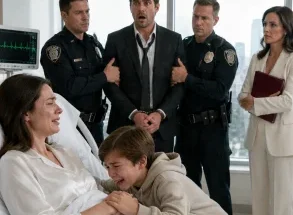
The judge did not ask the question out loud, but the silence made it land in my lap anyway.
Expose everything, or let them fold the truth small enough to fit back inside our family kitchen.
My mother stared at the screen as if the photographs belonged to someone she had never invited home.
My father kept one hand flat on the table, pressing his fingers down until his knuckles lost color.
The first photograph showed my eyebrow, the ruler beside the cut, the purple shadow spreading under my eye.
The second showed my ribs, not dramatic, not theatrical, only swollen skin and the careful notes of a nurse.
I heard my mother breathe in, quick and sharp, the way she did when something embarrassed her.
Not when something hurt me, I thought. Only when someone else was about to notice.
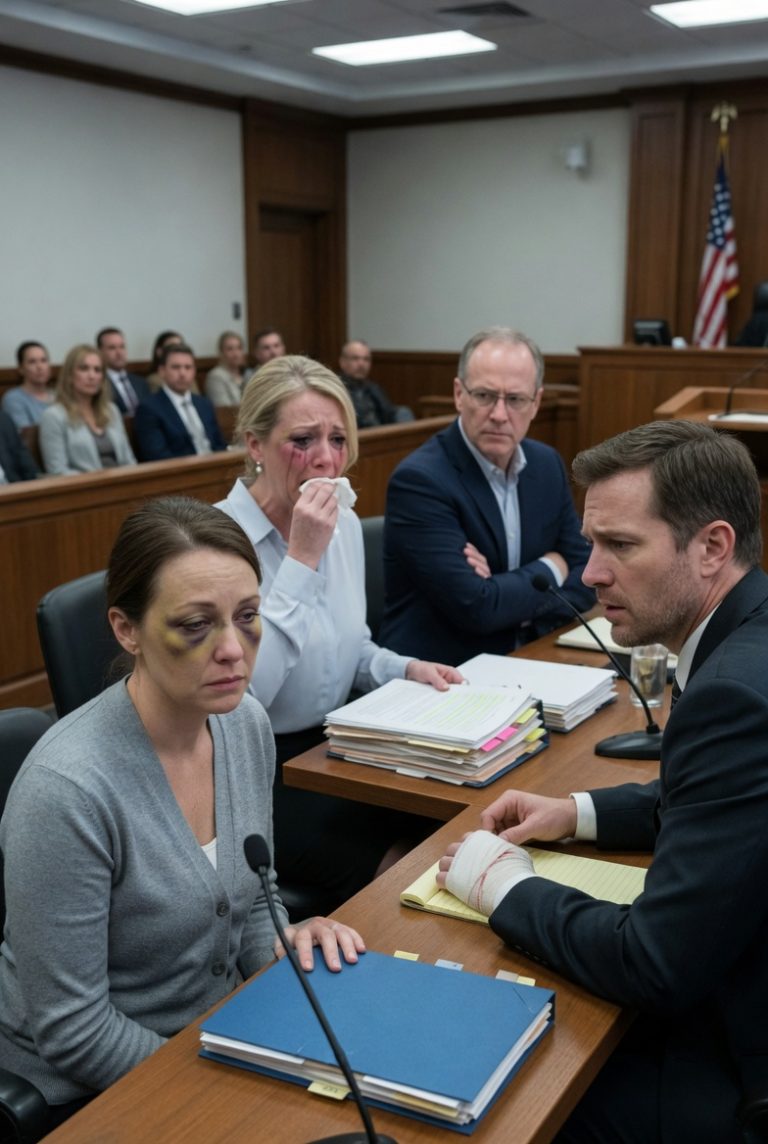
Ryan looked at the table instead of the screen, his wrapped hand suddenly resting lower than before.
For three weeks, that gauze had been his proof, his little white flag of victimhood.
Now it looked like what it was, a cover over the hand that had made choices.
The prosecutor played Mrs. Parker’s call, and the courtroom filled with my neighbor’s shaking voice.
“She’s on the floor,” Mrs. Parker said. “He’s standing over her, and they’re helping him.”
My mother closed her eyes before the recording reached the part where I tried to breathe.
I did not close mine, because I had already spent years looking away for everyone’s comfort.
The judge paused the audio and asked my attorney whether I was prepared to continue.
My attorney leaned toward me, close enough that only I could hear her bracelet tap the table.
“You can ask for a recess,” she whispered. “You don’t owe them your endurance.”
Across the aisle, my father turned slightly, just enough to let me see his profile.
His mouth barely moved, but I still understood the shape of the words: Don’t ruin him.
It was strange how some commands could travel without sound, trained into the body over years.
My ribs tightened under the brace, and I placed one palm against them without thinking.
The pain was less sharp now, more like a hand reminding me it had not disappeared.
When I was twelve, Ryan threw my science project into the driveway because I won a school prize.
My mother told me to remake it quietly, because he was “sensitive about being compared.”
When I was sixteen, he shoved my bedroom door so hard the hinge split the frame.
My father fixed the hinge and said, “Next time, don’t lock him out like a stranger.”
The memories did not arrive like lightning. They came like receipts pulled from an old drawer.
Small, flat, undeniable, each one carrying a date my body had kept when my mouth had not.
The judge looked from the exhibit to Ryan, then to my parents, then finally to me.
“Ms. Carter,” he said, his voice even, “the court needs your statement regarding the family’s claims.”
Family’s claims.
The phrase sat there, plain and clean, while my mother’s face moved into something almost pleading.
She mouthed my name, Elena, as if saying it softly could return me to my old place.
My father’s hand left the table and touched Ryan’s shoulder, one firm squeeze, one public reminder.
Ryan’s eyes finally met mine, and for a second he looked younger than thirty-two.
Not sorry, exactly. Frightened by consequence, which was not the same thing.
I wanted to believe there was some hidden sentence coming, something that would make him human again.
I wanted my mother to stand up and say she had been wrong before I had to say anything.
I wanted my father to look at me without measuring the cost of protecting Ryan.
Those wants were old. They had lived inside me longer than the bruises.
My attorney placed a page in front of me, my prepared statement typed in neat black lines.
At the top, my name waited above all the things I had finally agreed were true.
My hands trembled, not enough for everyone to see, but enough for the paper to whisper.
The courtroom clock clicked once, then again, each second stretching as if it had found resistance.
Rain tapped against the tall windows, soft and ordinary, like nothing important was happening inside.
I thought of Mrs. Parker standing barefoot on her back porch, choosing to call instead of pretend.
I thought of the nurse asking if someone was coming, and my silence answering before I could.
I thought of my mother’s cafeteria bag on Ryan’s lap, greasy with fries, warm from her hands.
Nothing for me.
That was the part I could not stop returning to, more than the counter, more than his fist.
Not because food mattered most, but because care had shape, weight, smell, and direction.
My parents had shown the entire room where their care went when two children were wounded.
One got a paper bag. One got a lesson about being dramatic.
The prosecutor waited, patient. The judge waited. Even Ryan’s attorney stopped flipping through his folder.
I picked up the paper, but the words blurred, and for one moment I almost chose the easier lie.
I almost said it had happened quickly, confusingly, that everyone had been upset.
I almost gave them the fog they needed, because fog was where my family knew how to survive.
Then my mother made a small sound, the kind she used when she wanted me to rescue her.
“Elena,” she whispered, just loud enough for the front row to hear. “Please.”
That single word opened something colder than anger.
Please had never meant help me tell the truth. It had always meant disappear for us.
I lowered the paper and looked at her directly, the way I had not looked in the hospital.
Her eyes were wet, but they were still searching for obedience, not forgiveness.
My father leaned back, disappointed already, as if my answer had become visible before I spoke.
Ryan’s jaw tightened, and his wrapped hand curled halfway, testing whether the room still belonged to him.
It did not.
“Your Honor,” I said, and my voice sounded smaller than I wanted, but it did not break.
“My family has called this a misunderstanding because that word asks less from them.”
The judge nodded once, not warmly, not coldly, just allowing the sentence to stand.
“It was not a misunderstanding,” I continued. “Ryan slammed me into the counter while my parents watched.”
My mother covered her mouth, but the sound she made was not surprise.
It was recognition being forced into public air.
“My parents followed him for treatment,” I said. “They left me on the kitchen floor until help came.”
Ryan shook his head, and his attorney touched his sleeve, warning him without words.
“They told the hospital he was hurt too, as if his swollen hand balanced my br0ken ribs.”
The word br0ken caught in my chest, but I made myself breathe around it.
The judge looked down at the medical file again, and the room seemed to shrink around those numbers.
Eighteen thousand six hundred dollars was just a bill, but it had become a witness too.
“My mother told me I was strong,” I said. “She used that word to explain why I could be abandoned.”
My father’s face changed then, not into guilt, but into the tired irritation of being exposed.
That expression almost pulled me backward, into childhood, into apologizing before I knew what I had done.
I gripped the edge of the table until the wood pressed crescents into my fingertips.
“I am not here to punish a family for being imperfect,” I said, slower now.
“I am here because what happened will happen again if everyone keeps calling it family.”
The courtroom was quiet enough for me to hear rainwater dripping somewhere near the hallway doors.
My mother stared at her lap, twisting Ryan’s discharge papers into a soft, ruined tube.
For the first time, she looked unsure what to do with something that could not protect him.
The prosecutor asked whether I wanted the protective order extended beyond the temporary period.
That was the second question, sharper than the first, because it reached beyond the courtroom.
A protective order meant holidays without them, calls unanswered, my childhood home becoming a place with legal distance.
It meant my mother telling relatives I had turned cruel, my father saying lawyers poisoned me.
It meant Ryan carrying my name in his mouth like a charge he planned to repay someday.
But refusing it meant giving him another doorway, and giving my parents another chance to open it.
I looked at Ryan, then at the gauze, then at my mother’s ruined papers.
My body already knew the answer before my heart was ready to live with it.
“Yes,” I said. “I want it extended.”
My mother lifted her head so quickly that one tear slipped down and stopped near her chin.
“You can’t mean that,” she said, forgetting where she was, forgetting the judge, forgetting the room.
My attorney stood, but the judge raised one hand, and my mother froze halfway out of her seat.
“I do mean it,” I said, and the calm in my voice frightened me more than shaking would have.
Ryan looked at me as if I had struck him by not letting him strike my life again.
My father whispered my name, not softly now, but with warning tucked behind it.
The bailiff shifted near the wall, just one step, enough to remind everyone that warnings had limits.
The judge ordered silence, and the old wood benches seemed to absorb my mother’s quiet crying.
I waited for regret to swallow me whole, but it came smaller than expected.
It came as a picture of my mother at the ER door, asking about Ryan’s X-rays.
It came as my father adjusting his watch while I lay under a hospital blanket.
It came as Ryan saying I made him do it, and everyone in my family needing that to be true.
The judge began speaking about dates, restrictions, evidence, conditions of release, words meant for files and calendars.
I heard only pieces, because my body had finally understood something my mind kept avoiding.
The choice was not between truth and family.
The choice was between truth and the version of family that required me to disappear.
When the hearing ended for the day, people stood slowly, collecting coats, folders, umbrellas, and careful expressions.
My mother tried to step toward me, but the prosecutor moved between us without touching her.
“Elena,” she said again, and this time my name sounded less like an order.
I wanted that to matter more than it did.
I wanted one softened syllable to undo years of being chosen last.
Instead, I placed my statement back into the blue folder and gave it to my attorney.
Outside the courtroom, Mrs. Parker waited near the vending machines, holding two paper cups of tea.
She did not ask whether I was okay, which was good, because I did not know.
She only handed me one cup and said, “It’s too hot. Hold it by the rim.”
That small instruction almost undid me.
Care, I realized, did not always arrive with speeches. Sometimes it came in warnings about burned fingers.
My attorney walked ahead to speak with the prosecutor, leaving me beside the window with Mrs. Parker.
Through the glass, my parents stood near the courthouse steps under one umbrella.
Ryan stood between them, his wrapped hand tucked safely against his chest.
My mother looked up once, saw me watching, and did not wave.
My father guided Ryan toward the car with the same steady hand he had used in court.
For a moment, I let myself imagine running after them, saying I had gone too far.
Then my ribs pulled under the brace, and the truth returned, not loudly, but completely.
I stayed where I was.
The tea burned my palm through the paper cup, but I did not put it down.
My attorney came back and said the next hearing would require fuller testimony about the past.
The past.
Not just one night, not just one kitchen, not just one medical bill glowing on a courtroom screen.
I looked again at the doors my family had walked through, and the hallway seemed longer than before.
“I’ll testify,” I said, before fear could teach my mouth another answer.
Mrs. Parker’s shoulder brushed mine, light as a question, steady as a promise.
The elevator chimed nearby, ordinary and bright, carrying strangers to rooms where their own choices waited.
I stepped toward it with the folder under my arm, knowing the next door would cost me.
But for the first time, the cost was not my silence.
Three weeks after I said I would testify, my mother left eleven voicemails I did not play all the way through.
The first began with crying, the second with blame, and the third with my aunt saying I was destroying everyone.
By the seventh, my mother stopped asking me to call back and started explaining what neighbors were saying.
I deleted none of them, because evidence had become a strange kind of language in my new life.
My attorney told me not to respond, and for once, silence felt less like surrender.
It felt like a door I was allowed to keep locked from the inside.
The protective order changed ordinary things first, not dramatic ones, which somehow made it feel more real.
I stopped shopping at the grocery store near my parents’ subdivision because my father bought coffee there every Saturday.
I changed the emergency contact at work from my mother’s number to Mrs. Parker’s, with hands that shook.
My coworkers noticed the brace under my sweater but pretended not to, offering small kindnesses without questions.
Someone left soup in the break room fridge with my name written neatly on blue tape.
I cried in the bathroom for seven minutes, not because of pain, but because kindness still startled me.
Ryan’s lawyer tried to make the next hearing about my temper, my childhood arguments, my leaving home at nineteen.
He asked whether I had ever shouted in that kitchen, as if volume and violence were cousins.
I answered yes, because truth did not need to be polished to protect me.
Then he asked whether I hated my brother, and the courtroom became quiet enough to hear paper move.
I looked at Ryan before answering, because part of me still wanted him to look ashamed.
He only looked tired, annoyed, and smaller without my parents’ certainty wrapped around him.
“No,” I said. “I don’t hate him. I’m afraid of what everyone excuses for him.”
The judge wrote something down, and my mother covered her eyes with one trembling hand.
My father stared straight ahead, jaw tight, as if still waiting for the room to become his.
The prosecutor called the hospital social worker, who explained each photograph without emotion.
Three br0ken ribs, facial bruising, swelling, documented distress, and a patient repeatedly asking for family.
That last phrase moved through me more sharply than the medical terms.
A patient repeatedly asking for family.
I had been twenty-nine years old, with blood in my hair, still asking for people who had left.
When Mrs. Parker testified, she wore the same beige cardigan from the night it happened.
She gripped the witness stand carefully, like truth was heavy but still worth holding.
“She was not fighting him,” Mrs. Parker said. “She was on the floor trying to breathe.”
Ryan’s attorney asked whether the window could have distorted what she saw.
Mrs. Parker looked at him for a long second before answering, calm and clear.
“Glass does not turn helping a man into helping a woman,” she said.
My mother made a small sound then, not quite a sob, not quite a protest.
For the first time, Ryan looked away from Mrs. Parker before she looked away from him.
The final witness was me, and my knees felt loose when I walked to the stand.
The courtroom smelled like rain again, damp wool and old paper, almost exactly like before.
I placed my hand on the Bible and promised to tell the truth.
The words felt simple, but they carried every dinner table silence I had ever swallowed.
The prosecutor did not ask me to make Ryan a monster.
She asked me what happened after dinner, where everyone stood, and what I remembered hearing.
So I told them about burned garlic, floor cleaner, the refrigerator humming too loudly.
I told them about the tile against my shoulder and my mother stepping past my face.
I told them about Ryan’s hand being lifted like something precious.
I told them the sentence I had heard in my sleep for weeks.
“She made me do it.”
The prosecutor asked what my parents did when I asked them to come to me.
I looked down at my hands, at the faint scar near my thumb from the casserole dish.
“My mother said Ryan was upset,” I answered. “She said I was strong.”
My voice stayed steady, but my chest tightened around each word.
The judge listened without interrupting, and that patience almost hurt more than disbelief would have.
Ryan’s attorney stood again, softer this time, as if softness could make the questions less cruel.
“Ms. Carter, isn’t it true your family had a complicated history?”
“Yes,” I said. “That is why I stayed quiet for so long.”
He blinked, perhaps expecting denial, perhaps expecting shame.
Instead, the truth sat between us, plain and stubborn.
He asked whether I understood that a conviction could affect Ryan’s job, apartment, and future.
I looked at Ryan then, and for the first time, I saw consequences reaching him instead of circling me.
“Yes,” I said. “I understand consequences. I have been living with mine.”