“That booklet isn’t worth anything. Let it rot with the old woman.”
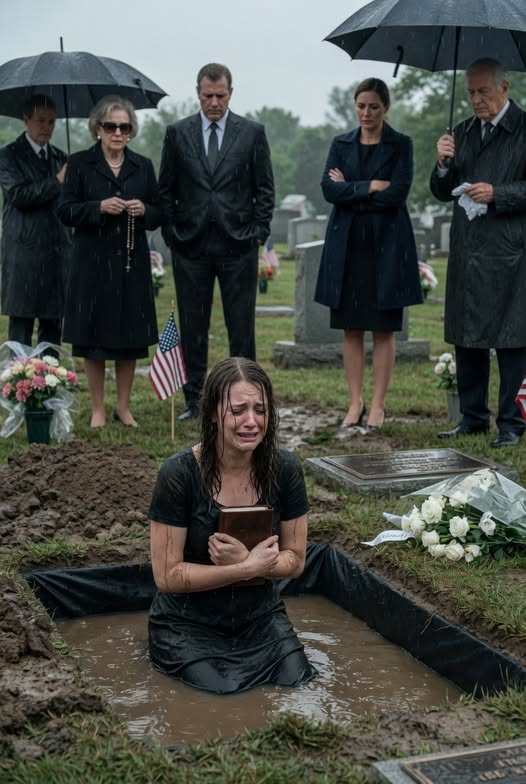
My father threw my grandmother’s savings booklet onto the open coffin, just before they lowered the box into the damp earth of the cemetery.
No one said anything.
Not my uncles. Not my cousins. Not the priest who had just prayed the final blessing. Everyone just stared at that little blue booklet, stained with mud, as if it were trash. As if it had not been the last thing Doña Guadalupe, my Grandma Lupita, had left me in this world.
I was twenty-seven years old, wearing a borrowed black dress, my hands so cold I could barely feel my fingers. My father, Víctor Salazar, adjusted his black gloves and smiled at me the way he used to smile when I was a child and told me crying was “making drama.”
“There’s your inheritance, Mariana,” he said. “An old booklet. No house, no land, no money. Your grandmother was always good at acting mysterious.”
My stepmother, Patricia, let out a little laugh behind her dark sunglasses.
“Poor thing,” she murmured. “She still thinks the old lady left her a treasure.”
“If there are fifty pesos in it, you’re buying tacos.”
Some cousins laughed.
I did not.
Licenciado Arriaga, the family notary, stood pale beneath the funeral tent. He had read the will twenty minutes earlier: “To my granddaughter Mariana Salazar, I leave my savings booklet and all rights connected to it.”
She left my father nothing.
That was why he was furious.
My grandmother had raised me since my mother died in an accident when I was five. She taught me how to make red rice without ruining it, how to check electricity bills, how not to sign papers without reading them, and how to look people in the eye when they tried to scare me.
A week before she died, in the IMSS hospital, she took my hand with her thin fingers and whispered:
“When they laugh, let them. Then go to the bank.”
At the time, I did not understand.
Now, staring at the booklet on her coffin, I began to tremble.
I took a step toward the grave.
My father grabbed my arm.
“Don’t you dare.”
I looked at him.
“Let go of me.”
“Don’t make a fool of yourself in front of everyone, Mariana.”
“You already did that for me.”
The silence fell heavier than the rain.
I climbed down carefully, my heels sinking into the mud, and picked up the booklet. Dirt clung to the cover, and it smelled of dampness. I pressed it against my chest.
“It was hers,” I said. “Now it’s mine.”
My father came so close I could smell tequila on his breath.
“Your grandmother couldn’t even save her house. You really think she saved you?”
Something inside me went out. Or maybe it lit up.
I put the booklet in my bag and walked toward the cemetery exit.
Diego blocked my path.
I looked at the rusty gate and the wet street beyond it.
“To the bank.”
He watched me as if he had just seen a match fall onto gasoline.
An hour later, soaked from the rain, I walked into the Banco del Bajío branch in downtown Querétaro. The teller, a woman with glasses named Maribel, opened the booklet, read my full name, and turned white.
Then she picked up the phone with a trembling hand.
“Call the police,” she told another employee. “And lock the door. The young lady cannot leave.”
I felt the floor move beneath me.
I could not believe what was about to happen…
PART 2
“Why did you call the police?” I asked, the booklet still on the counter. “Did I do something wrong?”
Maribel came out from behind the teller window and lowered her voice.
“No, Miss Mariana. But this account has had special instructions for many years.”
“What instructions?”
The branch manager appeared, a serious woman named Carmen Rivas. She took me to a small office with frosted glass walls. She closed the door and placed the booklet on the desk as if it were evidence in a trial.
“Your grandmother opened this account when you were a child,” she said. “She established that if one day you came in with the original booklet, we had to verify your identity, notify the authorities, and protect the related documents.”
“Protect them from whom?”
Carmen did not answer.
She did not need to.
“From my father,” I said.
She lowered her gaze.
My mouth went dry.
“What did he do?”
Carmen took a deep breath.
“He tried to close this account three times. The first time, he presented a death certificate under the name Mariana Isabel Salazar.”
I felt a blow in my chest.
“That’s impossible. I was alive.”
“You were thirteen,” she said. “The certificate was fake. Your grandmother came in the next day with you, crying, and asked that nothing ever be released without seeing you in person.”
A blurry memory cut through me: my grandmother squeezing my hand inside a bank, a woman giving me a tamarind lollipop, my grandmother crying on the bus ride home and saying it was allergies.
My father had tried to erase me.
Before I could speak, two investigative police officers arrived. One of them, Commander Valeria Montes, explained that I was not under arrest. The alert was meant to protect me.
Then Licenciado Arriaga entered, soaked, holding a yellow envelope in his hand.
“Your grandmother asked me to give you this only if you came here of your own free will,” he said.
I snatched the envelope from him.
Inside was a small key and a letter written in my grandmother’s firm handwriting.
“My girl: if you are reading this, it is because you were braver than they believed. That booklet is not money. It is a door. Your father stole what your mother left for you. He stole my house. He stole documents. And he tried to convince you that none of it was yours. Do not believe him.”
Tears blurred my vision.
Carmen led us to the vault. The safe deposit box was number 117. We opened it with two keys: mine and the bank’s.
Inside, there was no jewelry.
There were envelopes.
The first said: “FOR MARIANA — MONEY.”
Inside were bank statements, old investments, certificates. At the end, a number I could not understand at first:
23,480,000 pesos.
“That can’t be,” I whispered.
“Yes, it can,” Carmen said. “Your mother had insurance, investments, and a property. Your grandmother protected everything in financial instruments. She lived with little so your father wouldn’t suspect anything.”
My grandmother had worn the same patched sweater for years. She made broth with more water than chicken. She told me not to buy sweet bread unless it was on sale.
And all that time, she had been hiding my future.
The second envelope said: “THE HOUSE.”
I pulled out the deed.
It was the house in Colonia Álamos, the one with the white facade and bougainvilleas, where I remembered my mother’s perfume in the hallway. The house my father sold when I was thirteen, saying my grandmother could not afford it.
It was not my grandmother’s.
It was mine.
My mother had left it to me in a trust.
“Then how did he sell it?” I asked.
Licenciado Arriaga clenched his jaw.
“With forged documents. Powers of attorney, invented signatures, and a company connected to Patricia’s brother.”
At that moment, we heard pounding on the bank’s front door.
“Open up!” my father shouted from outside. “My daughter is stealing family documents!”
I looked through the blind. There was Víctor, soaked, furious, with Patricia behind him and Diego recording with his phone.
My father pressed his face against the glass and saw me.
Then he smiled and mouthed one word:
“Mine.”
Commander Montes opened the door with two agents.
“Víctor Salazar, come with us.”
“This is a family matter.”
“No,” she replied. “This is evidence now.”
Patricia tried to leave for the parking lot, but an agent caught up with her before she could get into her SUV. Diego stopped recording.
And I still had not opened the last envelope.
It said: “FOR THE POLICE — ABOUT LIDIA.”
Lidia was my mother.
The commander took it with gloves.
Inside were photos of the car where she died, receipts from a mechanic, and a USB drive.
The commander looked at me seriously.
“Mariana, what is in here may change everything you believed about your mother’s death.”
And just as she was about to explain, my father began screaming my name from the patrol car…
PART 3
The USB drive had recordings.
The first was of my grandmother, years earlier, speaking with my father in the kitchen.
“I know about the accounts, Víctor. I know you tried to declare Mariana dead.”
“You can’t prove anything, old woman.”
“I also know Lidia wanted to leave you.”
There was a long silence.
Then my father’s voice, lower, more dangerous:
“Some women learn too late what happens when they want to leave.”
I felt the air disappear.
My mother had not died because of bad luck on a wet road. At least, not only because of that.
The investigation was reopened. They found payments from my father to a mechanic shortly before the accident. They found altered reports. They found photos of the cut brake line that never appeared in the official case file.
The mechanic, now old and sick, confessed through tears that Víctor paid him to “scare” Lidia, so she would not leave with the girl or the house.
But that night, it rained.
The car did not brake.
My mother died.
My father inherited her silence.
When Commander Montes told me, I did not cry. I sat there with my hands on the table, staring at my grandmother’s blue booklet. The booklet he had thrown onto a grave like trash.
Justice was not quick. It took months. Hearings, statements, expensive lawyers, relatives saying that “family problems are solved at home.”
But my grandmother had left proof for everything.
The bank confirmed the fraud attempts. The notary proved that the sale of the house was fake. Patricia was exposed when searches appeared on her computer: “how to collect a bank account after death,” “how to challenge inheritance due to insanity,” “how to make a savings booklet disappear.”
Diego also testified. He admitted that he had mocked me at the funeral because he wanted to please his father. He said something that hurt me more than I expected:
“My dad hated Mariana because she looked like Lidia.”
The jury listened to my grandmother’s recordings. The strongest one was the last.
“Tell me why, Víctor,” she said.
“Because she was going to take what was mine.”
“Lidia was not yours.”
“My daughter wasn’t going to be hers either.”
“Did you cut the brakes?”
A silence.
Then my father said:
“She chose to drive.”
The entire courtroom went cold.
Víctor Salazar was found guilty of fraud, forgery, financial exploitation of an elderly adult, and homicide. Patricia received years in prison for conspiracy. Her brother also went down because of the house.
At the sentencing, I stood in front of the judge with the blue booklet in my hand.
“My father said this was useless,” I said. “But this booklet kept my grandmother’s courage, my mother’s protection, and the truth he tried to bury. He did not bury it deep enough.”
I did not look at Víctor searching for remorse. Men like him do not regret doing harm. They regret being discovered.
Months later, I recovered the house in Colonia Álamos. It was neglected, with peeling paint and wild bougainvilleas, but when I opened the door, I felt something recognize me.
In the kitchen, the pencil marks where my grandmother measured my height were still there.
“Mariana, 4 years old.”
“Mariana, 5 years old.”
Higher up, older, one line said:
“Lidia, first key, 19 years old.”
That was when I cried.
Not for what was lost.
For what had returned.
With part of the money, I opened a foundation in the name of Guadalupe and Lidia to help women and children fleeing family violence and theft inside their own homes. The first woman who arrived was named Ana. She had a bruise hidden under makeup and a sleeping baby in her arms.
“Sorry to bother you,” she said.
I placed a folder in front of her.
“You don’t have to apologize here.”
That day, I understood that my inheritance was not just money. It was responsibility.
I hung the blue booklet at the entrance of the house, inside a frame. I left one stain of cemetery dirt visible because some stains are not shame: they are proof.
Underneath, I had one sentence engraved:
“When they laugh, let them. Then go to the bank.”
Sometimes people ask why I did not keep that booklet in a safe.
Because it had been hidden for far too long.
Because my grandmother did not leave it so I would live in fear, but so I would learn not to surrender what is mine just because someone powerful calls it trash.
And because in Mexico, as in many families, there are still secrets buried beneath phrases like “don’t make drama,” “respect your father,” or “that stays at home.”
It is not always love.
Sometimes it is control.
Sometimes it is theft.
Sometimes it is violence with a familiar last name and a pressed shirt.
My father threw the booklet into the grave believing he was burying the truth.
But my grandmother knew something he never understood:
What a woman protects with love may take years to come into the light, but once it does, there is no family, money, or lie that can bury it again.