PART 2
Mother Caridad did not call Doctor Paloma immediately, though her hand stayed resting on the black telephone for almost a minute.
The little strip of medical tape lay on her palm, clean and pale, too ordinary to frighten anyone at first glance.
But the smell of antiseptic clung to it, faint and sharp, cutting through the wax, dust, and boiled milk of the convent.
She closed her fingers around it and listened to the hallway, where Esperanza’s soft humming floated from the kitchen.
For three years, Mother Caridad had prayed for an explanation that would let her keep believing in innocence without asking harder questions.
Now a small piece of tape had answered nothing, but it had made silence feel like a locked door.
She placed it inside the drawer beside the account books, then called Doctor Paloma with a voice she barely recognized.
“Come today,” she said. “Not tomorrow. And please, do not tell anyone before you arrive.”
There was a pause on the line, the kind of pause that belonged to people who already knew more than they admitted.
“Is Sister Esperanza unwell?” Doctor Paloma asked, careful, almost too careful.
Mother Caridad looked toward the doorway and lowered her voice until it was almost air.
“She says she is pregnant again.”
This time Doctor Paloma did not answer quickly. Mother Caridad heard paper shifting, then the doctor breathing close to the receiver.
“I will come after noon,” she said at last. “And Mother, keep her calm until then.”
That word stayed behind after the call ended.
Calm.
As if calm had not been the very thing that had covered every impossible moment in that house.
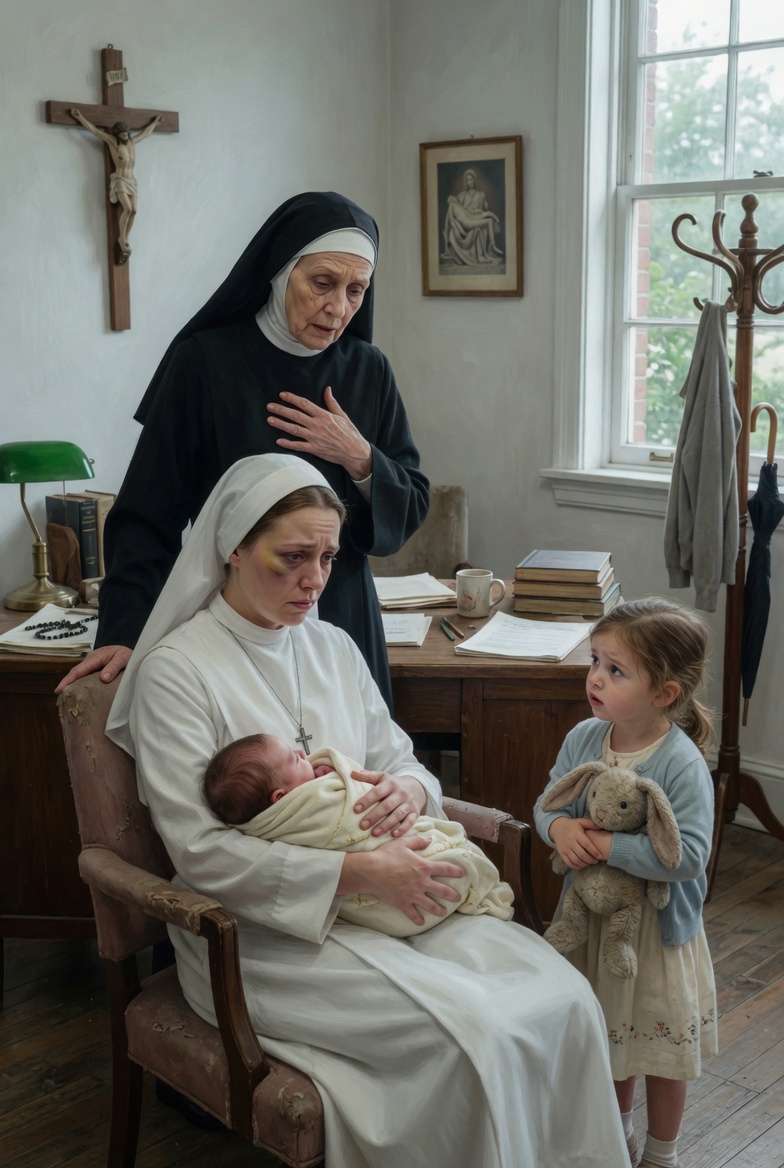
Mother Caridad walked to the kitchen and found Esperanza sitting by the stove, rocking Miguel while little Tomás played with wooden spoons.
The young nun looked tired, but peaceful, her face turned toward the window where sunlight touched the white walls.
“Doctor Paloma will come today,” Mother Caridad said, watching for any change in her expression.
Esperanza only nodded and kissed Miguel’s forehead.
“That is good. She is kind. The children like her hands because they are never cold.”
Mother Caridad looked at those children, both dark-haired, both quiet, both strangely still whenever the doctor’s name was spoken.
Tomás had stopped tapping the spoons.
His small fingers tightened around one handle, and his eyes moved toward the back door.
It was nothing. A child’s habit, perhaps. A tiny movement no one else would have noticed.
But Mother Caridad noticed.
She had spent thirty years learning how people avoided truth before they had language for it.
“Tomás,” she said gently, kneeling beside him. “Do you remember Doctor Paloma?”
The boy looked at her, then at his mother, then back at the door.
Esperanza smiled softly, unaware or unwilling to see the change in him.
“He is shy today,” she said. “He did not sleep well.”
Mother Caridad reached for the spoon, but Tomás pulled it against his chest as if it were something precious.
From the corridor, Sister Inés called that the laundry water had overflowed, and the small moment dissolved into ordinary noise.
All morning, Mother Caridad moved through chores like someone walking inside a dream that refused to end.
She signed for bread at the gate, counted candles in the chapel, and helped Sister Marta fold sheets in the laundry room.
Yet every time she turned a corner, she expected to see that white strip of tape again.
A small thing fallen from a sleeve, a pocket, a bag.
A small thing that did not belong to prayer.
Near noon, while crossing the infirmary, she stopped beside the cabinet where Doctor Paloma kept simple supplies for the sisters.
Bandages, fever drops, clean gauze, alcohol, a metal box with a lock that only the doctor opened.
Mother Caridad had never questioned that box.
It had seemed professional, necessary, almost comforting.
Now she stared at it until the scratches around the lock became impossible not to see.
They were thin marks, repeated, as though the box had been opened and closed many times in a hurry.
Behind her, Sister Inés spoke softly.
“Mother, are you looking for something?”
Mother Caridad turned too quickly, and the younger nun lowered her eyes.
“No,” she said. “I was only checking what needs replacing.”
Sister Inés nodded, but did not leave.
Her hands twisted the edge of her apron, wet from laundry water.
“There is something I should have said before,” she whispered, then looked toward the hallway.
Mother Caridad felt her chest tighten.
“Then say it now.”
Sister Inés swallowed, and for a moment she looked like a child preparing to confess a broken cup.
“Sometimes, after Doctor Paloma visits, Sister Esperanza sleeps very deeply. More deeply than seems natural.”
The words were quiet, but they changed the air in the infirmary.
Mother Caridad held the shelf to steady herself.
“How many times have you seen this?”
“I do not know,” Sister Inés said. “I told myself she was weak from caring for the babies.”
Mother Caridad waited, because she could see more pressing behind the younger nun’s lips.
“And sometimes,” Sister Inés added, “Doctor Paloma asks that no one enter until morning.”
The chapel bell rang once outside, thin and clear, marking the hour.
Mother Caridad wanted to reject the sentence at once.
She wanted to say the doctor was trusted, that suspicion was a sin, that fear could turn kindness into monsters.
Instead, she heard Esperanza’s voice from years before, trembling after her first fainting spell in the garden.
“I do not remember anything, Mother. Only a smell like flowers and medicine.”
Back then, Mother Caridad had called it exhaustion.
She had wrapped Esperanza in a blanket, pressed a rosary into her hand, and thanked heaven that she had woken.
Now that memory returned with edges.
Not a miracle.
Not weakness.
A gap.
Doctor Paloma arrived a little after two, carrying her brown leather bag and wearing the same gray coat she wore every winter.
She smiled at the sisters by the gate, accepted their greetings, and entered as if she belonged inside every room.
Mother Caridad watched her hands first.
Clean nails. Steady fingers. No nervousness.
That made the fear worse.
“Where is Sister Esperanza?” the doctor asked.
“In the small parlor,” Mother Caridad replied. “But before you examine her, I need to speak with you.”
Doctor Paloma’s smile did not disappear. It only became smaller.
“Of course.”
They stepped into the office, the same room where Esperanza had spoken that morning with a baby sleeping against her.
Mother Caridad closed the door but did not sit.
She opened the drawer, took out the strip of medical tape, and placed it on the desk between them.
Doctor Paloma looked at it for less than a second.
That was enough.
Not surprise.
Recognition.
Mother Caridad felt something inside her sink slowly, like a stone dropped into deep water.
“I found it after Sister Esperanza left my office,” she said. “It smells like your supplies.”
Doctor Paloma removed her gloves, finger by finger, folding them with unnecessary care.
“Medical tape is not a crime, Mother.”
“No,” Mother Caridad said. “But impossible pregnancies are not miracles simply because we are afraid to name them.”
The doctor’s eyes lifted then.
For the first time, there was something hard in them.
“You should be careful with words like that.”
Mother Caridad heard the threat, and also heard how calmly it had been placed before her.
Outside, a spoon dropped in the kitchen, and a child began to cry.
The sound entered the room like a reminder of what silence had already cost.
“Tell me what you have done to her,” Mother Caridad said.
Doctor Paloma’s face changed, but not into guilt. Into tiredness.
“You think I harmed her.”
“I think something happened under my roof while I was praying two doors away.”
The doctor looked toward the window, where dust moved slowly in the light.
“You have no idea what people ask of medicine when faith gives them no answers.”
Mother Caridad stared at her, unable to understand whether she was confessing or defending herself.
“Speak plainly.”
Doctor Paloma lowered her voice.
“Esperanza was never touched by any man inside this convent. That much is true.”
For one terrible second, relief tried to rise in Mother Caridad’s chest.
She hated herself for it.
Because the relief did not come from truth.
It came from the smaller, easier story she still wanted to keep.
Then Doctor Paloma continued.
“But pregnancy does not always require what you are imagining.”
Mother Caridad gripped the back of the chair.
The office seemed to stretch around her, the walls moving farther away while the doctor remained terribly clear.
“No,” she whispered. “No woman under vows would agree to that.”
Doctor Paloma did not answer.
That silence was worse than denial.
Mother Caridad thought of Esperanza’s serene smile, her soft voice, her words repeated every year with the same strange brightness.
“I am pure. You know that.”
Suddenly those words no longer sounded holy.
They sounded taught.
Protected.
Broken gently enough that no one had heard the crack.
“Did she know?” Mother Caridad asked.
Doctor Paloma’s fingers tightened around her gloves.
“She believed what she needed to believe.”
“That is not an answer.”
“It is the only answer that will keep her standing.”
Mother Caridad stepped back as if the desk had burned her.
Behind the door, tiny feet passed down the corridor, then stopped, then hurried away.
For the first time in years, Mother Caridad wondered how many doors in the convent had listened and said nothing.
“Who else knew?” she asked.
Doctor Paloma looked at her then, fully, sadly, almost with pity.
“You should ask why the last child matters.”
The words struck harder than any confession.
Mother Caridad remembered the warning that had haunted her since morning, the path of truth leading toward a coffin.
“What do you mean?”
Doctor Paloma reached for her bag, but Mother Caridad moved in front of the door.
“No. You will not leave until you answer me.”
The doctor’s eyes flicked toward the crucifix on the wall.
“The last baby has a mark,” she said softly.
Mother Caridad’s mouth went dry.
“What kind of mark?”
“A birthmark near the shoulder. Small. Dark. Shaped like a crescent.”
Mother Caridad knew that mark.
She had seen it once, many years ago, while washing the body of Father Anselmo after his sudden d3@th.
A crescent near the shoulder.
Small.
Dark.
Unmistakable.
The room seemed to lose sound.
Even the crying from the kitchen vanished, as if the convent itself had held its breath.
Father Anselmo had been buried in the old cemetery behind the chapel three winters before Esperanza’s first pregnancy.
He had been gentle, respected, and already gone when everything began.
Mother Caridad shook her head, slowly at first, then harder.
“That is impossible.”
Doctor Paloma’s voice was nearly a whisper.
“Not if something was taken before burial.”
Mother Caridad closed her eyes.
For years, she had protected the memory of a holy man because it was easier than questioning the living.
For years, she had protected Esperanza’s innocence by refusing to ask what kind of innocence needed protection from truth.
Now both protections lay shattered on the same wooden desk.
“Why?” she asked, and the word came out raw.
Doctor Paloma looked older suddenly.
“Because powerful families wanted heirs without scandal. Because a holy bloodline made people open their purses. Because grief makes fools of everyone.”
Mother Caridad understood then that the convent had not been hiding from the world.
The world had been entering through locked doors, carried in bags, papers, donations, permissions, and respectful smiles.
“And Esperanza?” she asked.
Doctor Paloma looked away.
“She was chosen because she believed completely. Because she would call pain a blessing if someone wrapped it in prayer.”
Mother Caridad felt shame rise so sharply that she had to press one hand against her mouth.
She had loved Esperanza like a daughter.
Yet love had not made her brave.
Love had made her patient, and patience had become another kind of neglect.
“Where are the records?” Mother Caridad asked.
Doctor Paloma did not answer.
Mother Caridad lowered her hand.
“Where are they?”
“In the crypt,” the doctor said at last. “Inside Father Anselmo’s coffin.”
The words were quiet.
They were almost absurd.
But nothing in Mother Caridad laughed.
Outside the office, the afternoon bell began to ring, each note falling slowly through the corridors.
Mother Caridad imagined the coffin beneath the chapel floor, sealed with prayers, flowers, and all the trust she had placed there.
To open it would wound the convent.
To leave it closed would wound Esperanza again.
She could call the bishop and wait for permission.
She could call the police and let strangers tear through holy ground.
Or she could walk down those narrow steps herself and decide what kind of mother she had truly become.
Doctor Paloma watched her, perhaps expecting hesitation, perhaps counting on it.
Mother Caridad went to the drawer, took the old iron key to the crypt, and closed her fingers around it.
Her hand shook.
But for the first time that day, her voice did not.
“Bring Sister Esperanza to the chapel,” she said. “And do not leave this convent.”
Doctor Paloma’s face went pale.
Mother Caridad opened the office door and stepped into the corridor, where the children’s voices echoed softly from the kitchen.
At the far end, Esperanza stood holding Miguel, her smile fading when she saw the key in Mother Caridad’s hand.
“Mother?” she asked.
Mother Caridad looked at her, at the baby, at Tomás hiding behind her skirt.
Then she understood the choice had already been made.
She could no longer protect Esperanza from truth by letting lies continue to breathe.
“Come with me, child,” she said softly. “There is something we must open before evening prayer.”
PART 3
The chapel was almost empty when Mother Caridad led Esperanza down the center aisle with the children close behind.
Doctor Paloma followed several steps away, watched by Sister Inés, whose face had lost all color.
No one spoke, because any ordinary sentence would have sounded false beneath the statues and the hanging lamps.
Esperanza kept one hand on Miguel’s back and the other on Tomás’s shoulder, as if the children might vanish.
“Mother,” she whispered, “why are we going to the crypt?”
Mother Caridad stopped before the small iron door beside the altar and turned to face her.
“Because I should have gone there years ago,” she said, and the truth in her voice frightened even herself.
Esperanza’s lips parted, but no question came.
Somewhere above them, rain began tapping softly against the stained glass, slow and patient.
Mother Caridad placed the key into the lock, and the sound seemed louder than the bell at evening prayer.
The door opened with a dry scrape, releasing cold air that smelled of stone, old wax, and closed earth.
Tomás began to whimper.
Esperanza bent to comfort him, but her own hands were trembling now, no longer serene or certain.
Mother Caridad wanted to turn back for one final second, to choose mercy that looked like delay.
Then she remembered the medical tape, the doctor’s silence, and three children born into a lie.
She took the first step down.
The crypt was small, with low walls and names carved into old stone plates.
Father Anselmo’s coffin rested beneath a faded cloth, where the sisters had placed flowers every year.
Mother Caridad stood before it and felt the weight of every prayer she had said for him.
“He was good,” she whispered, though she no longer knew whether she meant it or begged it.
Doctor Paloma looked away.
Esperanza stared at the coffin as if it were a door in a dream she could not wake from.
“Why is Father Anselmo part of this?” she asked, her voice thin and almost childlike.
Mother Caridad could not answer gently enough, so she answered simply.
“Because someone used what was left of him after he was gone.”
The sentence entered the crypt and stayed there.
Esperanza blinked once, then again, as though her mind refused to arrange the words into meaning.
“No,” she said softly. “No, Mother. My children were gifts.”
Mother Caridad stepped closer and took her hand.
“They are gifts. But the way they came to you was not holy.”
Doctor Paloma made a small sound, perhaps protest, perhaps shame, but no one turned toward her.
Sister Inés brought a crowbar from the storage room, crying quietly while she handed it to Mother Caridad.
The older nun accepted it with both hands, feeling how heavy truth could become when it had metal and edges.
Opening the coffin was slow work.
Not dramatic.
Not sudden.
Only wood resisting, nails lifting, breath catching, and rain tapping above like someone counting time.
Esperanza covered Tomás’s eyes, though he was watching the floor, not the coffin.
Miguel slept through it all, his cheek resting against his mother’s shoulder, innocent of every adult failure around him.
Inside the coffin, Father Anselmo’s remains lay wrapped with a rosary, a silver cross, and several sealed envelopes.
There was also a small metal case tucked beside the lining, hidden where no grieving sister would have searched.
Mother Caridad reached for it, and her fingers nearly failed her.
The case opened with a dull click.
Inside were papers, medical forms, coded names, dates, payments, and a thin vial wrapped in old cloth.
Esperanza stared at the documents without moving.
Doctor Paloma’s face collapsed before anyone accused her.
“It was not supposed to continue,” she said. “After the first child, I tried to stop them.”
Mother Caridad looked at her.
“Yet you came back.”
The doctor nodded once, and that single nod carried more guilt than any long confession could have held.