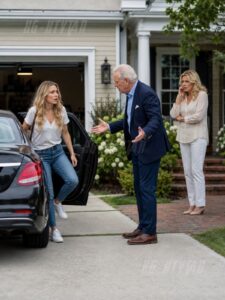
“Why are you arriving in an Uber? What happened to the SUV we bought you for your twenty-fourth birthday?” my grandfather asked, confused, and before I could even open my mouth in shock, my mother smiled from behind him and said, “Her sister needed it more.”
For a few seconds, nobody moved. The Uber driver was still pulling away from the curb, his taillights blinking red at the end of my grandfather’s long driveway. A mild October wind moved through the maple trees lining the road, sending a few yellow leaves skittering across the stone path. Somewhere beyond the house, a lawn mower droned in the distance, ordinary and careless, as if my life had not just tilted beneath my feet. My grandfather stood on the porch, one hand gripping the white railing, his silver eyebrows drawn together in genuine confusion. My mother stood in the doorway behind him with that smile on her face, the one I had known since childhood. It was not quite smug, not quite nervous. It was worse than both. It was the smile she wore when she had already decided her version of events was the only one that mattered and everyone else’s feelings were just obstacles to be managed.
I was twenty-four years old, wearing my hotel blazer over a black dress because I had come straight from work. My feet hurt from standing eight hours behind the front desk, my hair was pinned up badly, and my handbag strap was digging into my shoulder. I had spent twenty-three dollars and seventy cents on that Uber because the bus route from downtown Nashville to my grandparents’ neighborhood required two transfers and still left me half a mile from their house. I had almost canceled dinner entirely, but my grandfather had called me himself the night before and said, “Hannah, I want to see you. It’s been too long.” When Grandpa Samuel used that voice, tired but warm, I came.
Now he was asking me about an SUV I had never received.
“What SUV?” I asked.
The words came out thin. Not angry yet. Not even frightened. Just stunned.
My mother’s smile faltered for half a second before she recovered. “The one Grandpa gave you for your birthday, sweetheart. The black Chevrolet Equinox. Don’t tell me you forgot already.”
I stared at her.
My twenty-fourth birthday had been three months earlier. I had spent it working a double shift at the hotel because two front desk clerks called out sick and a regional conference had filled nearly every room. At nine thirty that night, I had walked back to my tiny studio apartment with aching calves and leftover cake from the break room in a paper cup. My mother had called around ten, wished me happy birthday in a distracted voice, and then said she had to go because Brooke needed help assembling a bassinet. My sister was pregnant, and ever since the announcement, every conversation in my family began and ended with what Brooke needed. No one mentioned an SUV. No one mentioned any gift. No one mentioned my grandfather had spent money on me at all.
“I never received a car,” I said, more clearly this time. “Nobody told me about a car.”
Grandpa’s fingers tightened around the porch railing. He was seventy-eight years old, but even after retirement, even after the knee surgery and the heart medication and the slower way he sometimes took stairs, he had a presence that made people straighten. Before he retired, he had built a construction company from two pickup trucks and a borrowed trailer into one of the most respected firms in Middle Tennessee. Men twice my size still called him Mr. Whitaker. He had a way of going quiet before he became dangerous.
“Patricia,” he said.
My mother visibly flinched.
That single word told me something. He knew. Maybe not all of it yet, but enough. Enough to understand that what had seemed like confusion was becoming betrayal.
“You told me Hannah had the car,” he said slowly. “You told me she loved it. You told me she drove it to work every day. You said she cried when she saw it.”
My throat tightened. “You told him I cried?”
Mom lifted both hands in a helpless gesture. “Dad, the situation changed.”
“The situation changed,” Grandpa repeated.
“Brooke really needed it,” Mom said, her voice gathering speed now, because speed had always been her favorite defense. If she could talk fast enough, emotional enough, long enough, people usually gave up correcting her. “She got that new job across town, and with the baby coming, and Tyler losing hours at the factory, they needed reliable transportation. Hannah lives close enough to downtown to manage with ride-shares and the bus. She’s young. She’s independent. She always figures things out. Brooke has a family to think about now.”
There it was. The family slogan. Hannah figures things out. It had been used for everything. Why didn’t Hannah get dance lessons? Hannah entertains herself. Why didn’t Hannah get help with college applications? Hannah is smart; she’ll figure it out. Why did Brooke get a second car after wrecking the first while Hannah bought her own used Honda with grocery store paychecks? Brooke needed support; Hannah was independent. My independence had never been a trait. It had been a sentence.
Grandpa’s face changed in the hard afternoon light. Confusion drained away first. Then disbelief. Then something much darker.
“You gave away a car I purchased with my own money,” he said. “A car I purchased for Hannah. A car I registered in Hannah’s name.”
Mom swallowed. “Well, technically—”
“Do not technically me.”
I had never heard my grandfather speak to my mother that way. Not once. He loved her. Everyone knew that. Patricia was his only daughter, his difficult miracle, born after years of miscarriages. He had spoiled her in ways Grandma Margaret sometimes shook her head about. He had forgiven her mood swings, her impulsive spending, her dramatic phone calls, her endless emergencies. But his voice now had no softness in it.
Mom looked at me then, and for one flickering second, she forgot to perform. Her eyes pleaded with me. Not for forgiveness exactly. For cooperation. For the old agreement to resume. The one where she did whatever she wanted, Brooke benefited, and I smoothed the room before anyone important became uncomfortable.
“Hannah understands,” Mom said. “Right, Hannah? We share in this family. We help whoever needs help most.”
I looked at her.
I thought of my birthday, the paper cup of leftover cake, the bus stop outside the hotel where I had waited under a broken light because I couldn’t afford too many rideshares. I thought of Brooke posting a photo of herself three months earlier beside a shiny black SUV with a bow on the hood, captioned: “Hubby surprised me! Baby girl and I are riding safe now.” I had liked that post. I had typed, “So happy for you!” while standing in my apartment kitchen eating cold noodles, never once imagining I was congratulating her for smiling beside my stolen birthday gift.
“No,” I said.
The word was quiet, but it reached everyone.
Mom’s face tightened. “Hannah—”
“No,” I repeated, and something in my voice steadied. “I don’t understand. I never understood. And I’m tired of pretending I do.”
Grandpa pushed away from the porch railing and straightened to his full height. “Everyone inside,” he said. “Now.”
The inside of my grandparents’ house smelled exactly as it always had: cedarwood, lemon polish, old books, and the faint ghost of the pipe tobacco Grandpa had given up years ago because Grandma threatened to bury his pipes in the garden. The house was a wide, beautiful Victorian just outside Nashville, painted soft blue with white trim and a wraparound porch where I had eaten popsicles as a child. I had loved that house once without complication. It held Christmas mornings, Easter egg hunts, summer thunderstorms, and the old upright piano nobody played well but everyone touched when passing. But as I stepped into the foyer behind my mother and grandfather, I felt the house shift in meaning. It was no longer just a place of memory. It was a courtroom.
Grandma Margaret came from the kitchen wiping her hands on a dish towel. She wore a soft green sweater and her gray hair pulled back in a clip. “What on earth is going on?” she asked.
“Sit down, Margaret,” Grandpa said. His voice was gentler with her, but still sharpened. “We need to have a family discussion.”
Mom let out a small, wounded laugh. “Dad, this is unnecessary.”
Grandpa turned his head toward her. He did not raise his voice. He did not need to. “Sit.”
She sat.
I remained near the fireplace at first, unable to make myself sink into the floral sofa where I had once napped as a child. My legs felt weak, but standing gave me the illusion of control. Mom perched on the antique loveseat, knees pressed together, hands folded in her lap. She looked like a woman accused unfairly, which had always been her favorite costume. Grandpa took his leather chair. Grandma sat beside me after a moment, close enough that her hand brushed mine.
“I want to understand something,” Grandpa said. “When I bought that vehicle, I specifically asked you, Patricia, to arrange for Hannah to come sign the remaining papers and pick it up because my appointment with Dr. Sykes got moved. You told me she came. You told me everything was handled. You told me she was overwhelmed with gratitude.”
Mom’s lips pressed together.
“You even sent me a picture,” he continued. “A picture of Hannah standing beside the car.”
My stomach dropped.
“A picture?” I said.
Grandpa looked at me. “Yes.”
I already knew before he opened his phone. The truth was assembling itself too quickly now, piece after ugly piece.
“Was it in front of Brooke’s house?” I asked.
Mom’s face went pale.
Grandpa looked from me to her.
“Brooke posted a photo with a black SUV around my birthday,” I said. “She said Tyler bought it for her. I remember because I liked it. I thought… I thought it was hers.”
Grandma made a soft sound beside me.
Grandpa pulled up the photo and turned the screen toward me. There I was, or nearly. From a distance, beside a black Chevrolet Equinox, standing outside Brooke’s subdivision. Only it wasn’t me. It was Brooke, angled slightly away, wearing sunglasses and a beige cardigan I had once borrowed and been accused of stretching out. Her hair was similar enough to mine from behind, long and brown, though hers was styled in loose waves and mine usually lived in a practical knot. The photo was taken from far enough away that an old man who wanted to believe his daughter would not deceive him might accept it.
My stomach turned.
“She sent you a photo of Brooke,” I said. “And told you it was me.”
Grandpa looked at my mother.
Mom lifted her chin. “It was a hectic day. Brooke picked it up because Hannah was busy. We were going to tell her later, but then Brooke’s situation became complicated.”
“You mean Brooke started driving it,” I said.
“She needed it.”
“It was mine.”
“You didn’t even know about it.”
The sentence came out before she could stop it.
The room went dead silent.
Grandma stood so abruptly the dish towel fell from her lap. “Patricia.”
Mom’s eyes darted around, realizing too late what she had admitted.
I stared at her. “You didn’t tell me because then I could object.”
Mom’s voice hardened. “You would have objected because you never think about what your sister needs.”
I laughed once. It sounded strange in that room. Too sharp. Too bitter. Too adult for the girl I still felt like whenever I stood in my grandparents’ house.
“Brooke needed my birthday gift,” I said. “So you lied to Grandpa, forged whatever you needed to forge, gave it to her, and then acted like I was selfish for being upset about finding out.”
Grandpa’s eyes narrowed. “Patricia, how exactly did you transfer a vehicle registered in Hannah’s name?”
Mom’s composure cracked fully then. Her cheeks flushed, and she looked at the carpet as if the answer might be written there. “The registration wasn’t finalized yet. The dealership had Hannah’s information from the purchase paperwork, but I called and said there had been a clerical mistake. That the vehicle was meant for Brooke, not Hannah. I had enough personal information to confirm things, and I signed some documents when I picked it up.”
Grandpa was very still.
Grandma whispered, “You forged her signature.”
“It wasn’t like that,” Mom said quickly. “It’s family. I was correcting the situation.”
“You committed fraud,” Grandpa said.
Mom flinched.
“You impersonated or misrepresented your own daughter, altered ownership documentation, and took possession of property that belonged to her.”
“I was helping Brooke.”
“You were stealing from Hannah.”
Mom’s eyes filled with tears then, but I had learned a long time ago that my mother’s tears often arrived when accountability did, not remorse. “Brooke is pregnant. Tyler lost hours. They’re under so much pressure. Hannah is fine. She’s always fine.”
I heard my own voice before I felt it. “I am fine because I had no choice.”
Everyone looked at me.
Maybe if I had not been so tired from work, from the Uber, from twenty-four years of swallowing the same sentence in different forms, I would have stopped there. But the SUV was not just a car. It was a door opening onto every locked room in my past.
“You all keep saying I’m fine like it means I don’t need anything,” I said. “But being fine was never proof I needed less. It was proof I learned early that asking didn’t work.”
Grandma’s face crumpled.
Mom started to protest, but Grandpa lifted one hand. “No. She talks now.”
So I did.
I told them about the laptop that was supposed to be my high school graduation gift, the one Grandma had mentioned in a birthday card years later without realizing I had never received it. Mom had said Brooke needed it for community college applications after her old one broke. I had done my first semester on library computers.
I told them about the savings bond Grandpa had bought when I was born, the one Mom cashed when I was sixteen and said went toward “family car repairs,” though the car repaired had been Brooke’s. I told them about birthday checks I knew had arrived because Grandma mentioned them, but Mom always said she had deposited them “for safekeeping.” I told them about the necklace that belonged to Great-Grandma Elise, which Grandma once said she hoped I wore for prom. I had never seen it until Brooke posted a photo wearing it at her bridal shower.
I told them about my own car, the used Honda I bought at eighteen after working at Davis Grocery for two years, and how Mom borrowed it “for one afternoon” because Brooke had an interview, then returned it two days later with a dented fender and an empty tank. I had paid for the repair myself because Mom said Brooke had been stressed and accidents happened.
I told them about college. How I wanted to attend Belmont’s hospitality program but stayed local because the financial aid gap was too big. Mom had said Grandma and Grandpa couldn’t help because they were on a fixed income. Grandma’s face went white at that, because apparently they had sent money. Not enough for all tuition, maybe, but enough that I could have made different choices.
The more I talked, the more the room changed.
Grandpa’s anger became something solid and cold. Grandma began crying silently, one hand over her mouth. Mom sat rigid, eyes wet, jaw tight, less like a woman ashamed and more like a defendant waiting for a loophole. I thought I would feel satisfied watching her cornered.
I didn’t.
I felt young.
I felt tired.
I felt like the version of me who had bagged groceries at sixteen, saving for a band trip I never took because Brooke needed shoes for dance competition. I felt like the eighteen-year-old who signed community college paperwork alone while Mom shopped for Brooke’s wedding guest dress. I felt like the twenty-four-year-old who arrived in an Uber to a family dinner and discovered she had been driving the bus while her sister drove her birthday gift.
When I finally stopped talking, the room was silent except for Grandma’s soft crying.
Grandpa stood.
“Where is the car now?” he asked.
“At Brooke’s house,” Mom whispered.
He took out his phone.
“Dad, please,” Mom said, panic cutting through her voice. “Don’t do this tonight. Brooke is pregnant. She’ll be devastated.”
Grandpa looked at her as if he had never seen her clearly before.
“Hannah was devastated quietly for years,” he said. “You did not seem concerned.”
He made calls with the calm efficiency of a man who had run job sites, payrolls, equipment fleets, and lawsuits before breakfast. First to his attorney. Then to the dealership. Then to the police department’s non-emergency line. Then to a towing company whose owner apparently still owed him favors from construction days. I sat on the sofa beside Grandma while the machinery of consequences began moving.
Mom tried to interrupt twice.
“Dad, please, let me talk to Brooke first—”
“Sit down.”
“Can’t we handle this as a family—”
“We are.”
Finally, she fell silent.
Grandma took my hand. Her palm was cool and trembling. “I am so sorry,” she whispered.
I looked at her.
“I always wondered,” she continued, voice barely audible. “There were little things. Gifts you never mentioned. Checks we sent. Your grandfather asked Patricia about them, and she always had explanations. You were busy. You were shy. You didn’t like fuss. She said you wanted money saved instead of gifts. She said Brooke was more expressive but you were grateful in your own way.” Her eyes filled again. “We believed her because she was our daughter.”
That hurt, but not in the way I expected.
I had spent years believing my grandparents cared less about me than Brooke. It had been easier, somehow, to accept generalized rejection than imagine a more complicated betrayal. Now I realized they had been reaching toward me through my mother, and my mother had been quietly redirecting their love like mail stolen from a box.
“You trusted her,” I said.
Grandma squeezed my hand. “We should have trusted you enough to ask directly.”
No one had ever said something like that to me before.
Trusted you enough.
It turned something inside me.
Forty-five minutes later, a tow truck pulled into the driveway with a black Chevrolet Equinox strapped to its flatbed. I stood at the living room window watching it roll past the porch. Brooke’s pink diaper bag hung from the passenger seat. A fuzzy charm dangled from the rearview mirror. There was a sticker on the back window that said Baby on Board.
My hands shook.
“That’s my car,” I said.
The words felt impossible. Too big for my mouth.
Grandpa came to stand beside me. “Yes. It is.”
The tow driver had barely finished lowering the vehicle when another car screeched into the driveway. A silver sedan stopped at an angle behind the truck, brakes squealing dramatically enough to announce exactly who had arrived before the door even opened.
Brooke stepped out like a storm in designer maternity clothes.
She was twenty-eight, seven months pregnant, beautiful in a way that had always made strangers rush to help her. Her brown hair was blown out smooth, her makeup perfect despite the fury on her face, one hand braced under her belly as she hurried toward the SUV.
“What the hell is going on?” she screamed. “Why is my car being towed?”
Grandpa opened the front door and stepped onto the porch before anyone else could move.
“This car has never been yours,” he said. “It was purchased for Hannah. Your mother gave it to you without authorization. Now it is being returned to its rightful owner.”
Brooke’s face changed from rage to confusion and back to rage so quickly it was almost impressive. “That’s insane. Mom said you wanted me to have it.”
Mom appeared behind Grandpa in the doorway, pale and trembling. “Brooke, honey—”
“You said Hannah didn’t need it,” Brooke shouted at her. “You said Grandpa bought it for the family and agreed I should have it because I had the baby coming.”
Grandpa turned slowly toward my mother.
Mom’s mouth opened, but no sound came out.
I stepped onto the porch.
Brooke’s eyes landed on me with pure venom. “You did this.”
“I didn’t know the car existed until an hour ago.”
“Oh, please, Hannah. You always do this.”
“Do what?”
“Act like everyone is against you.” She gestured toward the SUV. “You live alone. You take Uber everywhere. I have a baby coming. I need safe transportation.”
“That doesn’t make my property yours.”
“Property?” She laughed bitterly. “You sound like Grandpa.”
“Good.”
That stopped her for half a second.
Neighbors across the street were beginning to peek through curtains. The tow driver stood beside the truck pretending to check straps that were already done. Grandpa noticed and gestured sharply.
“Inside. All of you.”
Brooke looked as if she might refuse, but Grandpa’s voice still had power over her. She followed us into the house, one hand on her belly, face flushed with anger. We returned to the living room, though now the room seemed smaller, hotter, overfull with years of things no one had said.
Brooke stood near the coffee table. “I didn’t steal anything.”
“No one said you forged the paperwork,” Grandpa said. “We said the car was never yours.”
“Mom told me—”
“Your mother lied.”
Brooke looked at Mom, and for the first time, I saw something close to fear cross my sister’s face. Not fear of consequences exactly. Fear that the version of her life she preferred might not survive the room.
Mom started crying. “I was trying to help you.”
“You told me Grandpa wanted me to have it,” Brooke said.
“I knew he’d understand if he thought about it. Hannah doesn’t need it the way you do.”
I laughed softly.
Brooke turned on me. “What is funny?”
“The fact that you’re hearing the truth and still looking for a way to keep the car.”
Her mouth snapped shut.
Grandma, who had been quiet since Brooke arrived, stood with her phone in her hand. Her voice was sharper than I had ever heard it.
“Patricia, I have records.”
Mom froze.
Grandma’s eyes were wet, but her hands were steady now. “I have records of every check we sent for Hannah. Every birthday. Every graduation. Every contribution to her education. I have notes beside some of them because your father always insisted we keep clean books. Seventeen thousand dollars for her college fund over six years. Where is it?”
Mom whispered, “Times were hard.”
Grandpa said, “Where is it?”
“It went toward family expenses.”
“What family expenses?” Grandma asked. “Because in the same years, Brooke went to Europe after graduation, had a new bedroom set delivered, received a second car, and took private dance coaching.”
Brooke’s eyes widened. “What are you saying?”
Grandma looked at her with sorrow. “I’m saying we sent money for Hannah. And apparently much of it never reached her.”
Brooke’s hand moved to her belly. “I didn’t know.”
I watched her carefully.
Did she? Maybe not in the beginning. Not when we were children. A child handed a better gift rarely asks whether her sister was robbed to provide it. But adulthood had come. Patterns had continued. Brooke knew she received things I did not. She knew Mom’s explanations always favored her. She knew enough not to ask.
“That may be true,” I said. “But you benefited.”
Her eyes filled. “So what am I supposed to do? Apologize for things I didn’t control when I was a kid?”
“No,” I said. “You’re supposed to stop pretending you’re the victim because something stolen is being returned.”
Brooke looked away.
Grandpa took control again. He asked Mom for the truth. How long? How much? What exactly had been redirected? Mom resisted at first. She said she didn’t remember. She said it wasn’t that simple. She said mothers make hard choices. She said Brooke needed more help. She said I was so capable. She said family resources had to go where they mattered most.
The more she talked, the more the room understood.
Eventually, under Grandma’s record-keeping and Grandpa’s questions, the rough shape emerged. Years of birthday money. Education funds. Graduation gifts. Jewelry. Savings bonds. The laptop. The car. Smaller checks. Occasional cash. Maybe forty thousand dollars. Maybe more. Not all documented. Not all recoverable. But enough to turn memory into evidence.
“I didn’t keep a ledger of love,” Mom snapped at one point.
“No,” Grandpa said. “You kept a hierarchy of it.”
That silenced even Brooke.
By the time the tow driver handed Grandpa the keys, dusk had settled over the yard. The SUV sat in the driveway, black paint reflecting the porch light. It was beautiful, practical, and painful to look at. It represented freedom I had not been allowed to know I had. It also represented every bus ride, every canceled plan, every shift I took because transportation was expensive, every time Mom told me Brooke needed more.
Grandpa placed the keys in my hand.
The metal was warm from his palm.
“This is yours,” he said. “It always was.”
I looked down at the key fob and felt tears finally rise. I tried to blink them back. Failed.
Grandma put an arm around me.
Mom began crying harder, but for once nobody moved to comfort her first.
Brooke left furious. She said she needed to rest, that stress was bad for the baby, that we were all punishing her for Mom’s choices. Tyler arrived thirty minutes later to pick her up, looking embarrassed and angry in the way men look when they have been told only one side of a story and sense the other side might be expensive. He did not speak to me. He glared at the SUV as if it had betrayed him too.
Mom stayed.
Not because she wanted to. Because Grandpa told her they were not finished.
The next week was one of the strangest of my life.
For the first time, I had possession of something valuable that had been given to me rather than earned through exhaustion. The SUV sat in the parking lot outside my apartment, and every time I saw it, I felt a mixture of gratitude, anger, and grief. I drove it to work the first morning with both hands tight on the wheel, overly cautious, almost embarrassed by the comfort of it. The seat warmer worked. The backup camera worked. The Bluetooth connected to my phone instantly. I cried at a red light because I realized how low my standards had become for what I was allowed to receive.
At the hotel, my coworker Lila noticed immediately.
“Girl,” she said, stopping beside the front desk. “Please tell me that beautiful SUV is yours.”
I opened my mouth to explain. Nothing came out.
Her smile faded. “Complicated?”
“Very.”
She squeezed my arm. “Then congratulations anyway.”
That was the perfect response.
Grandpa handled the legal side with the same calm force he had shown that first night. The dealership corrected the title after reviewing original purchase records and fraudulent transfer documents. An attorney filed paperwork documenting that the vehicle had always been intended for me and that any transfer to Brooke had been unauthorized. Because Grandpa wanted to avoid criminal charges against Mom for the moment, and because I did not yet know what I wanted, he paused before pressing the issue further. But he made one thing clear to everyone: if anyone attempted to interfere with the SUV again, he would not hesitate.
Mom left voicemails for three days.
At first, they were apologies.
“Hannah, honey, I’m sorry things got so emotional. I should have handled the car differently.”
Then explanations.
“You have to understand, Brooke was desperate. I was making the best choice I could with the information I had.”
Then blame.
“You embarrassed me in front of my parents. You could have protected me while we worked this out privately.”
Then guilt.
“Your sister is pregnant, and you’re putting stress on her. I hope you understand what that could do.”
I did not respond.
Grandpa told me I didn’t have to.
That sentence alone felt like a gift.
My grandparents began calling me directly. Not through Mom. Not through family group chats where Brooke’s needs ate every conversation. Directly. Grandma called to ask if I had eaten after late shifts. Grandpa called to ask how the car handled on the interstate. They both called to ask questions they should have been able to ask for years: Did I need anything? Was work treating me well? Had I ever thought about finishing a bachelor’s degree? Did I like Nashville, or did I stay because leaving felt harder?
At first, their attention made me uncomfortable.
I was not used to being asked something without immediately being expected to reassure the asker that I did not need much.
One Sunday, two weeks after the SUV came back to me, I drove to my grandparents’ house alone. No Uber. No bus schedule. No calculating fare. The drive was easy, smooth, almost luxurious. I parked in the driveway and sat for a moment, looking at the porch where the truth had first cracked open.
Grandpa came outside with two mugs of coffee.
He handed one to me before I even unbuckled.
“Still like it black?” he asked.
I stared at him.
He remembered.
I nodded.
We sat on the porch steps like we had when I was little, only now the conversation was heavier.
“I met with my attorney,” he said.
I looked into my coffee. “About Mom?”
“About my estate.”
My stomach tightened.
“Hannah, I am restructuring everything. Your grandmother and I both are. Not out of revenge. Out of correction.”
“Grandpa—”
“No.” His voice softened but stayed firm. “Your mother created an imbalance for years. We enabled it unknowingly. I cannot undo what she did. But I can make sure my final decisions do not reinforce her lies.”
“What does that mean for Brooke?”
“It means Brooke will receive what is fair, not what Patricia has trained everyone to assume she deserves.”
I thought of Brooke pregnant, furious, suddenly without the SUV she had built into her daily life. I felt anger, yes, but also a thread of pity. She had been shaped too. Not deprived, but distorted by receiving without asking where things came from.
“I don’t want to ruin her life,” I said.
Grandpa looked at me for a long moment.
“That is how I know you deserve what should have been yours,” he said. “Because even now, you are worried about fairness.”
“I don’t feel fair. I feel angry.”
“Good. Anger can be honest. Just don’t let it make your decisions alone.”
Grandma joined us with a plate of biscuits and honey, because in her mind emotional repair required carbohydrates. She sat on my other side.
“We want to set up an education fund,” she said. “If you want to finish your degree, take certifications, anything that helps your career. Directly. In your name. No middle person.”
I swallowed.
Hospitality management had always been the unfinished room in my life. I loved hotel work—the pace, the guests, the details, the way a well-run property could make strangers feel cared for. I had climbed from front desk clerk to assistant manager through effort and instinct, but I knew a degree could open doors. I had told myself I didn’t need it because needing it hurt too much.
“You don’t have to do that,” I said.
Grandma placed her hand over mine. “We know. We want to.”
I looked away toward the maple trees because if I looked at her, I would cry again.
“It’s hard,” I admitted. “Accepting help.”
Grandpa nodded. “I imagine it is, when help has so often been stolen before it reached you.”
That was the first time anyone named it that way.
Stolen before it reached you.
I breathed out slowly.
Brooke’s baby arrived three months later.
A girl named Stella Rose.
I found out through social media, which hurt more than I expected. Brooke posted a hospital photo: exhausted smile, pink blanket, tiny hat, Tyler leaning close with one hand on the bassinet. Mom commented first, all capital letters, “MY BEAUTIFUL GRANDBABY.” Grandma commented later, warmly but simply. I stared at the photo for a long time.
Stella was innocent.
That was the complicated part. Babies enter stories already in motion and are blamed for none of it but affected by all of it. I did not want my niece’s life to begin with a ledger of who had wronged whom. But I also knew how easily babies became tools in my family. Brooke’s pregnancy had already been used as justification for stealing a car. Stella’s birth would become the new reason everyone was supposed to forgive everything quickly.
I sent a gift anyway.
Not through Mom. Not with cash. Not something that could be redirected.
I ordered a handmade quilt from a local maker, soft cream with tiny embroidered stars, and shipped it directly to Brooke’s house with signature confirmation. The note was short.
Welcome to the world, Stella. You are loved. —Aunt Hannah
Brooke texted me from an unknown number two days later.
Thank you for the blanket. It’s beautiful.
I stared at the message for a long time before replying.
You’re welcome. I hope you’re healing well.
Three dots appeared. Disappeared. Appeared again.
I’m sorry about the car.
It was not enough. Not nearly. But it was something.
I typed, Thank you for saying that.
She wrote back, Mom lied to me. But I also didn’t ask questions because I liked the answer she gave. I know that now.
I sat down on the edge of my bed.
That was more than something.
We did not rebuild overnight. We did not have a movie-scene hug in a coffee shop with swelling music and forgiveness tied in a bow. At first, we texted cautiously. Stella’s sleep. My work. The SUV, never mentioned again for a while. Then Brooke asked if we could meet.
We chose a coffee shop near my apartment, neutral ground. She arrived with Stella in a stroller and dark circles under her eyes. Motherhood had stripped some polish from her. Not beauty, but performance. She looked tired in a way that made her more human.
“I almost didn’t come,” she admitted after we sat.
“Me too.”
She laughed weakly.
Stella slept through the first twenty minutes, tiny hands curled near her face.
Brooke looked down at her daughter. “I keep thinking about what I want for her.”
I waited.
“I don’t want her to become me.”
That was not what I expected.
Brooke touched the stroller handle. “I know that sounds dramatic.”
“No,” I said. “It sounds honest.”
She swallowed. “I spent my whole life being handed things and told it was because I needed them. I believed it. It felt good. I didn’t think about what it made you feel. Or what it cost. I thought you were judging me because you acted like you didn’t need anyone.”
“I acted like that because needing people didn’t work.”
She nodded, eyes wet.
“I know.” She wiped at her cheek quickly. “I’m sorry. Not just about the car. About liking being the one chosen. About not looking too closely. About calling you self-righteous whenever you were just tired of being treated unfairly.”
I looked at her across the little table, this sister I had resented, loved, envied, protected, and lost in pieces for twenty years.
“Thank you,” I said.
“Do you hate me?”
“No.”
“Do you forgive me?”
I looked down at Stella.
“I don’t know yet.”
Brooke nodded slowly.
“That’s fair.”
It was perhaps the first time she had used that word without demanding something.
My relationship with Mom was different.
Brooke had benefited from the theft, but Mom had engineered it. She had not simply favored one daughter emotionally. She had forged, diverted, manipulated, lied, and then used motherhood, pregnancy, family, and my supposed strength as moral cover. Her apologies came in waves, but most broke apart before reaching shore.
I’m sorry, but Brooke needed help.
I’m sorry, but you don’t understand what it’s like having two daughters with different needs.
I’m sorry, but your grandparents are treating me like a criminal.
I’m sorry, but you’ve always been closer to Grandpa anyway.
I responded only when she took real responsibility, which meant I barely responded at all.
Grandpa and Grandma struggled with her too. I think for them, the betrayal had layers. Their daughter had lied to them. Their granddaughter had been robbed. Their other granddaughter had been shaped into entitlement. And they had missed it because they wanted to believe family love moved cleanly through the channels they trusted.
Grandpa eventually chose not to pursue criminal charges, partly because I asked him to wait and partly because Grandma, despite everything, could not bear the thought of her daughter in court. Instead, they used civil tools and estate planning. They documented what had been taken. They created direct accounts for me. They changed beneficiaries. They removed Mom’s ability to act as intermediary in anything. They informed her in writing that any future misrepresentation involving their assets would result in legal action.
Mom called that “being treated like a stranger.”
Grandpa said, “No, Patricia. A stranger would have been reported already.”
That sentence became family legend in the quietest way.
A year after the porch confrontation, I graduated with my bachelor’s degree in hospitality management.
It took night classes, online credits, transfer evaluations, and more caffeine than any medical professional would endorse. My grandparents’ education fund covered tuition, books, and the laptop I chose myself. I worked full time while studying, which meant my life became shifts, coursework, meal prep, and occasional calls with Grandma reminding me that sleep was not optional. It was hard, but it was different from the hardship I had known before. This difficulty had support under it. It had purpose. It had a future attached.
On graduation day, I wore a black cap and gown and arrived in the SUV.
Grandpa cried before I even crossed the stage.
Grandma pretended she was not crying, which fooled no one.
Brooke came with Stella, who wore a yellow dress and slept through the ceremony like higher education bored her deeply. Tyler came too, awkward but polite. Mom came alone. She sat at the end of the row, hands folded, face tense. I had not invited her directly, but Grandma had asked if I minded her attending. I said no. Not because things were repaired, but because I no longer wanted every choice to be organized around my pain.
Afterward, we gathered at my grandparents’ house for cake. A real cake this time, with my name spelled correctly in blue icing. Hannah Whitaker—Bachelor of Science in Hospitality Management.
Mom approached me near the dining room window while everyone else admired Stella’s attempt to put frosting in her hair.
“I’m proud of you,” she said quietly.
I looked at her.
She seemed older. Maybe guilt ages people when it finally has nowhere to go.
“I know I haven’t shown it,” she continued. “I know I hurt you. I’m still trying to understand all the ways. But I am proud of you, Hannah. Truly.”
I wanted the words to erase things.
They didn’t.
But they entered the room. That mattered.
“Thank you,” I said.
She wiped her eyes. “I’m sorry.”
“For what?”
Her mouth tightened, not in anger this time, but effort.
“For taking things meant for you and giving them to Brooke. For telling myself it was okay because you were stronger. For making you strong by leaving you alone. For lying to my parents. For making you believe you were less loved.”
The room blurred slightly.
That was the first apology I had ever heard from her that did not collapse under its own excuses.
I nodded once.
“I hear you.”
It was not forgiveness.
It was not reconciliation.
It was a door opened one inch.
Sometimes one inch is all truth can manage at first.
My life changed after that, though not in the way people might expect. I did not become rich overnight because of a car and an education fund. I still worked. I still paid rent. I still budgeted. The SUV needed oil changes, insurance, tires. A degree opened doors, but I still had to walk through them. What changed was not ease. It was orientation. I no longer moved through the world believing every gift had a trapdoor. I no longer assumed receiving made me weak. I no longer accepted the family story that my ability to survive meant I deserved less.
Two years after the SUV returned, I became general manager of a boutique hotel group’s newest Nashville property. I hired staff, designed guest experience systems, built training protocols, and ran that place like I had been preparing for it my entire life. Maybe I had. Every year of watching unequal treatment taught me what fairness was not. Every missed gift taught me documentation. Every lie taught me the value of direct communication. Every time I had been forced to figure it out alone made me determined not to leave my team guessing in silence.
I became known as a manager who noticed things.
The housekeeper who was too quiet after a guest yelled at her. The night auditor working double shifts because his mother was ill. The front desk clerk too embarrassed to say she couldn’t afford the required shoes. I noticed, and unlike my family, I did not turn noticing into control. I turned it into policy. Emergency funds. Clear schedules. Promotion pathways. Written expectations. No favoritism dressed as intuition. No “she needs it more” without asking who had already been carrying too much.
Brooke and I rebuilt carefully.
She went to therapy after Stella was born, partly because Tyler insisted, partly because motherhood scared her in ways entitlement could not solve. She began seeing Mom more clearly, not as a villain exactly, but as someone whose love had been tangled with control. Brooke apologized more than once, and the apologies became less theatrical, more specific.
“I should have asked why Grandpa never mentioned the car to you,” she said one afternoon while we walked Stella through a park.
“Yes.”
“I didn’t because I was afraid the answer would mean giving it back.”
“Yes.”
She winced. “You’re not making this easy.”
“I’m not trying to.”
Then she laughed, and somehow that was progress.
Stella grew into a bright, stubborn little girl who liked trucks more than dolls and called me Aunt Han before she could pronounce Hannah. I loved her carefully at first, then helplessly. Children do that. They bypass defenses not because they are innocent in a sentimental way, but because they arrive without the history adults keep trying to hand them. Stella did not know about the SUV. She only knew I kept fruit snacks in my bag and let her press elevator buttons when she visited my hotel.
Mom remained difficult.
Real accountability came and went like weather. Some days she understood. Other days she slipped into old patterns, complaining that I was “punishing” her by keeping boundaries, or that Brooke was “fragile” and needed patience. The difference was that now, people challenged her.
Brooke did. Sometimes.
Grandma always did.
Grandpa never let anything slide again.
And I stopped waiting for my mother to become the parent I needed before building a life anyway.
Five years after that day on the porch, Grandpa passed away in his sleep.
He was eighty-three.
The funeral was held on a bright spring morning. The church was full of people from his company, old neighbors, friends, former employees, men with rough hands and women who hugged Grandma like she might break. I gave a eulogy. I did not plan to, but Grandma asked, and when Grandma asked, I found courage.
I stood at the front of the church and talked about a man who built structures, yes, but also corrections. A man who believed foundations mattered. A man who, late in life, realized trust had gone through the wrong channels and chose to fix what he could. I did not mention the SUV directly. I did not need to. The people who knew, knew.
After the service, Grandma handed me an envelope.
“Your grandfather wrote this last year,” she said. “He wanted you to have it after.”
I opened it alone that night in my apartment, now larger than the old studio, with Stella’s crayon drawing on my fridge and my degree framed on the wall.
Hannah,
I have built many things in my life, and I have learned that no structure fails all at once. There are signs before collapse—small cracks, uneven settling, doors that don’t close right. I am sorry I did not see the cracks in our family sooner. I am sorry love meant for you was intercepted before it reached your hands.
But I want you to know this: when the truth appeared, you stood straighter than anyone in that room. Not because you were unhurt, but because you refused to keep helping us misunderstand you.
I am proud of you. Not for being strong because you had no choice. For becoming strong and still remaining fair.
Do not let anyone convince you that receiving what was yours makes you selfish.
Drive safely.
Grandpa
I cried so hard I had to sit on the floor.
His estate, when settled, reflected his correction. Grandma was cared for first. After that, assets were divided in ways that acknowledged what had been taken. I received enough to put a down payment on a townhouse near the hotel. Brooke received less than she expected and, to her credit, did not fight it. Mom was furious privately, then quiet publicly, which was perhaps the best she could manage.
The SUV stayed with me for years.
Long after the initial shock faded, long after the title was corrected, long after Brooke bought her own used minivan and joked that it was “less glamorous but legally obtained,” the black Equinox remained more than transportation. It was the first substantial thing returned to me. The first visible proof that my memory was not dramatic, my resentment not imagined, my sense of unfairness not childish.
Eventually, I traded it in.
That surprised people.
Grandma asked if I was sure.
Brooke looked emotional.
Mom said nothing.
But I was ready. The SUV had done what it needed to do. It carried me through night classes, new jobs, graduation, Stella’s first birthday party, Grandpa’s hospital visits, and the long drives where I processed old grief out loud to no one. When I traded it for a newer vehicle I bought myself, I kept the old key fob. It sits in a drawer with Grandpa’s letter.
Not as a wound.
As evidence.
Today, when I think about revenge, I do not picture Brooke losing the car in the driveway or Mom being called out in front of everyone. I do not picture Grandpa’s fury or Grandma reading numbers from her phone like charges in an indictment. Those moments were dramatic, yes, but drama is not the same as justice.
The real revenge was quieter.
It was direct phone calls with my grandparents after years of filtered affection.
It was finishing my degree.
It was learning to accept help without shame.
It was watching Brooke choose honesty with her own daughter instead of repeating what had shaped us.
It was building a career where fairness became policy, not theory.
It was no longer believing that being capable meant I deserved less care.
The stolen gift was returned, but more than that, the stolen story was corrected.
For most of my life, I thought I had been invisible because I was less lovable. Then I learned I had been hidden by someone who benefited from my absence. That knowledge hurt, but it also freed me. If love had been redirected, it could be reclaimed. If truth had been buried, it could be named. If I had been taught to accept scraps, I could still learn to sit at the table without apology.
My grandfather asked why I arrived in an Uber because he believed he had given me safe transportation.
My mother said my sister needed it more because she believed my needs were negotiable.
I asked, “What SUV?” and that question cracked open years of lies.
Everything that happened afterward began with that crack.
A car came back.
Money was accounted for.
Relationships changed.
Some broke.
Some healed.
Some remained complicated because real families rarely resolve into clean lines.
But I was seen.
Finally, undeniably seen.
And once that happened, I never let anyone make me invisible again.